Man Booker at Birkbeck 2018: A conversation with Mohsin Hamid

Dr Ben Winyard, Senior Content Editor, discusses the recent Man Booker at Birkbeck event, which saw writer Mohsin Hamid in conversation with Birkbeck’s Dr Anna Hartnell about his novels Exit West (2017) and The Reluctant Fundamentalist (2007).

Writer Mohsin Hamid on Anarkali Street in Lahore, Pakistan.

On Tuesday 30 October 2018, in a stimulating, erudite and humane exchange, Mohsin Hamid spoke to an audience of over 200 Birkbeck staff and students about his Man Booker Prize-nominated novel, Exit West (2017). Many of the recent novels discussed at the Man Booker at Birkbeck event have been partly or fully set in the past, but Hamid’s novel is set contemporaneously and is concerned with the challenges we collectively face in our globalised, interconnected world, including armed conflict, climate change, religious violence and the mass migration of peoples.

The novel tells the story of Nadia and Saeed, who meet unexpectedly in an unnamed city and feel drawn towards one another, despite their manifest differences. Saeed is religiously minded, straightforward and well-behaved, while Nadia belies her outwardly conformist appearance by living alone, riding a motorbike, experimenting with psychedelic mushrooms and refusing to pray. Where Saeed is cautiously content, Nadia is instinctively interrogative and rebellious. However, their tentative, burgeoning relationship is beset by an armed conflict that sees their city seized by shadowy, sadistic militants. Forced to flee, the thrown-together couple find themselves bivouacked in a refugee camp on Mykonos, squatting in an uninhabited, palatial mansion in London, and subsisting on a hillside just outside San Francisco.

Initially, Exit West is an apparently realistic novel that depicts Nadia and Saeed’s relationship with wry empathy and the coming onslaught with clear-eyed horror. But, the novel soon becomes something far stranger and less predictable, when the characters begin moving between countries via mysterious black doors. While omitting the great strain and trauma of life-threatening journeys across increasingly militarised borders, the novel still viscerally conveys the poverty, suffering and shock experienced by the uprooted everywhere.

If the novel begins to feel like a magical realist allegory about contemporary migration, it evades our expectations again, by imagining a not-too-distant future, in which the West – and London in particular – teeters on the edge of dystopia, as the inhabitants of nation-states struggle with the arrival of hundreds of thousands of migrants through the enchanted doors. Hamid’s compassionate and optimistic vision is of a world that adapts to this challenge; Nadia and Saeed find themselves on a building site, helping with the expansion of London as it grows to absorb the incomers. The nascent threats of racism, nativist violence and authoritarianism thus give way to a pragmatic humanitarianism. While Nadia and Saeed’s relationship does not survive the upheavals they face, they are able to separate amicably and the novel’s coda depicts an older, friendly re-encounter between them in the now-peaceful city of their birth.

Dr Anna Hartnell, Senior Lecturer in Contemporary Literature in Birkbeck’s Department of English and Humanities, asked Hamid about the large themes that provide a backdrop to Nadia and Saeed’s relationship and he wryly observed, “My life has always seemed to play out against a huge political backdrop”, including the rise of militarism and Islamism in Pakistan, the 9/11 attacks in the United States, and Brexit in the UK. In the face of these vast, overwhelming tumults, Hamid’s focus is on the ordinary, everyday affability of Nadia and Saeed, who retain their humanity despite the most extreme provocations. “We have the most powerful people in the world who tell us that there is no truth and that nobody’s decent”, Hamid observed, “so, I tried to write a novel about people being decent.”

For Hamid, the novel is both a mirror of ‘what it is like to be a human being on this planet’ and a navigational tool that can orientate us in discombobulating times. The make-believe elements of Exit West are, for the author, a means of understanding and circumnavigating the real world. “I’m interested in writing books that do what books can do”, Hamid argued. In an era saturated in the cinematic, the novel, he asserted, should do what the screenplay can’t: it should dispense with dialogue and get inside of people and their feelings. He is interested in ‘taking novels in a bookish direction’ and he spoke passionately about the ‘really powerful’ narrative voice of children’s books, which is often on the side of the characters and of the reader, too, drawing them together and making the reader feel deeply invested in the action. With his interest in children’s literature, Hamid also humorously acknowledged that the magical doors in Exit West ‘may owe something to Narnia’.

Hamid was clear that we must all acknowledge and embrace our innate hybridity and categorical impurity. In the face of those who vociferously insist on crudely simplified, unidirectional ethnic, national and religious identities, Hamid passionately insisted that he is ‘a complete hybrid’ and a ‘mongrel’. He identified ‘underlying trends’ in the contemporary world towards ‘nostalgic tribal politics, rooted in the false belief in permanence’ and ‘living life backwards’. Having lived in California, New York, London and Lahore, Hamid remarked that “this desire for purity is something I take very personally”. He espied parallels between Pakistan and the UK, where nativist ideas about ‘pure’ national identity have rent the social fabric, created impossible categories of nationalist belonging, and prioritised security and surveillance at the expense of liberty, the rule of law and freedom of expression. In his work and in his political outlook, then, Hamid is interested in replicating the magic of the black doors: collapsing distance and difference and encouraging us to acknowledge our similarities and our shared vulnerabilities. He insisted that he writes ‘half novels’, which gift an interpretive capaciousness to the reader and allow these vital cross-boundary identifications. He based the nameless city in Exit West on his hometown of Lahore, but readers have identified it with other places on the verge of bloody conflict, including Warsaw in the 1920s and Sarajevo in the 1980s. For Hamid, the novel’s opening location is ‘the city you wish it to be’.

Hamid also made a fascinating comparison between the magical black doors in Exit West and the ubiquitous mobile phone. They are physically similar and both close the distances between people and give us immediate access to elsewhere – ‘each of us carries a black rectangle in our pockets’. Indeed, mobile technology is a key element of the novel, with mobile phone access cut off in the war-torn city and in the evocatively titled ‘dark London’ in which Nadia, Saeed and the other migrants are, siege-like, denied electricity, lighting and internet access.

For Hamid, contemporaneous challenges represent opportunities for a more just and equitable world. “It’s preposterous to tell people that the accident of where they were born should determine their life, or death”, and he insisted that, in 200 years, people will marvel at our current obsession with nations and borders. He cited the great strides towards equality for people regardless of gender, ethnicity and sexuality as great causes of optimism and he also articulated the universal benefits of migration: “Better music, better food – and the average sex life will improve.” “I don’t have a prescription for the future,” he mused, “but it could be a lot better than this.”

Hamid’s novel thus invites ‘the reader to imagine the migrant within themselves’. The passing of time makes us all migrants in our lives and he memorably described being an adult as being ‘a refugee from’ your own ‘childhood’. He observed that most people have an experience of feeling foreign or out of place in their own lives – you may be the only gay person in your family, or getting older may be disorientating you, for example – but this is a source of strength and insight that should be embraced. For Hamid, a radical identification with migrants is enabled by the novel as the supremely empathetic art form and it allows us to refuse narrowness and prejudice – and the violence they breed. “I’m a mixed-up, weird thing,” Hamid concluded – “but so is everybody else”. Nadia and Saeed thus stand as archetypes of two aspects of the human personality, with Saeed representing the instinctive searching for sameness and that which is homely and safe, while Nadia represents the longing for freedom, change and difference.

With many creative writing students in the audience, Hamid made a passionate case for what Professor Anthony Bale, Executive Dean of the School of Arts, described as ‘the pleasure and provocations’ of literature. The Booker Prize Foundation and Birkbeck share a commitment to breaking down the barriers that can prevent people accessing literature and culture and this hugely successful event, which saw two thousand free copies of Exit West distributed beforehand, further confirmed the ongoing benefits of this rewarding partnership.
The future of management research

A recent workshop from Birkbeck’s Centre for Innovation Management Research and publisher Wiley saw debate about the new directions that research in entrepreneurship and innovation could take, including the potential future role of Artificial Intelligence.

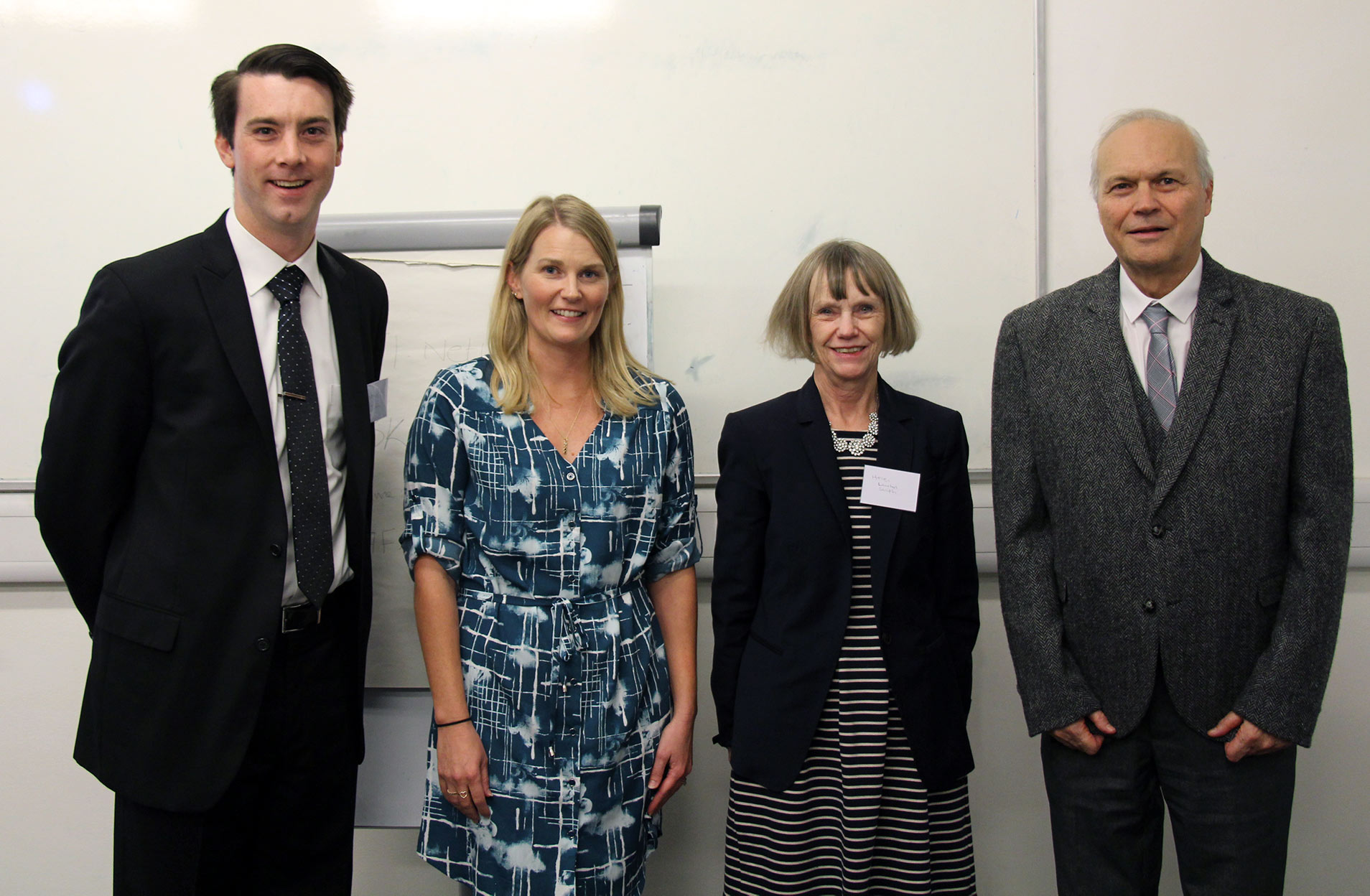
On Monday 29 October, Birkbeck’s Centre for Innovation Management Research (CIMR) hosted a research workshop in collaboration with Wiley, publishers of the Strategic Change: Briefings in Entrepreneurial Finance Journal. Professor Helen Lawton Smith and Professor Carlo Milana in the Department of Management are editors of the journal.

The aim of the workshop was to stimulate debate on new directions in research in entrepreneurship and innovation, in order to encourage new submissions, reach wider audiences, and highlight opportunities for more dynamic research contributions in the field. The workshop also provided an opportunity for current Management PhD students to discuss their research and progress with the audience, demonstrating the Centre’s diverse and unique research expertise.

Future Directions and Artificial Intelligence Research

Professor Carlo Milana opened the workshop with a discussion of the journal’s “business model” – a thematic approach whereby each issue deals with a particular topic, encouraging a variety of submissions that provide different perspectives on key issues in entrepreneurial finance, sustainable business models, and emerging economies, among other areas of innovation management and entrepreneurship. He also expressed his interest in contributions that will address important questions around the future development of artificial and social intelligence; for example, how will artificial intelligence (AI) engage and impact entrepreneurship? Professor Milana concluded his presentation with a list of practical issues with AI, such as technological unemployment, jobs displacement, security and privacy, and the reliability of automated systems.

Continuing with the theme of artificial intelligence in business and management, Professor Damir Tokic (International University of Monaco) joined the workshop via Skype to discuss his research on the implications of AI for executive decision-makers, asking whether AI can replace human discretion. The world’s largest investment management firm, BlackRock, recently announced the launch of the BlackRock Lab for Artificial Intelligence, suggesting that it intends to “keep tapping into artificial intelligence” to improve the financial wellbeing of its clients. Thus, Professor Tokic asks in his research: “Can AI replace the human discretion in investing?

The answer is yes, technically, because AI programmes can use econometric methods to extrapolate historical data and can interpret and use economic forecasts embedded in financial assets, ultimately ensuring market efficiency. However, legislation, unpredictable geopolitics, and the justice system might prevent the rise of “Robo decision-makers”, meaning that while machines can be fed with all possible human knowledge and available data, as long as human imperfections are preserved, AI-powered machines will not be able to replace human discretion.

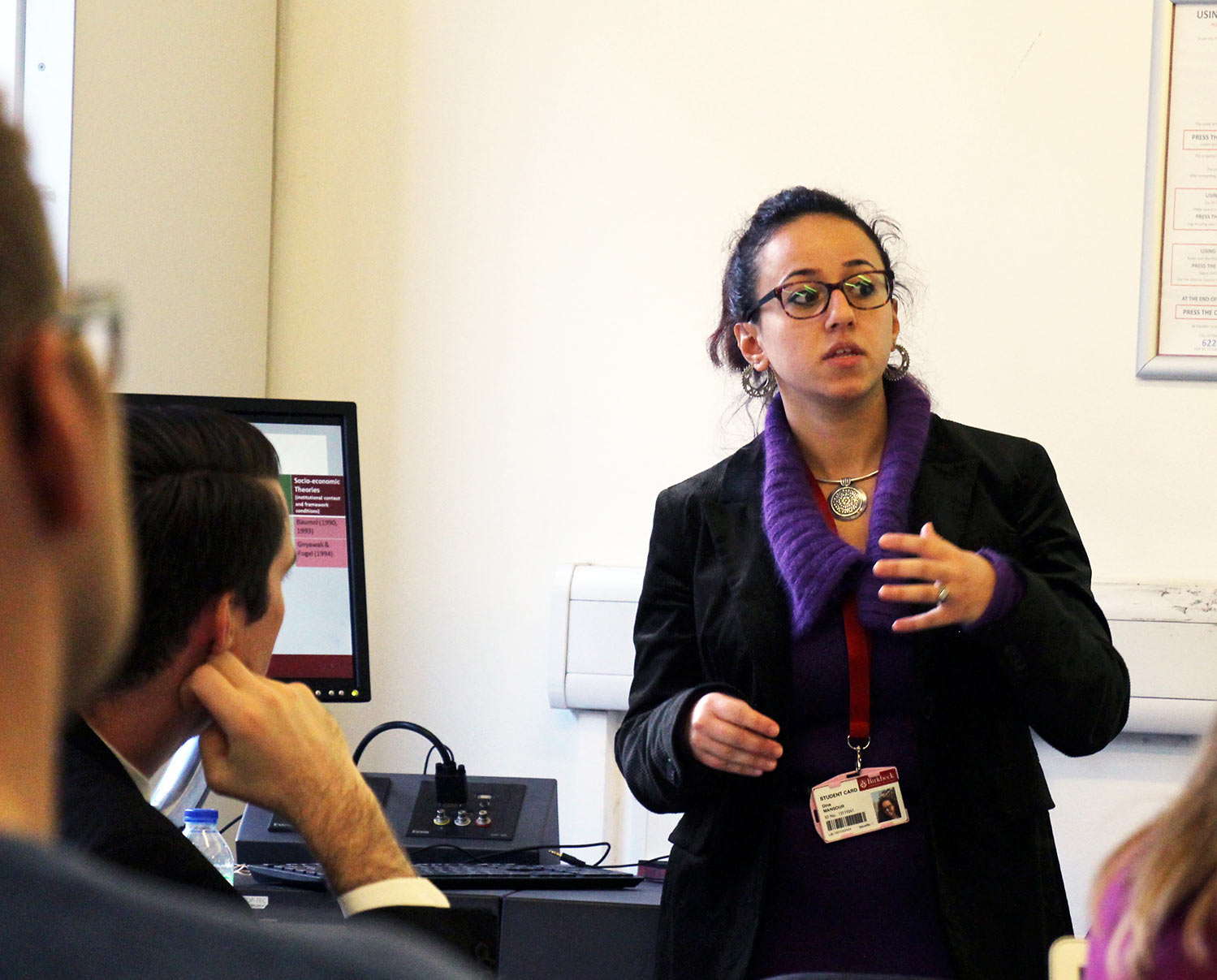
Birkbeck PhD candidate Dina Mansour

Open Research, Transparency and Relevance

When we talk about research in the current academic environment, the topic of impact inevitably comes up. In his presentation, Chris Graf, Director of Research Integrity at Wiley, asked what it means for research to be “open”, saying that open science/access is a way of doing research that brings about new opportunities for publishers by: (1) driving forward new models of publishing to emphasise relevance, (2) creating new services for researchers to support their requirements through innovation, and (3) taking a thought leadership position through community engagement. He also discussed issues of reproducibility in research and publication bias, whereby reviewers and editors may be more inclined to accept manuscripts based on the direction of findings, potentially neglecting lesser known research and making some studies seem more significant than they are. His recommendation was to increase the transparency of the research process and products to improve research reproducibility.

Research on Gender and Entrepreneurship

Professor Colette Henry (Dundalk Institute of Technology) provided greater insight into the nature of research on gender and entrepreneurship, noting that in the entrepreneurship literature, “gender typically means ‘women’s entrepreneurship’”, and there is urgent need for new perspectives on the topic, such as: (re-)conceptualising the gender perspective in entrepreneurship, the influence of gender on the entrepreneurial ecosystem, leadership styles, and business model innovation.

She also shared data on women’s participation in entrepreneurship, highlighting that more women are engaged in ‘necessity entrepreneurship’ than opportunity-based entrepreneurship. This means that women across the world are more likely to become entrepreneurs due to gender-specific issues, such as childcare challenges and restrictive workplace policies; and in some cases, some women simply become entrepreneurs to meet basic economic survival needs as they have no other options.

A Publisher’s Perspective: Maximising Research Impact

After a full day of discussing future areas of research in entrepreneurship and innovation, it was only appropriate to end with the publisher’s perspective on how to maximise the reach and impact of publications. Shannon Canney, Senior Editor at Wiley, began by asking the audience which metrics mattered to them. For most people, the answer was citations, which was consistent with Wiley’s research findings: most people think citations are highly important, whereas some think downloads come next, and a smaller percentage believe social media sharing matters.

Joshua Tufts, Editor at Wiley, said that all these metrics matter for research impact, as they contribute to a comprehensive view of a paper’s performance. It is important for researchers to use various channels to publicise their research because search engine optimisation (SEO) is vital in a digital age, and between June 2016 and July 2017, 54% of visits to Wiley Online Library came from search engines (26% had no referrers, 18% came from other websites, and 1% came from social media). Academics and researchers can maximise their impact through SEO in 4 easy steps, including: usage of relevant key words/phrases throughout the article, choosing a smart, descriptive title which incorporates key phrases, writing a good abstract by expressing key points from the article in simple terms, and creating a network of inbound links and citations to one’s article.

Wiley provides a useful self-promotional author toolkit that researchers can utilise to help ensure their work is seen, read, and cited.

It was a very insightful event for researchers in entrepreneurship and innovation, and the organisers would like to give particular thanks to the sponsors, Wiley, and all speakers:

  • Shannon Canney, Senior Editor, Wiley
  • Chris Graf, Director, Research Integrity & Publishing Ethics, Wiley
  • Colette Henry, Adjunct Professor of Entrepreneurship, Dundalk Institute of Technology
  • Carlo Milana, Editor in Chief, Strategic Change: Briefings in Entrepreneurial Finance
  • Damir Tokic, Professor of Finance, International University of Monaco
  • Joshua Tufts, Editor, Wiley

Birkbeck PhD Students

  • Maryam GhorbankhaniExploitation of Public Sector R&D
  • Maximillian Giehrl – Open Innovation Collaborations in German Manufacturing Firms
  • Dina MansourEntrepreneurship and Economic Development in Developing Countries: The Case of Egypt
  • Peter RossTheories of Diffusion of Innovation and Medical Engagement: Successful Adoption and Assimilation of Healthcare Reform

Presentations from the workshop can be downloaded from the CIMR website.

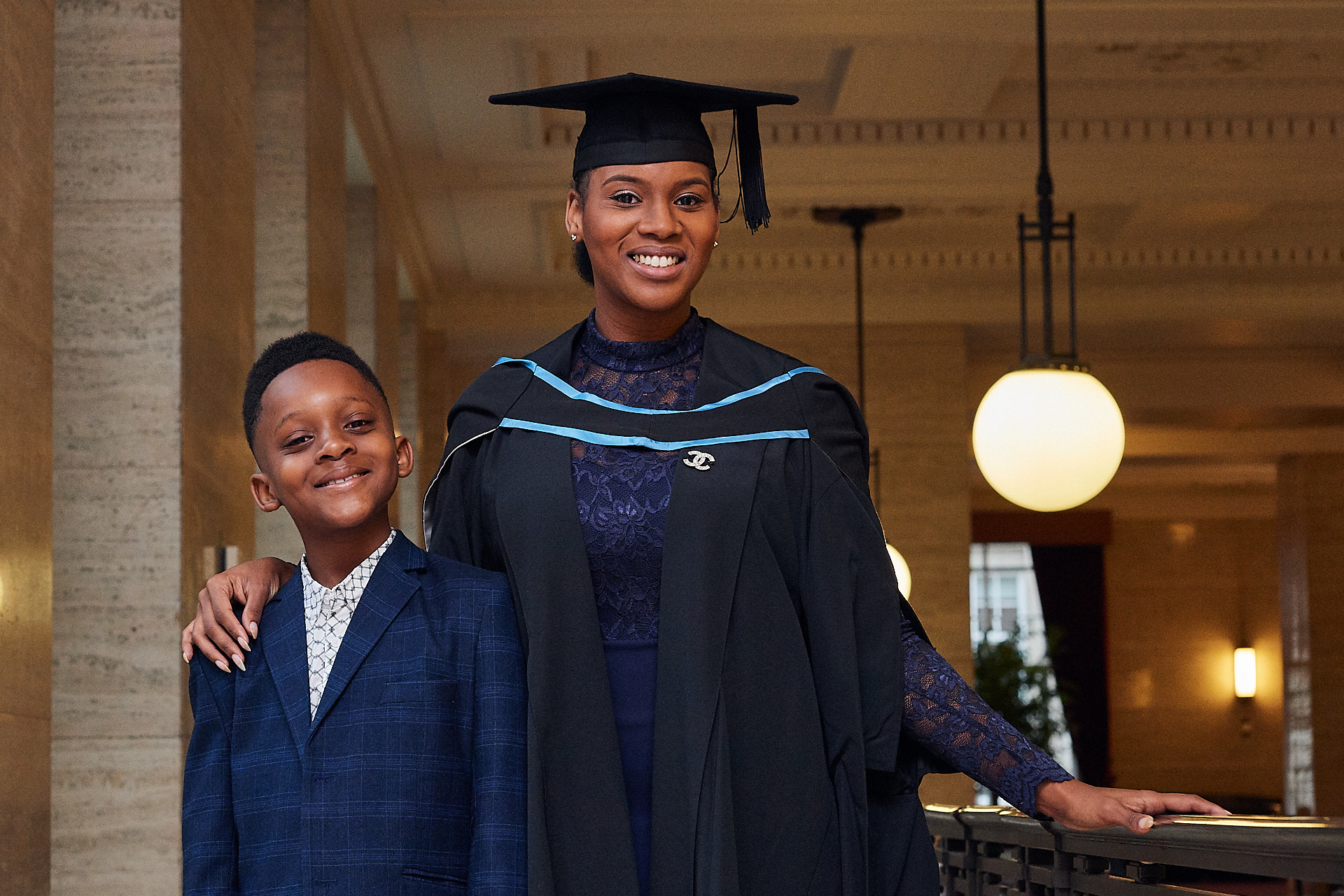
9 year old tells mum “You’re going to be amazing” as she graduates with a first class degree in Law from Birkbeck

Chloe Livingston, 29, took the meaning of multi-tasking to the extreme when she decided to enrol for a law degree whilst working full time and raising her son as a single parent. On 6 November 2018, she graduated with a first class honours in Law from Birkbeck.

Growing up, Chloe had always dreamed of being a lawyer or a doctor, but fell into a career in banking on leaving school. Although successful, she never lost the desire to return to study. “People always told me I was smart, but I had nothing to back it up,” she explains. “When I first began looking into university, it was really so I could tell people that I had a degree.”

Discussing returning to study with a friend, Chloe was reluctant to become a student again. “I didn’t want to go back to being a student with no money,” she says, “It wouldn’t have been fair to subject my son to that lifestyle.” That’s when Chloe’s friend suggested Birkbeck – the evening study model meant that she wouldn’t have to give up her job and could continue supporting her son while getting the education she’d always wanted.

Chloe knew that it wouldn’t be easy to give up so much time to study, but was lucky to have a support network of friends and family close by to help with childcare. Despite being only five years old when his mum started her course, Chloe’s son was really supportive. “Some days I would be locked in my room or glued to the dining room table working and he’d come in and say ‘are you ok mummy? Do you need anything?’” she remembers.

As well as her responsibilities as a parent, Chloe took on the additional challenge of full-time study while working. “I took part in a Birkbeck alumni mentoring scheme before starting my course, and my mentor asked if I was sure I could take on the workload,” she remembers. As a relationships manager for a bank, Chloe’s day job is no nine-to-five and she would frequently be required to stay late, even completing an additional banking course at one point during her studies. “I thought that because lots of Birkbeck students also work during the day, the lecturers might go easy on us, but that definitely wasn’t the case!” she laughs. Thankfully, Chloe’s employers were very supportive, especially as they could see the impact of her studies in the workplace, as she became a voice for key issues like diversity.

Just as she was hitting her stride though, a terrible accident almost changed everything. A near fatal head-on collision towards the end of second year threatened to stop Chloe’s progress in its tracks. “Thankfully I was okay,” she remembers, “Birkbeck were really supportive and gave me the adjustments I needed to complete my assignments. Second year nearly broke me, but I had too much to lose to not pull through. I couldn’t let the sacrifices my friends, family and most of all my son had made for me be for nothing.”

There’s no doubt that taking on further study alongside other commitments is tough. Chloe’s advice is to be realistic about what will be expected of you in terms of time and effort – “They’re not going to spoon feed you anything,” she warns. Having heard of the non-traditional routes that students take to Birkbeck, Chloe wasn’t expecting to make good friends on the course. She says, “People told me that I wouldn’t meet like-minded people at Birkbeck, but you get out what you put in and I’ve come away with some brilliant friends.”

Having begun her degree to prove herself, Chloe was surprised to find how much she enjoyed studying Law. On her course, she learned skills that she could put to use straight away – an in-depth knowledge of contract law proved particularly useful during a booking dispute for a family holiday!  Now, Chloe is looking to leverage her experience in finance with a career in corporate or commercial law and will be applying for a masters in Law next year.

Graduating with a first class University of London degree, Chloe is proud to be a role model for her son. “At first, I think he thought that university looked too much like hard work!” she remembers, “But when we were walking home from school the other day he turned to me and said ‘I’m so proud of you mum, you’re going to be amazing.’” Chloe, who has taken her son to both her siblings’ graduations, is looking forward to celebrating her own graduation with her family.

“The way I got my degree worked best for me,” she says. “If I’d gone to university at eighteen, I don’t know if I would have completed my course, or got a first. Now I’m wondering what to do with my evenings!”

Graduation 2018: walking talking art

Kathryn Hallam Howard, graduating today with a BA History of Art, discusses why she decided to start studying in her fifties, and why Birkbeck was the perfect place to develop both her love of art history and her new venture, creating specialised walking art tours for fellow enthusiasts.  

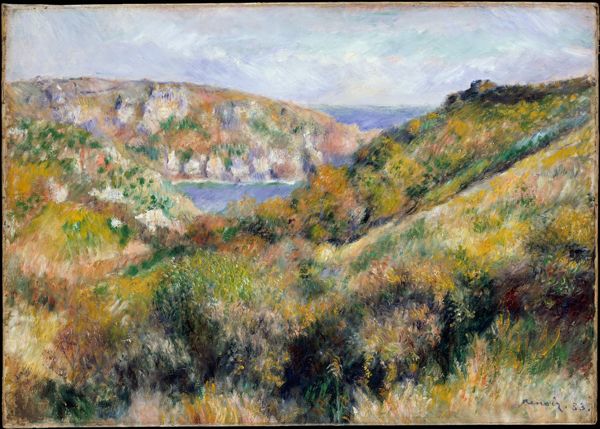
Pierre-Auguste Renoir, Hills around the Bay of Moulin Huet, oil on canvas, 1883, The Metropolitan Museum, New York (Open Access)

The summer of 2014 found me in a tiny hamlet on Guernsey. The path down to the local beach, Moulin Huet, is steep and rocky and used only by locals and visitors, who are lucky enough to know its well-kept secret. Visitors like Pierre-Auguste Renoir, who often painted the dramatic landscape with its imposing cliffs, ice cold seawater and crystal-clear light. So why, am I recalling my trek down a Channel Island path used by Renoir? Well, that was where I first decided to apply to Birkbeck to do a BA History of Art and Architecture.

I had always been interested in art and had visited many art galleries. However, I often found myself first to arrive at the gift shop, wondering where my friends and family were. Then in 2013, I trained to be a Blue Badge tourist guide and found myself taking groups around London’s amazing galleries and museums. Yet, I felt a fraud! I could easily take someone around the National Gallery and discuss twenty-odd paintings. However, were they to ask me about something I hadn’t researched, then my superficial grasp of art history would have been exposed. I decided to rectify that and an undergraduate degree at Birkbeck suited me perfectly. Term dates complemented the guiding season and the modular composition meant I could study different subjects without being restricted to one time period. The annual field trip was an added incentive and I enjoyed two trips to Paris and Berlin.

Another unexpected pleasure was the sheer diversity of the students in terms of age, background and nationality. I met many interesting people and made some good friends.  All my tutors and lecturers were experts in their field but also offered first class support to help us maximise our learning experience. I found the environment rewarding, stimulating and challenging. Preliminary surveys of European Art (pre-1800) and Modern Art, gave a good introduction to the discipline and the sheer variety of modules offered in the subsequent years was excellent. I studied topics as wide-ranging as art and architecture from 1250-1550, satire and caricature, the relationship of the body to modern architecture and the relationship between public and private space and modernity. One module, The Impact of immigration on Modern British Art inspired my dissertation topic – the art produced by those fleeing Nazi persecution, whilst interned as ‘enemy aliens’ on the Isle of Man 1940-1941.

I’m currently working with the family of an interned art historian, Klaus Hinrichsen, to explore recently discovered papers and correspondence. Some interesting lines of enquiry have already emerged. I am also creating specialised art tours for those who would like an affordable and interesting day out with a small group of like-minded enthusiasts, to be launched in 2019. If you are interested in learning more or can suggest an interesting theme for a tour then please get in touch at walkingtalkingart@btinternet.com