Mongrel Tongues/Mongrel Nation: William Matthews Lecture 2018

On Thursday 29 November, author Bernadine Evaristo delivered an insightful lecture exploring how and why authors create voices that challenge the predominance of Standard English as the literary and cultural norm.

If you were passing the Beveridge Hall in Senate House on Thursday 29 November, you may have been surprised to hear a speaker addressing her audience in a language decidedly far from Standard English. Indeed, it wasn’t just author Bernadine Evaristo’s voice that filled the hall as she gave her fascinating lecture entitled ‘Mongrel Tongues/Mongrel Nation’, but the voices of countless others who have been left out of traditional English literature. From the pidgin English of Ken Saro-Wiwa’s Sozaboy [soldier boy] (1985) to the inner city gang slang voiced by Evaristo’s protagonist in Hello Mum (2010), this year’s William Matthews Lecture challenged our ideas of the language that should be spoken in literature, and opened the floor to include every voice in the discussion.

Following a welcome from Professor Heike Bauer, Head of Birkbeck’s Department of English and Humanities, Bernadine Evaristo, who has written eight books and numerous other publications, began the lecture with a discussion about belonging. Having grown up in Britain with a black father and a white mother, Evaristo knows what it is to feel different. Recalling the disapproval of her mother’s family when their daughter married a Nigerian, Evaristo explains “My father always said that he became a black man when he arrived in England … Black British people were not seen as fully, properly British, and from this I absorbed the concept of ‘blackness’ as a negative.” This idea was explored in her first novel, Lara (1997).

Evaristo herself felt like an outsider for much of her youth, neither fully belonging to her father’s Nigerian culture nor the British one in which she was growing up. “People don’t know you, but they think they do,” she explains, “they know ‘your kind.’” Such was Evaristo’s father’s concern that she should be fully integrated into British culture, that he deliberately avoided passing his own language and heritage onto his children. Perhaps it is due to this loss that Evaristo is determined to broaden our understanding of the value of a range of different voices in literature.

Through the evening’s discussion, Evaristo asks “Can you truly capture characters’ lives in Standard English?” Take the aforementioned Sozaboy, for example. His stream of consciousness is punctuated with non-standard phrases that form part of the pidgin English spoken by 75 million people in Nigeria. Evaristo argues that by using Sozaboy’s language, its author, Ken Saro-Wiwa, establishes the setting, society, culture and context that make up Sozaboy’s world. The use of dialect, far from patronizing the protagonist, means that “we are charmed by him”, and “when he goes to war, so do we.”

By giving the text the subtitle “A Novel in Rotten English”, Saro-Wiwa brings the discomfort that an audience accustomed to Standard English might feel on reading (and understanding) the book to the forefront. But Evaristo also draws attention to writers that go further than this, such as Junot Díaz, who leaves vast swathes of his novel The Brief Wondrous Life of Oscar Wao (2007) in Spanish, without offering his reader a convenient explanation or glossary. This act, which Evaristo dubs “assertive non-translation”, forces the reader to engage with “the bilingual and bicultural reality of the text”, and begs the question: how far can we embed foreign words and phrases in our literature, without alienating our reader?

For Evaristo, the expansion of accepted novelistic languages is a welcome one, and she argues that writers and artists should have the freedom to write from any perspective (while amused by the fact that, as a self-titled black writer, she should be seen as more limited in subject matter than a white writer, given the vast cultural richness and experiences of the 54 countries of Africa and 33 countries of the Caribbean, not to mention the Americas and Britain itself). Indeed, in her 2010 short novel Hello Mum, she sought to get inside the mind of a teenage boy, conducting extensive research in youth detention centres and carefully mimicking the style of speech she found. For, as Evaristo says, “How do we begin to claim ownership of something as nebulous and transitory as culture?” It is not the right voice, but every voice, that should be heard through literature.

The annual William Matthews Lecture at Birkbeck is made possible by a bequest from the estate of the late Professor William Matthews for a lecture on either the English language or medieval English literature.

Further information:

Reflections on hospitality, the hostile environment and the law

Netty Yasin, second-year part-time LLM student, and Patrick Page, Senior Caseworker, Duncan Lewis Public Law discuss the Birkbeck School of Law’s recent residential weekend at Cumberland Lodge, where they took part in discussions and workshops with eminent legal scholars.

Each year the School of Law at Birkbeck hosts a residential weekend at Cumberland Lodge, Windsor, giving staff and students the opportunity to participate in discussions, workshops and lectures with internationally renowned researchers. This year the discussions centred around the themes of Hospitality, the Hostile Environment, and the Law. Two of those who attended reflect on the weekend’s events:

Netty Yasin, second-year part-time LLM Qualifying Law Degree student
The presentations covered a broad range of topics, including the creation of the ‘bad immigrant’, racist narratives in the sentencing of migrants, as well as detention and deportation policies and practices. Speakers included a former barrister, PhD students, a solicitor who shared some harrowing case studies from his experience of representing clients with medical needs in detention centres and even a personal perspective from a former detainee. Although there was a full schedule of seminars, there was also plenty of time to relax and enjoy the beautiful environment of Cumberland Lodge and its surroundings. It was also a great opportunity to network and have informal discussions with the speakers over dinner or drinks at the bar. It was a hugely interesting, informative and enjoyable weekend in a wonderful setting and I hope to return next year. Thanks to the School of Law for organising such a fantastic event.

Patrick Page, Senior Caseworker, Duncan Lewis Public Law
‘You don’t need permission to be anti-establishment.’ This was a response to a question by one of the speakers at the Cumberland Lodge conference on Hospitality, the Hostile Environment, and the Law. The speaker in question had been detained at Yarl’s Wood immigration detention centre, and has since been shining a light on the injustice of immigration detention – what she calls ‘the hostile environment on steroids.’ For me, the answer encapsulated the spirit of the weekend. With its range of lawyers, academics and activists (many, indeed, wearing a number of these hats at once), the programme thoroughly exposed the hostile environment in all its manifestations. We were taken through the way in which the UK government has conscripted civil society in its racialised system of immigration control, how the ‘good migrant/bad migrant’ narratives dominate the legal system, and how executive powers to detain and remove have steadily expanded. Frances Webber, a barrister who has been working in this area for decades, put it simply: ‘it was never good, but it was never this bad.’ But this sombre tone was lightened by a cautious optimism that change is possible, that resistance isn’t always futile. As we saw with the Windrush scandal, those targeted by the hostile environment, like the speaker mentioned above, are increasingly mobilised to expose injustice. In the last talk of the weekend, we were reminded of the words of James Baldwin: “The victim who is able to articulate the situation of the victim has ceased to be a victim: he or she has become a threat.”

Read more of Patrick’s thoughts on the Cumberland Lodge weekend at the No Walls blog

Pioneer Programme supporting entrepreneurial students at Birkbeck kicks off with a bang

Students on the Pioneer programme began the journey to develop their entrepreneurial skills with an inspiring session on Innovation and left feeling energised and motivated for the year ahead.

On Saturday 17 November, nearly 200 Birkbeck students started their journey on the Pioneer programme, a 7-part course that develops their entrepreneurial skills and knowledge and culminates with a Pitch and Celebration Evening in June 2019.

The programme, in partnership with Santander Universities, began with an inspiring and energetic session on Innovation from serial innovator and entrepreneur Julie Holmes, who motivated the students to pursue their ideas and turn them into reality. In between science-experiment style fireworks and top tips for starting a business, Julie kicked off the Pioneer programme with a bang and prepared the audience for a brilliant programme ahead.

Students also heard from Ambi Mistry at Creative Entrepreneurs, a movement that brings together the resources, roles models and networks creative people need to turn their ideas into successful businesses. Ambi delivered an invaluable networking session to encourage students to collaborate and think outside the box when it comes to making connections for their business ideas.

Jenna Davies, Programme Manager for Pioneer said, “Pioneer offers a fantastic platform for students who have a business idea or who are keen to develop entrepreneurial skills. Julie and Ambi have started this year’s programme in incredible fashion; the students were genuinely buzzing when they left the building.”

Baldeep Hothi, Programme Coordinator added, “The students will benefit immensely from Pioneer and it’s clear that they have already gained so much from this first session. Santander’s support has made this happen and we can’t wait to continue the journey in the coming months.”

Pioneer continues in December followed by a monthly workshop on a range of topics including Lean Business, Start-up Marketing, Funding, Pitching and more.

Further information:

Birkbeck welcomes generous alumni back to Malet Street

The College invited alumni and guests to learn about the difference gifts in wills can make to Birkbeck’s students and community.

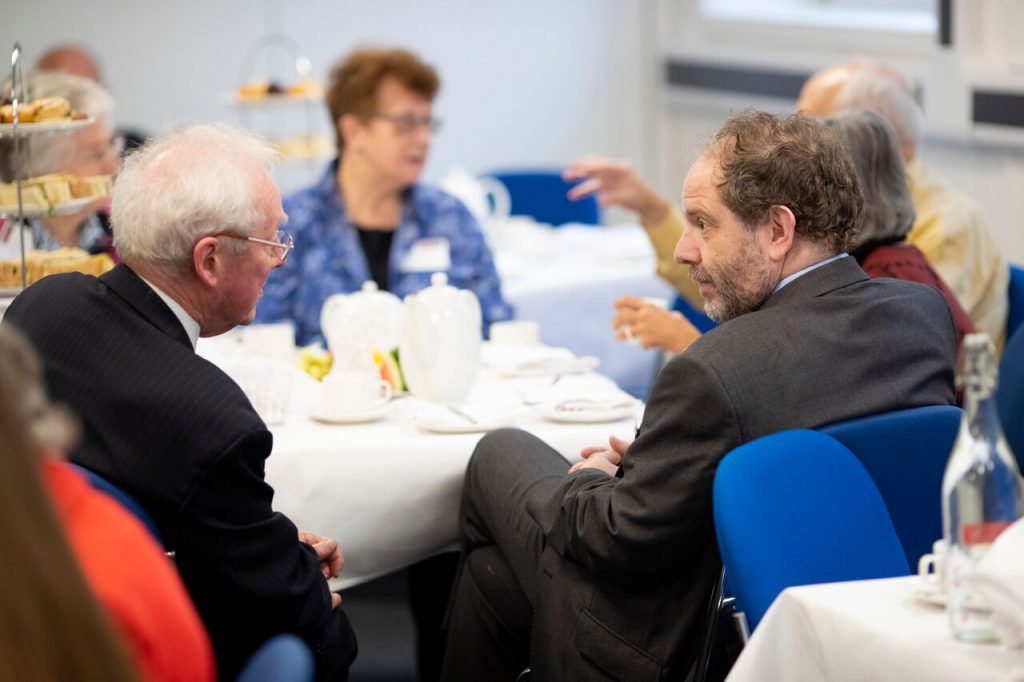
Master of the College, Professor David Latchman (r) speaks with an alumnus over tea.

Many Birkbeck alumni and supporters have generously chosen to help secure Birkbeck’s future by remembering Birkbeck with gifts in their wills. On Tuesday 13 November, the Master of Birkbeck, Professor David Latchman CBE, invited some of the College’s alumni to Malet Street to tell them more about this way of giving and to thank those who have already remembered Birkbeck in their wills.

Gifts in wills have made a huge difference to Birkbeck. From 2016-2018, Birkbeck received £2.5million from gifts in wills. These gifts have supported Birkbeck students,  provided for student-centred facilities as well as enabled world-leading research projects.

The late alumna Constance Kenway provided a very generous gift to the Psychology Department to support excellent students in financial need. Christine Ozolins, recipient of the Constance Kenway Scholarship in 2017, spoke to the guests about her story.

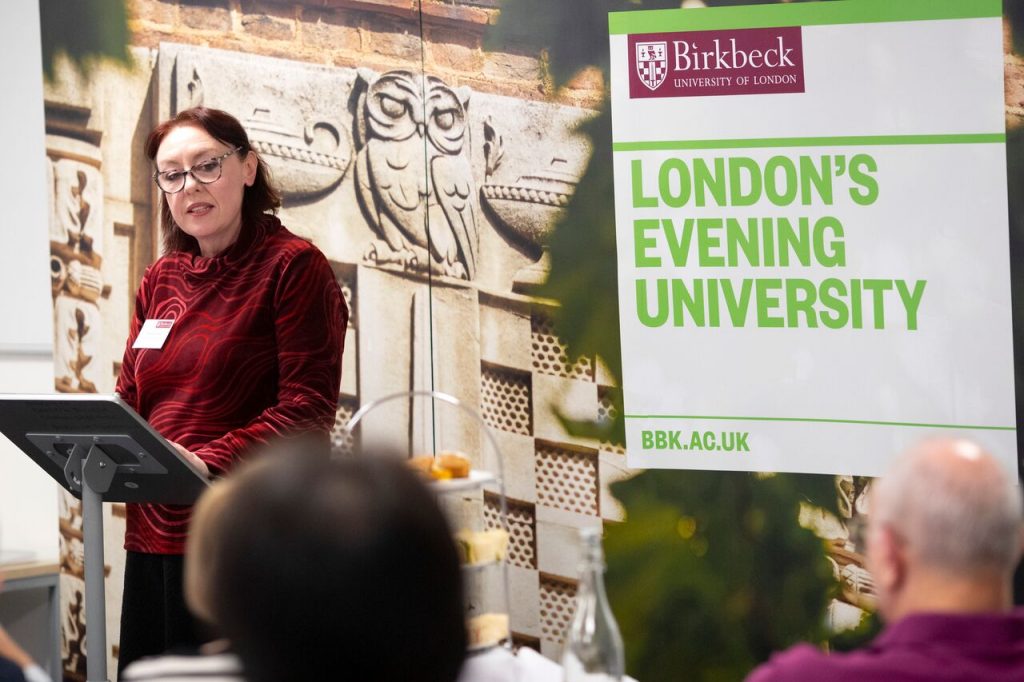
Christine Ozolins, recipient of the Constance Kenway Scholarship, addresses the group.

She said: “As a child, I had a difficult home life and was unable to finish my schooling.  I spent many years working in a variety of different jobs. However, I always felt unfulfilled and longed to be in a career where I could help others and fulfil my potential.  It took me years to get the courage to change my life, but when I eventually did, I commenced a BSc in Psychology here at Birkbeck.  This degree transformed my life in ways I never could have imagined. I fell in love with the brain and with cognitive neuroscience, something I was not expecting.”

Christine graduated with a first-class degree, and went on to a master’s degree. When her marriage broke down, she worried she would no longer be able to afford to continue her studies. She applied for, and was offered, the Constance Kenway Scholarship which is available for postgraduate psychology students experiencing financial hardship. The scholarship enabled her to complete her MSc.

She continued: “I believe it is so important that people like myself are given a chance to fulfil our potential and create value for society in the present and the future. I believe Birkbeck stands alone in its mission to provide the highest quality education to everybody, regardless of age, background or gender.”

Christine now plans to start a PhD, and she is putting all her energies into finding a way to fund her studies. As there are few funding options available for part-time candidates, she plans to become successful enough to leave money in her own will to support students like herself and to make the path easier for those who will come after her.

Chris Murphy, Director of Development and Alumni and himself an alumnus of Birkbeck, also addressed the group and explained that he and his wife had both chosen to leave a gift to the College in their wills. Gifts in wills, Chris noted, are one of the most private and therefore most generous ways that alumni and supporters can give to the College.

The tea was an opportunity for some of our supporters to find out how integral these types of gifts are to the future of the College. They fund a variety of research projects and support students in different ways. Whatever the amount, gifts in wills make an enormous difference to the College and to students who may otherwise be unable to continue in education.

Legacy gifts of every size have a lasting impact and help to ensure that Birkbeck’s high-quality teaching and world-class research continue to serve future generations of students. If you would like to know more about remembering Birkbeck with a gift in your will, please get in touch with the Development & Alumni Team by calling Kara McMahon on 020 7380 3187 or sending an email to k.mcmahon@bbk.ac.uk