“My disability does not have to halt my career options in the way I thought they would”

After an accident left Esther Adegoke with a disability she sought to complete her studies in Politics at Birkbeck. Last week, she graduated with a First.

Esther doesn’t recall exactly what sparked her interests in studying politics. Just that her sisters who had studied politics at AS level would come home and discuss topics from their classes, topics that piqued her interest more than any of the GSCE subjects she was studying at the time.

After completing her A levels she opted for a degree in Politics at the University of Leicester. In the beginning of her third year she was involved in an accident that left her using a wheelchair and in need of a full-time care team, meaning she could no longer study in Leicester.  Determined to continue her degree, Esther looked for options in her home city of London where she came across Birkbeck, “what gave Birkbeck the winning edge for me was the evening classes, it was more practical having lectures at 6pm because it fit my routine as opposed to morning lectures and seminars.”

At Birkbeck, Esther found new topics that sparked her interests in Politics further and in different ways. “My favourite course, funnily enough wasn’t a module taken under the politics department but actually the psychosocial department called, ‘racism and antisemitism’. I found it interesting because it did something unique in that it challenged us to investigate the commonalities and differences between anti-black racism and antisemitism. Of course, I had seen instances of the two racisms being studied separately, but never together.”

Fortunately, Esther had the support of her family and friends who were pivotal in helping her complete her work.  “My mum accompanied me to every lecture and seminar I attended and my sisters often read my essays.” The College’s Disability team were also instrumental in allowing her to complete her course. She recalled: “My disability officer Mark Pimm and scribe Yvonne Plotwright were a massive support to me. Mark went above and beyond to ensure that my points were taken seriously and Yvonne was extremely thorough in her note-taking, ensuring I didn’t miss any vital information from my lectures and seminars.”

The accident left her unable to speak for long periods of time before her voice became exhausted so she used EyeGaze to help her craft her essays. EyeGaze is software that enables the individual’s eye to control the mouse and keyboard of a computer. She explained: “I took to it rather quickly, I used to use it recreationally and even then I was told the hours I would spend on it were unheard of. Without Eye Gaze I wouldn’t have been able to complete my degree. “

Now Esther has graduated with a First Class degree, recognition for all of her determination and resilience. She says of her achievement, “It felt amazing, I was over the moon with my result and without sounding arrogant it was even more rewarding because I knew I deserved it. I worked so hard for it so it was special to know my hard work had actually paid off.”

Unsure of what she will do next, Esther still feels positive about her future. “My experience at Birkbeck with the assistance of Eye Gaze has really given me the confidence to say that my disability does not have to halt my career options in a way I previously thought they would. I have often said that I have no plans to return to study after my undergraduate degree but never say never; at least I know it’s a case of if I want to go back as opposed to I can’t.”

Dr Ben Worthy, Senior Lecturer in the Department of Politics said: “Here at the Department of Politics, we are all so proud of what Esther has achieved and honoured to have been able to help her in her studies. She’s not only been a model student but an inspiration to us all. We also want to say a big thank you to everyone around her, especially the disabilities office and her family and friends who supported her along the way.”

Further information
The Booker at Birkbeck: Atonement

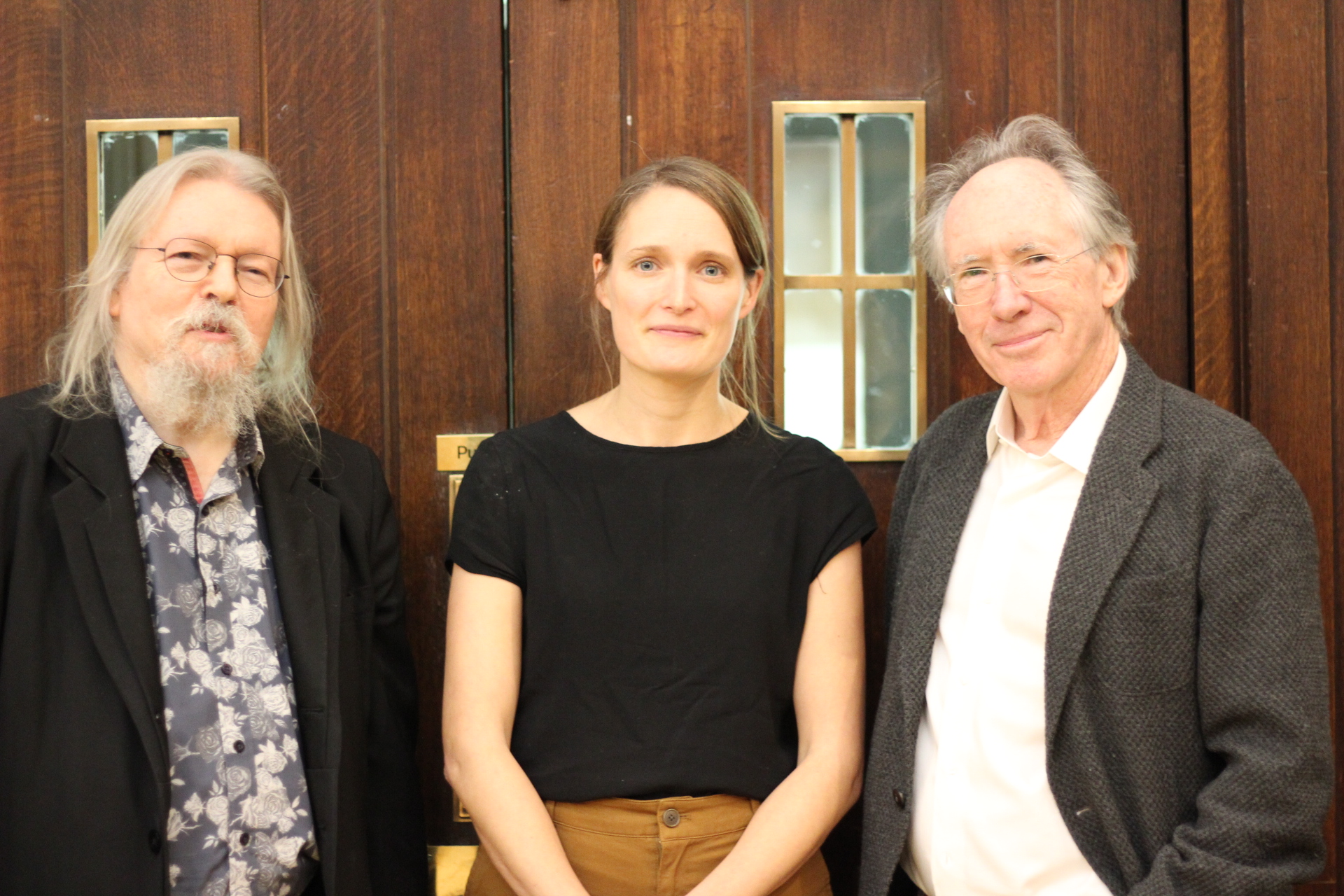
Ian McEwan, the best-selling author of over twenty books, came to Birkbeck to discuss the process of adapting a novel into a film with Atonement screenwriter Christopher Hampton and Birkbeck Lecturer Dr Agnes Woolley.  

L-R: Christopher Hampton, Agnes Woolley, Ian McEwan

Ian McEwan joined Birkbeck’s students, alumni and wider community to discuss his Booker Prize shortlisted book, Atonement, alongside screenwriter Christopher Hampton, with whom he adapted the title for the big screen. The discussion was mediated by Dr Agnes Woolley, Lecturer in Transnational Literature and Migration Cultures at Birkbeck. Focusing on the collaboration between the writers, they discussed the process of adapting a book for cinema, and the unique challenges and opportunities this brings to storytelling.

Atonement is set in three time periods; 1935 England, Second World War England and France, and present day England. It hinges on the fateful mistake of upper-class Briony, who as a child witnesses – and misinterprets – a series of events which lead her to falsely accuse her family’s housekeeper, Robbie, of raping her cousin, Lola.

“Sometimes powerfully in people’s lives,” explained McEwan, “believing is seeing. It’s part of the reason the police no longer rely on identifications from line-ups. Memory is very malleable.”

Robbie, who is truthfully in love and beginning a relationship with Briony’s sister, Cecila, is imprisoned; and the lives of all three are irreparably damaged by the lie. Following his release, Robbie joins the army, and is seemingly able to reunite with Cecilia prior to fighting in the war. In 1940, Briony visits Cecilia to atone for her actions, while Robbie is home, on leave from the army. Cecilia and Robbie both refuse to forgive Briony, who nonetheless tells them she will try to put things right.

McEwan, an accomplished screenwriter himself, turned down the job of adapting the title for film declaring himself “in a long term sulk” about the process following a particularly excruciating previous experience. This decision, he says, was vindicated when Hampton came on board, who himself said he had become enthralled with the novel while reading it on holiday: “I scarcely left my hotel.”

The ending of Atonement, wherein the reader learns that Briony is the author of the preceding story – and that Cecilia and Robbie were in fact never able to reunite before their premature deaths – was an “overwhelming” challenge from a screenwriting perspective. “Part of the success of the film,” said Hampton, “was that after going through a lot of labyrinths [to tackle this], what we ended up with was much more simple.”

He remembered one possibility they explored involved Vanessa Redgrave, who plays 77 year old Briony, appearing throughout the film observing her ‘characters’ and narrating different parts; but in the end they kept the three-part structure of the book, with the final section seeing Briony’s older self, a successful writer whose health is in decline, explain that the fictionalisation was her atonement: it finally allowed the lovers to be together.

McEwan noted that “the breadth of the imagination in the adaption” was complemented by the “fidelity to the source material.” He added that while he wouldn’t dare to intervene with the filming, there is a certain “chaos” to film sets, and where things are filmed out of sequence, the author can be useful as they “always know what’s going on in the psychology of a character’s head.”

McEwan is one of the most adapted novelists working today, a testament to “how well his novels work as dramas,” according to Hampton. “Even Atonement, which is a very ruminative novel, is very dramatic.”

Before the event, McEwan attended a prize-giving for a creative writing competition at Birkbeck, and kindly presented the awards to the winner: Richard Roper for his short story The Carousel of Progress; and the runners-up, Matthew Bates (Another Language) and Marienna Pope-Weidemann (Dandelion).

The Booker Prize has been the UK’s leading literary award for over 50 years. Every autumn, Birkbeck hosts an evening with a Booker Prize nominee, which gives students, staff and alumni the opportunity to hear from, and pose questions to, a celebrated writer.

Find out about Birkbeck’s previous Booker events, with authors including Ali Smith, Kazuo Ishiguro and Hilary Mantel. 

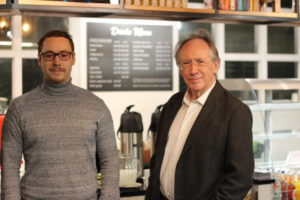
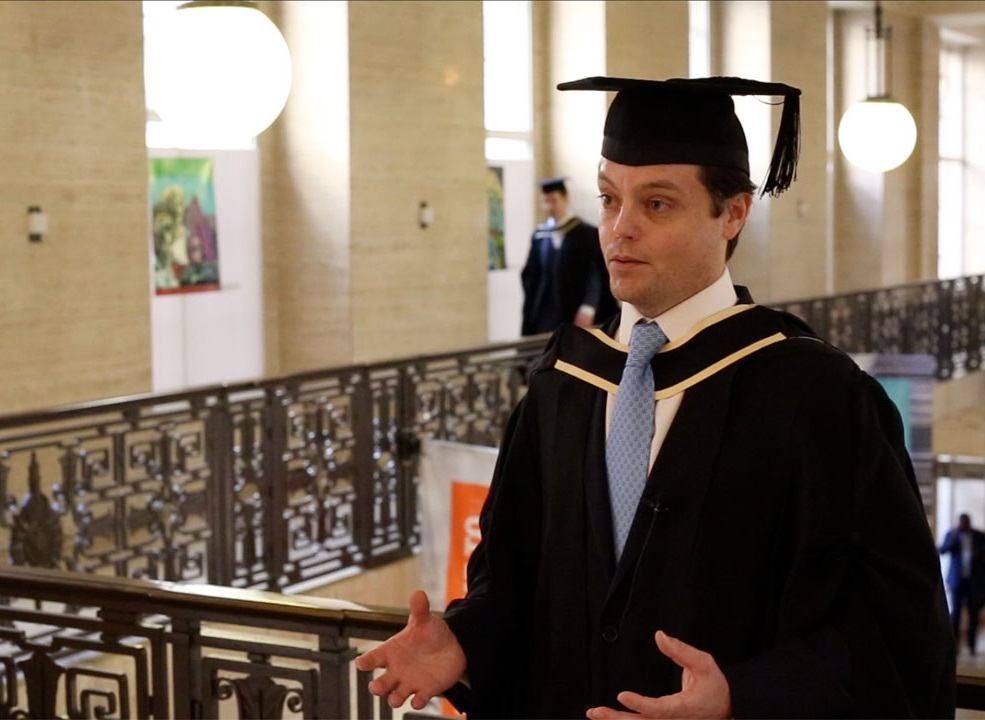
Breaking through the ceiling: BSc Business and Management at Birkbeck

Jeremy Galea came to Birkbeck to further his career. Last week, he graduated with the Best Project prize in the Department of Management.

When I was growing up, there wasn’t much emphasis on education at home, but I’ve always had a strong work ethic. I failed my last year of school in Australia and got a job straight away. I did everything from cleaning supermarkets to polishing stainless steel; being a hard worker was my way of escape.

After moving to the UK to start a junior project management role, I started to worry about hitting a ceiling. I was really into my career and very ambitious, but I could only get so far with no formal qualifications. I’d done courses along the way, but never tackled anything as big as university study.

I chose Birkbeck because it was the only university that would allow me to continue working while studying in the evening. The first two years were tough; I didn’t have access to Student Finance, so I worked seven days a week to fund my studies. Working 70 hour weeks and then studying on top meant sacrificing other areas of my life, but coming into lectures and meeting people who were in the same struggle motivated me to keep going.

I’ve always been able to put on a confident front, but Birkbeck really gave me that self-belief – my ambition is higher now than when I started. I never submitted an assignment in high school – my first university assignment was a 70!

I was just about to finish my second year at Birkbeck when I got my current role in the senior operations management team in the NHS. Drawing on my experience of my course really helped me in the interview, as did the confidence I’d gained along the way.

When it came to choosing a topic for my research project, my seminar teacher gave me some great advice: you don’t get extra points for a ‘sexy’ title! It’s best to write about what you know.

I chose to research whether outsourced organisations or in-house provide better non-clinical support services to the NHS. Having worked in operations for over ten years, I knew my subject matter pretty well. Basing my project on my work has taught me so much; it’s had an effect on how I think and I’m already directing things in a different way than I would have done before. In large organisations, management don’t know what it’s like on the front line and the front line has tunnel vision, so it was fascinating speaking to people across my organisation.

I was lucky to have the support of my line managers at work and of Dr Marion Frenz, my supervisor. In the end, I didn’t come to a definitive answer in my project, but that didn’t stop me from doing well as loads of information on management and relationships still came out of it.

My advice to students undertaking a project would be to start early: it can be hard when your nerves get in the way and you’re juggling work as well, but the quality won’t be there unless you allow yourself time.

If you’re in work, Birkbeck is the place to study to further your career. You can learn so much from other people’s life experience on campus. Undertaking a work-based project gets your name out there within your organisation – even if you work in a coffee shop there’s a business model there that you can learn from.

At school it felt like you were either naturally talented or dumb and there was no in-between, but now I believe that if you set your mind to something, you can achieve it. There’s nothing negative about further education; you learn how to analyse, research and make up your own mind. The world opens up to you once you’ve had that experience.

Further Information:

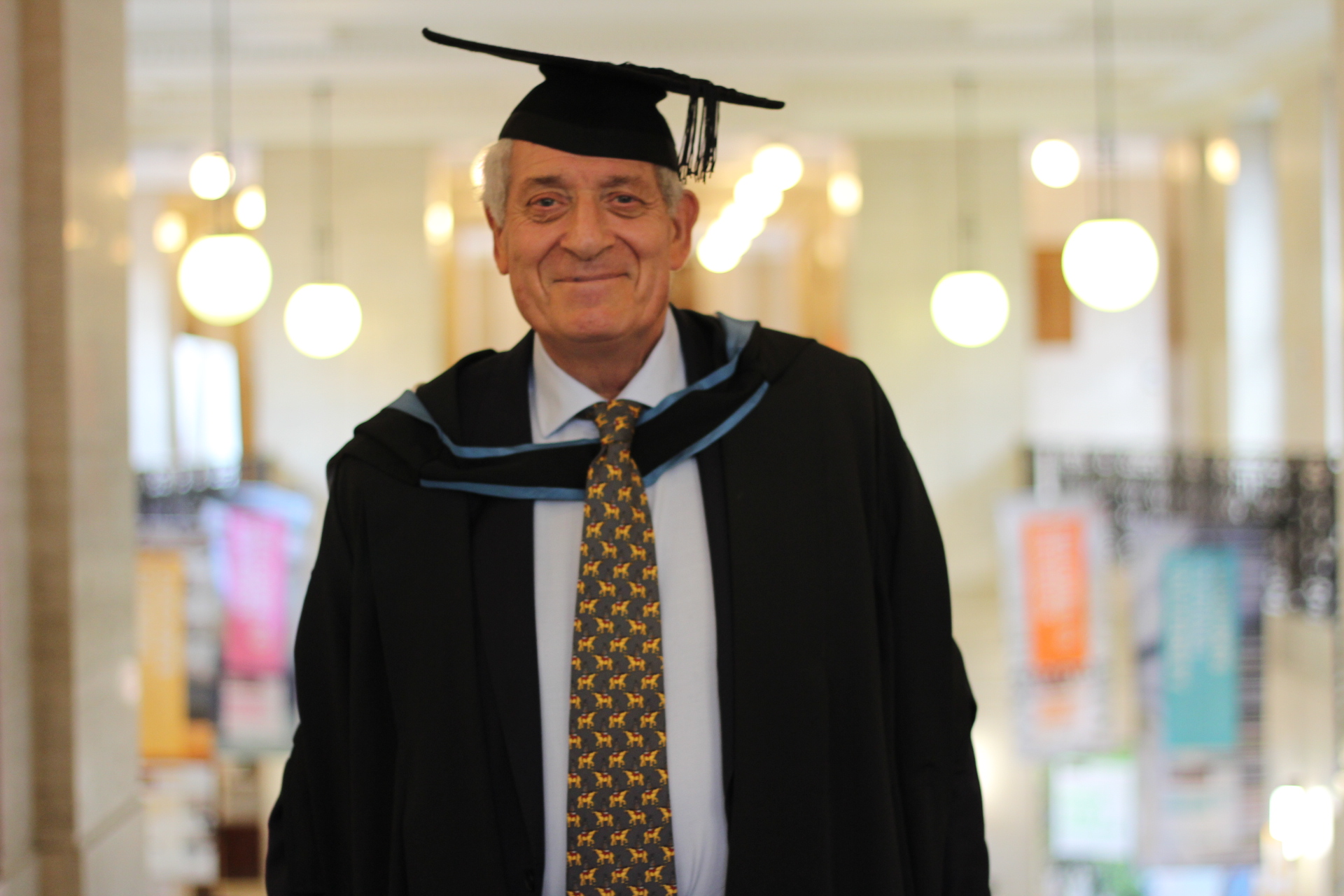
“There’s no such thing as ‘can’t’”

Former television presenter and journalist Gavin Campbell grew up in a house full of books, jazz, and intellectual discussion, and credits his parents for instilling his love of learning. His successful TV career brought him into contact with various aspects of the law, sparking an interest in human rights, criminal law, and in particular the uses and abuses of custody. He chose to pursue this further by undertaking an LLB at Birkbeck, which he graduated from this week aged 73, and in a new career as a paralegal.

He follows in his mother’s footsteps, who, despite leaving school at 14, was able to pursue her own scholarly interests later in life, gaining a BA from the Open University in her eighties. His father, having been seriously wounded at Dunkirk, spent much time in military hospitals studying, with a particular interest in the early Greek and Roman periods.

He says: “I think it was my parents’ attitudes to learning – to never be afraid to question that to think that one might be able to achieve something – that made me believe I could.”

He left Drama School to pursue acting work, before training as a journalist and joining the BBC’s current affairs unit, working on That’s Life, and other features and current affairs programmes. However it was his work as an investigative reporter which brought him into frequent contact with various aspects of the law and accelerated his interest in the subject.

“A short documentary that I reported on following the suicide of a young teenager at a Young Offender’s Institution, gave me an insight into and a further interest in the use of custody in the UK,” he remembers,  “an interest which has deepened and led to an undergraduate dissertation on Restorative Justice for my LLB at Birkbeck.”

“Although a tough regime in terms of the reading and essay writing, preparing for and attending lectures and seminars, I loved the subject and was hugely encouraged by some remarkable teachers.”

His advice for an older person who may be worried about starting university and whether they can make a go of it, he says, is simple and straightforward: “everyone has talent, and talent will out; it’s just a question of finding the right outlet for it. Ask yourself why you want to study. Finding the right subject  – something that fascinates you and you really have a need to find out about and explore  – is essential if you are going to be able to enjoy it and sustain the effort required over three or four years.”

“Everyone finds some aspects of study difficult, so don’t expect that there won’t be times when you think ‘I can’t get this’ – there will be. But don’t ever be afraid to ask for help – your Personal Tutor, the academic teaching the subject, your fellow students. There are always solutions; it’s just a question of getting help and advice to find them.”

“Lastly, and really importantly, make sure that you have the support of your family in undertaking a degree. Discuss it with them first, explaining what it is, why it’s so important to you to undertake it and what the likely and possible demands it may make on the family life are. Honesty is the very best policy here. A united, agreed start is the best start to studying.”

He is doubtful about whether he could have finished the degree without “the kindness, encouragement, help and support from the Birkbeck teaching and administrative staff,” who he says were central to his studies. “The inclusive and open atmosphere of Birkbeck and the sense of ‘you can’ is, I believe, perhaps the most important aspect of studying here. Never once was I told that I couldn’t, or that it would be too difficult. On the contrary, at every turn I was encouraged to continue, to work hard, to feel able to approach staff with a difficulty and seek a solution – and never to lose sight of the fact that there is no such thing as ‘can’t’”.

He is now working for a firm of solicitors with a practice focused on immigration, personal injury, public law and human rights, which he combined with his studies at Birkbeck. He is currently working on the Grenfell Tower Fire Inquiry, where his firm represents many of the bereaved survivors and relatives of the 72 victims of the tragic fire.