Student Circus and Tier 4 Employment

In November, Birkbeck Futures delivered two workshops for international students to set them up for career success.

November proved to be an informative month for Birkbeck’s international students, with Birkbeck Futures offering two key employment events.

Birkbeck Futures is a one-stop service that combines the Careers Service, Enterprise Pathways and Birkbeck Talent to support our students and graduates in their future lives.

On the 5 November, Jenna Davies spoke to a bustling audience about Birkbeck’s Student Circus initiative.

Presenting an insightful and inspiring workshop detailing the British job market, Birkbeck Futures encouraged all international students to explore entrepreneurship. Among other topics, this workshop presented students with an overview of the employment environment in the UK as well as tips and tricks for Tier 4 students looking to a begin their professional careers.

Following the Student Circus event, Lucy Robinson then led a session on Tuesday 19 November which outlined employability for Birkbeck’s Tier 4 students.

In her role as head of the Enterprise Pathways scheme, Lucy shared her insight into student employability and the many ways in which work can support students’ evening studies at Birkbeck, from meeting new people to getting a foot in the door of your future career.

Alongside work, she reminded students of the many extracurricular opportunities at Birkbeck, both in their Departments and delivered by the Students’ Union.

Lucy advised students to plan ahead and work out how many hours they can commit to work and other activities in order to get the most out of their time at university.

By seeking to enhance students’ entrepreneurial skills and to help develop business ideas, Enterprise Pathways provides bespoke support for those looking at starting a business.

For further information about the Student Circus initiative, and all other divisions of Birkbeck Futures, please visit the Birkbeck Futures website.

Further Information
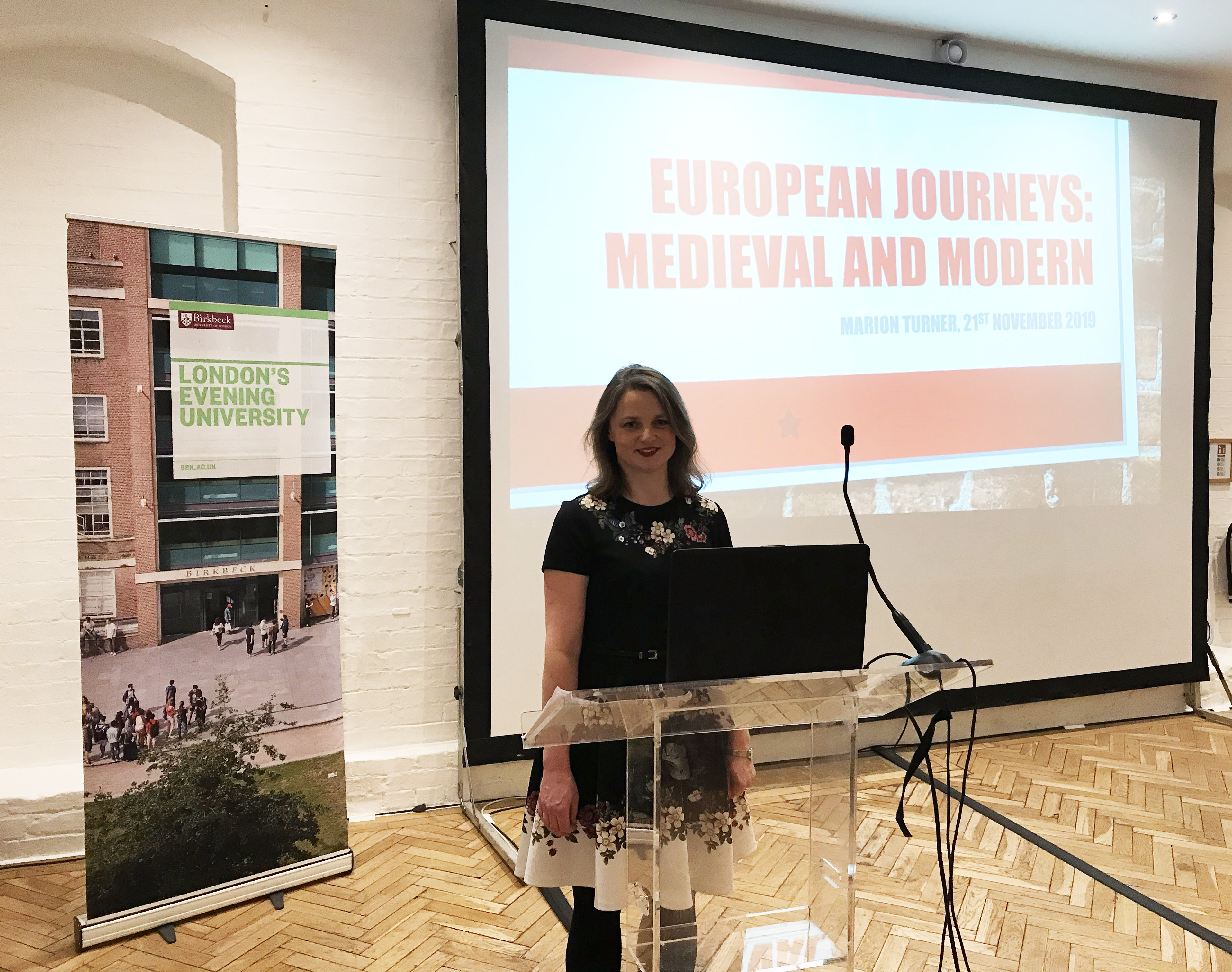
William Matthews Memorial Lecture: ‘European Journeys, Medieval and Modern’

Dr Marion Turner’s lecture on Chaucer’s writings and journeys reframed the quintessentially English writer as a great European poet and source of inspiration beyond the continent.

Dr Marion Turner took an audience of Chaucer enthusiasts on a journey through the poet’s works for the 2019 William Matthews Memorial Lecture. Following on from her own travels around Europe, where she contrasted the medieval with the contemporary, she demonstrated how Chaucer weaved his journeys through Europe into his works of poetry. Geoffrey Chaucer was an English poet and author, whose most famous works include The Canterbury Tales. He is often thought of as ‘the Father of English Literature.’

During her research, Dr Turner endeavoured to go on a physical journey through contemporary Europe in order to retrace Chaucer’s journey through Medieval Europe, to understand his interests, works and what gives the writer appeal beyond the borders of England.

Early on in the lecture, Dr Turner shared the impetus of her travels; being approached to write a biography of Chaucer’s life. She lamented that, upon sitting down to write the book, the plan she sketched was not very different from any other biography written about Chaucer. Frustrated, she set out on a walk to help her find ways of approaching the structure of the book, when she came to her ‘road to Damascus moment’; the idea to approach Chaucer’s work through his travels through Europe in the fourteenth century as a way of understanding the writer in the reader’s imagination.

Dr Turner reflected on numerous characterisations of Chaucer as an English poet firmly rooted in the English imagination and identity. She used the example of UKIP aligning Chaucer’s Wife of Bath’s Alisoun with the party during the 2013 election, thus painting her as an English archetype. But this trope is challenged by the numerous writers of colour, particularly women, who have taken Chaucer’s work and adapted it to create stories in their own contexts.

What’s more, through her travels she found that Chaucer’s stories came from distant places made up of diverse demographics. Particularly Navarre, located in the northern region of Spain, where Chaucer visited and saw members of the three main religions living harmoniously. She highlights that in the medieval period the most educated of the population were multilingual and that Chaucer himself would have been influenced by French, Italian and Latin poetry, which he enjoyed.

Chaucer’s travels through Europe also highlighted to Dr Turner the importance he places on perspective in his work, and it is this transition of perspective that characterises much of his poetry. She gives the example of the prominence of birds and someone who can only see from the ground as a way of demonstrating these different perspectives, which will inform an individual’s thinking on any given situation.

The lecture concluded with a reflection on Chaucer’s views of time and crossings, the place of crossing being “a place of magic, darkness and possibility” – an ongoing action in which the past infiltrates the present, much like the persistent influence of Chaucer’s works on writers across place and space within the literary canon.

The William Mathews memorial lecture is an annual lecture on either the English language or medieval English literature.

Further Information:

Birkbeck students’ away day fuelled their appetite for interdisciplinary collaborative research

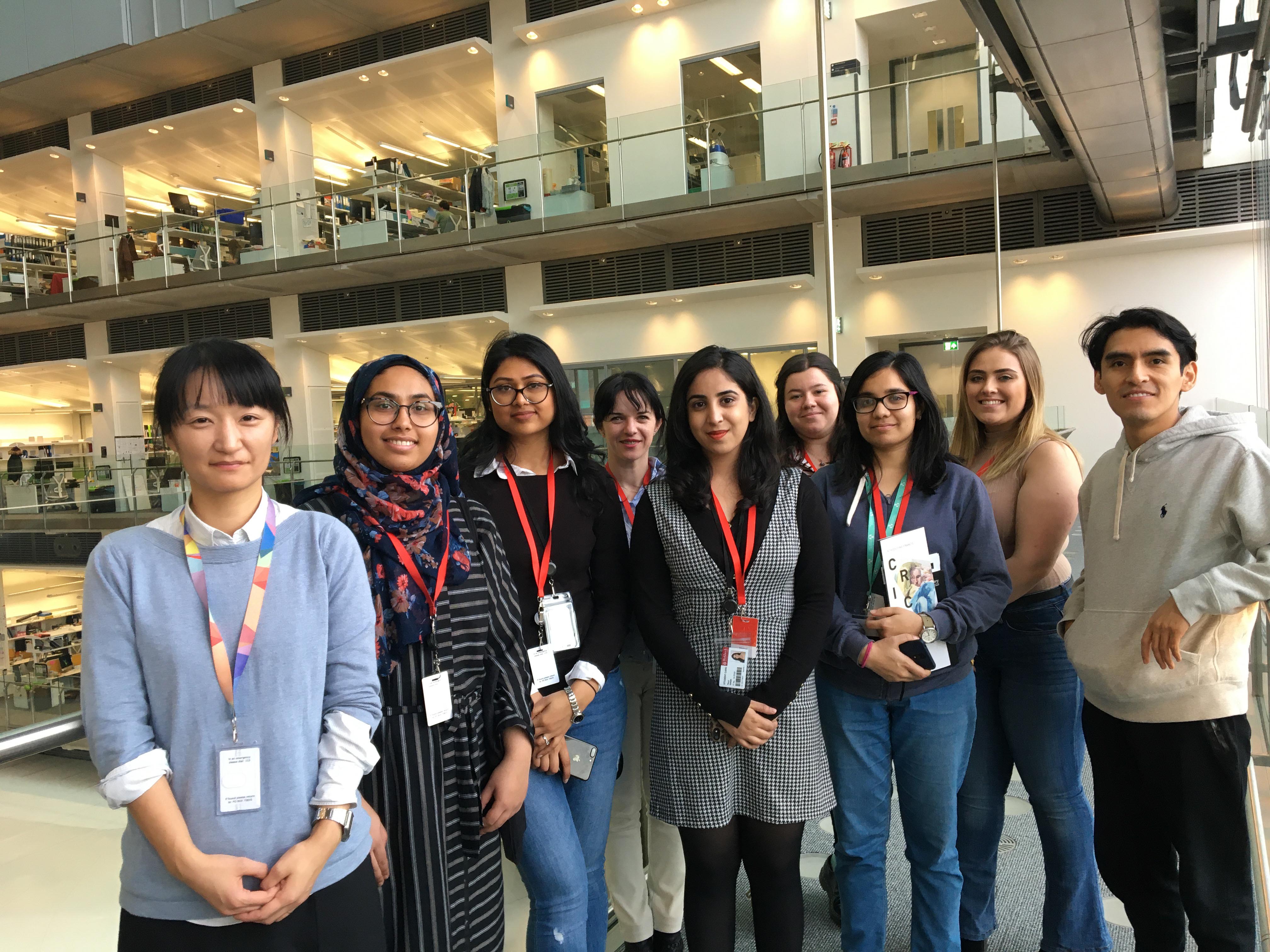
Last week a select group of Birkbeck’s BSc Biomedicine and MRes Global Infectious Diseases project students with a few others visited The Francis Crick Institute, informally known as ‘Sir Paul’s Cathedral’, located just a short walk from Birkbeck’s main campus.

The Crick Institute (formerly the UK Centre for Medical Research and Innovation) is a biomedical research centre right at the heart of London. The institute is named after Francis Crick, co-discoverer of the structure of DNA, who shared the 1962 Nobel Prize for Physiology and Medicine with James Watson and Maurice Wilkins.

La Young Jackson from International Students’ Administration team in collaboration with the Scientists from the Crick Institute organised this trip which was part of enhancing international students’ experience agenda at Birkbeck. The Birkbeck group was hosted and guided by Dr Minee Choi, a brilliant neuroscientist and researcher who showed the laboratory facilities and the sophisticated equipment used by the scientists working at the Crick.

Borna Matubber, a BSc Biomedicine Independent Research Project Student at Professor Sanjib Bhakta’s Mycobacteria Research Lab at Birkbeck, University of London said: “This was an amazing opportunity to interact with the scientists at the biggest single biomedical laboratory in Europe! It was truly motivating for young researchers like us to go above and beyond and appreciate how discoveries to change lives.”

Professor Bhakta adds: “A collaborative interdisciplinary approach is the way to address many of the major global challenges of our time. Students had the opportunity to step outside their lab and own zone of interest to think beyond the obvious, reflect and bring new energy back to their project. This would add great value to their research experience that we always encourage at our institution.” Professor Bhakta added.

Birkbeck officially partners with the Crick, UCL and LSHTM to jointly host the World TB Day 2020 on the 24 March at UCL Great Ormond Street Institute of Child Health.

Further information:


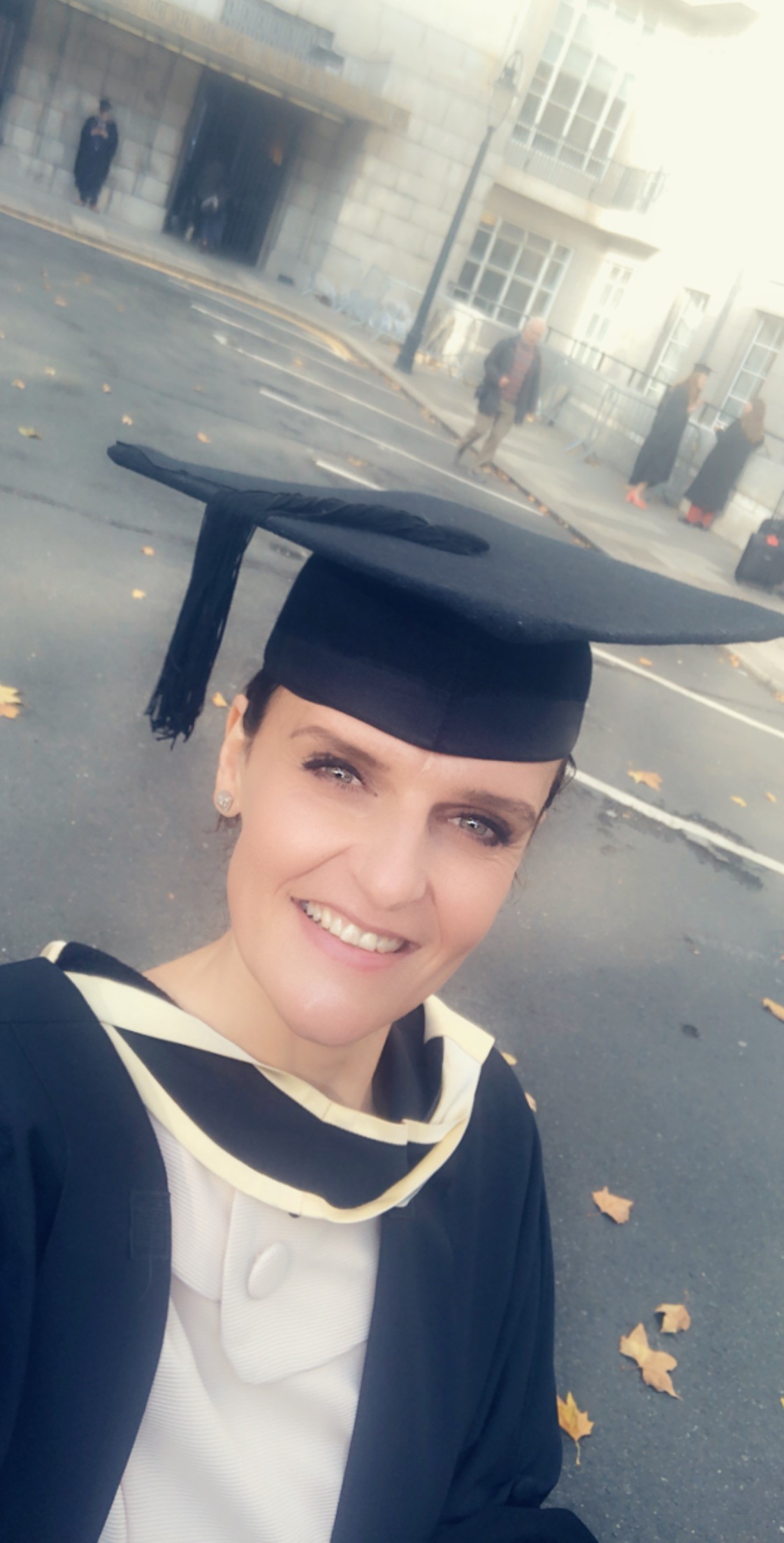
Setting an example: mother and son graduate in the same year

When Miroslava Ezel’s teenage son started browsing university prospectuses, she couldn’t resist taking a look as well.

Miroslava Ezel had always wanted to study Mathematics, but prioritising work and family life meant plans for further study were put on hold. Still, while encouraging her son to apply to university, she couldn’t resist taking a look for herself.

Then she stumbled across Birkbeck. “The evening study model appealed to me as I could fit studying around my work and family life,” she explained. “I also felt it would help me meet people a similar age to me – it did, but in reality I’m friends with people of all ages on my course, so I needn’t have worried.”

Miroslava began studying the BSc Accounting at Birkbeck’s Stratford campus, which was conveniently located near her home in Southeast London. She attended academic writing workshops on campus to develop her skills and prepare for full time study. “Coming back to the classroom after a break and as a speaker of English as a second language, I wanted to make sure I was prepared to write an academic essay,” she explains. “I love Maths, so I applied to study accounting, but I became really interested in microeconomics and macroeconomics, so in my second year I transferred to BSc Accounting with Finance.

“I had some fantastic lecturers, like Dr Ike Ndu, who teaches Financial Economics – we loved Ike! Another lecturer also told us “we are not here to fail you, we are here to help you” during exam term, which was really reassuring. I think it’s really important to see your lecturers as people who are there to support you and help you do well.”

Graduating with a first, Miroslava admits to being very strict with herself and prioritising her studies, and with two students in the family at the same time, it was easier to stay on track. She also credits the friends she made through her course for helping her succeed: “We would be great motivators for each other – we knew what we wanted to get out of the experience and we pushed each other to do our best.” She admits that the first day of a new course can be daunting, but has now made friends for life at Birkbeck.

Miroslava’s confidence grew so much through her studies that, before finishing her degree, she had switched careers from retail to banking. Her son graduated from his degree in Law in July, although she had to rush back from the celebrations to sit one of her final exams in the evening!

For Miroslava, studying at Birkbeck has fulfilled a lifelong dream: “I’ve loved every minute of it. I’ve always enjoyed learning, but I never knew before what I was capable of, especially in a second language. When I got here, I realised that age is not a limit: all that matters is knowledge, drive and your desire to prove yourself.”

Further Information: