International students’ summer event: a guided tour with open-air music and afternoon tea at the Kensal Green Cemetery, London

Cecilia Danielsson, BA Linguistics and Language student, writes about the science-themed summer event, that brought Birkbeck international students together to learn more about the College’s history by visiting the final resting place of its founder, George Birkbeck.

Birkbeck international students’ stand by the Birkbeck family mausoleum at the Kensal Green Cemetery. Credit: Harish Patel, School of Science

After over a year of meeting in the ethereal cyberspace, the glimmer of spending time face-to-face was a welcome return to normal, even if we all had to re-learn our interpersonal skills again! Fortunately, these skills were all firmly intact and everyone was delighted to engage in real conversation.

The weather was kind to us with slabs of blues and green, contrasting sharply with grey stones of the graveyard all reignited by the sun. It was the perfect day to celebrate George Birkbeck, and a chance to reflect on the extraordinary vision actioned to bring higher education to the working people of London. Birkbeck has been transforming lives since 1823, and the university has transitioned through various colourful identities through its long and extensive history. In 2023, Birkbeck will be celebrating its 200th anniversary.

Developed as an engineering and science faculty, the tour of Kensal Green Cemetery was a chance to not only pay respects to the University founder, but also to consider works in Literature, Botany, Languages and Royalty from notable pioneers in science, such as Brunel and Babbage.
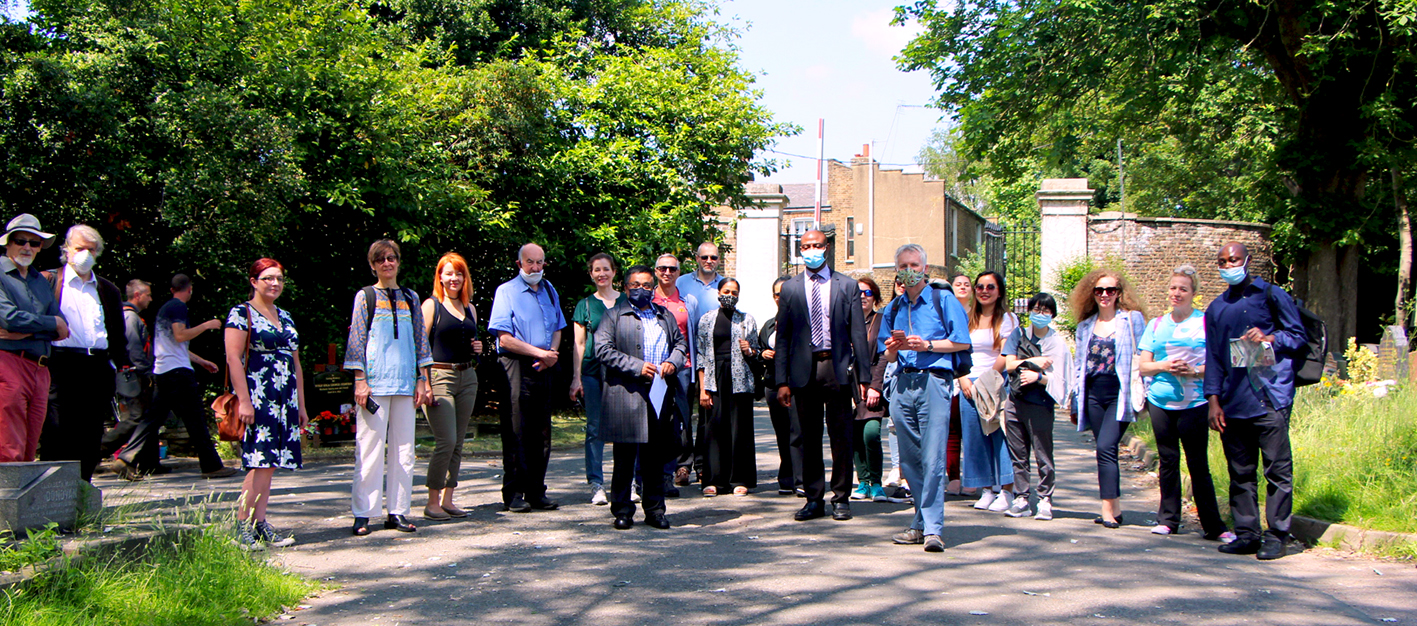
Students gather for a group photo at the Kensal Green Cemetery. Credit: Harish Patel, School of Science

The enthusiastic tour guides were rich in their knowledge of tombstone architecture and the famous residents of this corner field in West London. For the architecture fans among us, the tour talk referenced some of the neogothic styles of concrete structures, as well as Egyptian and post-modernist designs.

Glancing around there were parallels with the built environment we are familiar with in the London buildings around Bloomsbury, including Birkbeck’s luminous neighbour, the British Museum. Once we had paid respects to the family of George Birkbeck, there was a chance to reflect on the requirement for institutions to continue to support access to cutting edge research-led higher education and to London, and the need for lifelong learning.
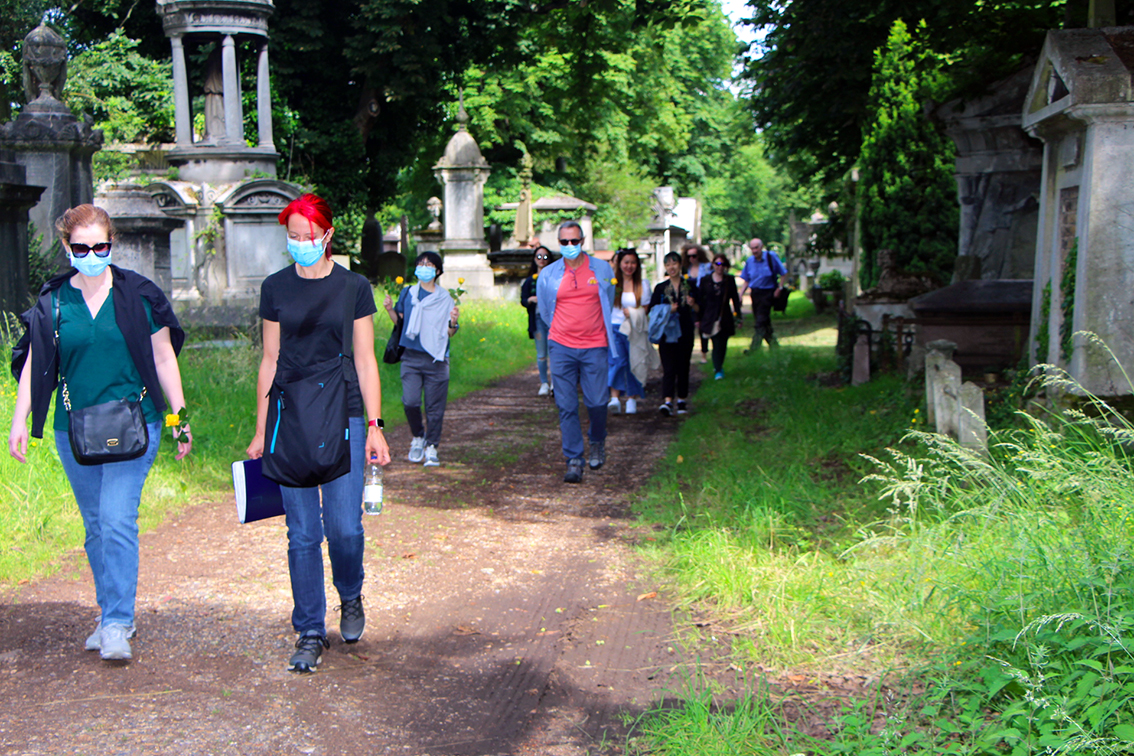
Students on their tour of Kensal Green Cemetery. Credit: Harish Patel, School of Science

After our meandering weave through the stony paths and tall green trees, it was time for afternoon tea. With a delicious spread of lovingly home-baked fayre by the very kind hosts of Kensal Green Cemetery, it was time to kick back and reflect upon our day in the sun to the soundtrack of the talented The Dionysus Ensemble and the opportunity to thank the organiser of the event, Professor Sanjib Bhakta, Assistant Dean (Internationalisation and Partnerships) who put together a memorable day for us all.
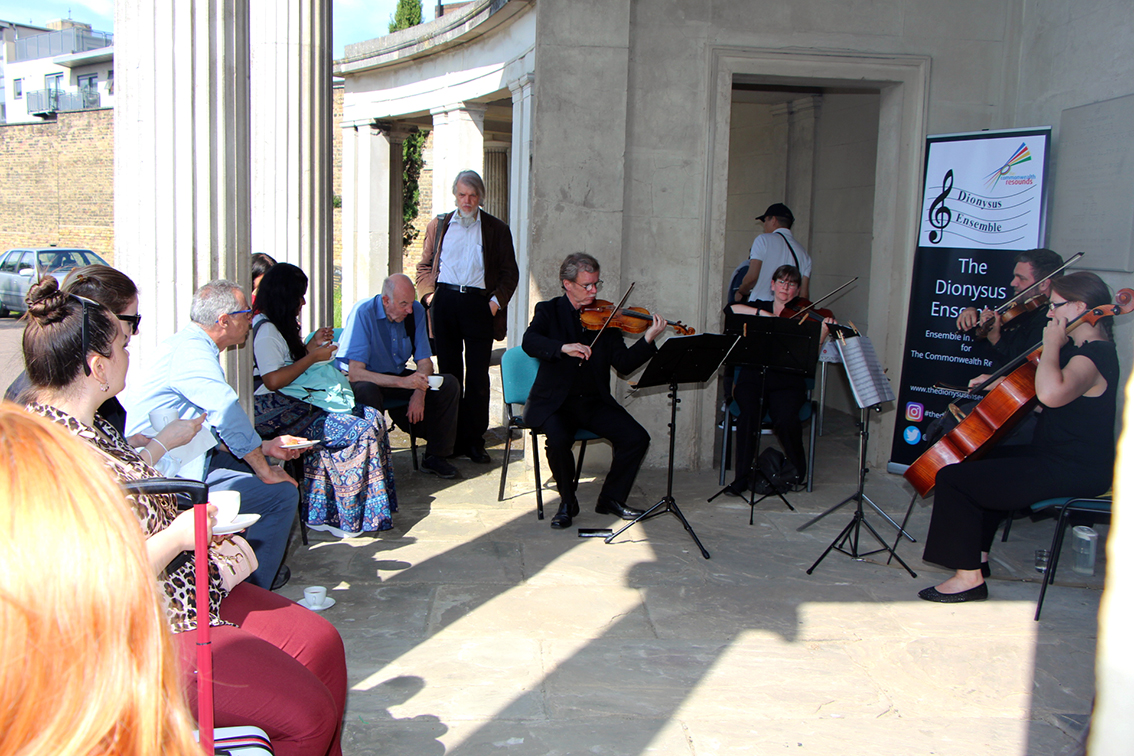
The Dionysus Ensemble. Credit: Harish Patel, School of Science

Further information

“My business wouldn’t have taken off without Birkbeck’s Pioneer programme”

The Pioneer 1.0 programme is the springboard for entrepreneurially minded students to develop their skills and business ideas. In this blog, Kate Strivens, winner of ‘Best Business Pitch’ in the recent Pioneer Awards and Birkbeck graduate, tells the story of how her business idea came about and her ambitions for the future.

Kate Strivens

Back in 2019, as an avid cyclist who cycled every day to work, Kate was growing increasingly frustrated with how damaged her hair was getting by wearing a helmet. She trawled the internet for helmets designed for adults with afro hair but to no avail. This led her to dreaming up her business idea in early 2020, during the first COVID-19 lockdown, of designing a helmet that provides safety to the cyclist and protection for afro hair.

Kate first heard about Birkbeck’s Pioneer 1.0 programme in early 2020, through a recommendation from a friend. Having already graduated from Birkbeck’s MSc Global Environmental Politics and Policy programme in 2019, she was pleased to find out that it wasn’t too late for her to enrol, as the course accepts recent graduates as well as current students.

Kate set out on the course, and cites it as being the reason for her taking her business idea seriously. “Initially, enrolling on the Pioneer programme was just for fun. I didn’t really see my business idea as being something I would properly pursue. However, not long after I started the course, I began to realise it had the potential to be a feasible and viable business. What held me back initially was my imposter syndrome. If I could give advice to others in my position, it would be to believe in yourself and your idea. It’s just crazy I’ve now won a Pioneer Award, I’m still in shock!”

Having completed the Pioneer programme, Kate is now balancing developing her business and working full-time in Sierra Leone, as a Business Development Manager for Plan International, a development and humanitarian organization that advances children’s rights and equality for girls. It is a world away from her upbringing in rural Wales, “I grew up on a farm in North Wales and when it came to choosing a university, I wanted to get as far away as possible, so I moved to London to study. My passion for travelling from a young age has now meant I work abroad as much as I can – I find different cultures and languages fascinating.”

Kate is currently at the prototyping stage and is spending time conducting market research. She says, “The recent headlines in the news about Fina, the water sports world governing body, rejecting the use of a swimming cap designed for afro hair at competition level has really brought the conversations around sport and afro hair to the fore. I find it so motivating that my invention will be helping others and I can’t wait for my helmets to come to life over the next few months.”

Further Information

Meet the Editor Series Welcomes Professor Ben Martin

The Editor of Research Policy shared advice on how to pitch to leading journals in this virtual event hosted by our Department of Management.

Professor Ben Martin outdoors, looking into the camera.Having been an Editor of Research Policy (RP) for fifteen years, Professor Ben Martin (SPRU and University of Sussex Business School) is well versed in the pitfalls that hopeful contributors should avoid and, more importantly, the steps they can take to give papers the best chance of being published.

In our fourth Meet the Editor session, Professor Geoff Walters, Executive Dean of Birkbeck’s School of Business, Economics and Informatics welcomed Professor Ben Martin and the international audience comprising more than 45 scholars from around the world. Chaired by Dr Muthu De Silva, Professor Martin shared insight into Research Policy and best practice in paper development with colleagues in our Department of Management.

What is the positioning of Research Policy?

Professor Martin began the presentation by giving an overview of RP, its scope and structure. RP is widely regarded as the leading journal in innovation studies and its focus is on innovation, technology, knowledge, learning and entrepreneurship. The journal is unique in that authors choose which of the twelve editors to pitch their paper to based on their area of expertise.

RP is oriented towards policy and practice and is less theory driven than many other leading journals. It is also interdisciplinary in scope, drawing on economics, management, organisational studies, sociology and political science. Among the most highly cited papers from RP are those which involve conceptual exploratory analysis, as opposed to purely empirical analysis.

In terms of coverage, RP is a global journal, with an even number of contributions from North America and Western Europe and a growing number of papers from Asia.

Advice for academics thinking of submitting to Research Policy

Professor Martin shared insight into how to provide a good submission, stressing that much of the advice could apply to submissions to other journals as well:

  • Read similar papers in the journal to get a flavour of the content, style and theoretical or conceptual approach.
  • Check the website for the scope of the journal and instructions to authors.
  • Seek advice from experienced authors.
  • Present the preliminary version of your paper at conferences and seminars, get feedback and improve the quality before submitting.

Aside from ensuring authors have ‘done their homework’, RP editors ask three key questions when examining papers:

  • Is the topic within the scope of our journal?

An author might demonstrate this by referring to literature that is familiar to RP readers, ensuring the topic has broad appeal for RP readership and arriving at a conclusion of interest to RP readers. This can be further justified in the covering letter if required.

  • Is the paper high quality?

Quality is understood both in terms of topic, which should be embedded in relevant literature and offer an original contribution, and in structure, which must feature systematic analysis, logical argument and a clear, interesting conclusion with specific policy or management implications. Papers should also be written in good English.

  • Who to referee?

Professor Martin highlighted that reliable, conscientious referees have been particularly hard to find during the COVID-19 pandemic. Authors should consider who the editor might ask to referee and may influence the editor’s choice of reviewer through the references they cite.

Revise and Resubmit

Professor Martin offered advice for academics who are invited to revise and resubmit their work to RP:

  • Read referees’ comments very carefully.
  • Decide which points you can respond to.
  • Revise your paper and prepare a detailed accompanying note explaining to each referee how and where you have responded to the points that they made.
  • Be prepared to revise and resubmit more than once.

What to do if your Paper is Rejected

The sheer volume of submissions that RP receives means that inevitably some papers will be rejected. Professor Martin advises authors in this situation to learn from critical comments and to revise and improve their paper for submission in another journal.

We would like to thank Professor Martin for the opportunity to learn from this thought-provoking presentation and for taking the time to answer our audience questions.

Further Information:

Knowledge Intensive Business Services: Post-Pandemic New Normal

In our third collaborative event between Birkbeck’s Department of Management and Essex Business School, we explored the impact of the COVID-19 pandemic on Knowledge Intensive Business Services. 

The COVID-19 crisis has forced many organisations to transition to remote working. How has this impacted Knowledge Intensive Business Services (KIBS), which rely on in-person interaction and team working to deliver their services? 

In a joint event hosted by Birkbeck’s Department of Management and Essex Business School, University of Essex, Professors Ian Miles (Alliance Manchester Business School, University of Manchester) and David Doloreux (HEC Montréal) outlined their view of the post-pandemic new normal for KIBS. 

As Chair, Dr Muthu De Silva, Director of Research in Birkbeck’s Department of Management, introduced the session, which began with discussion from Professor David Doloreux on KIBS and their key characteristics. KIBS are services which involve economic activities which are intended to result in the creation, accumulation or dissemination of knowledge. The KIBS sector includes establishments whose primary activities depend on human capital, knowledge and skills. This inevitably involves close interaction between KIBS and their clients in order to create and disseminate knowledge. 

Scholars have identified three broad classifications of KIBS: 

  1. Social and professional services (P-KIBS) 
  2. Science and technology (T-KIBS) 
  3. Cultural and creative services (C-KIBS) 

Having conducted a literature review into the key research streams relating to KIBS, Doloreux noted that very few studies prior to the pandemic have dealt with digital services and their capacity for innovation, so webinars like this address an important and under-researched area of the field. 

Regarding how the pandemic has affected the macro- and micro-pictures for KIBS innovation, Professor Doloreux made the following observations: 

  • There will be an evolution of demand on KIBS innovation, with greater opportunities related to big data, analytics and AI. 
  • COVID-19 may result in a widening gap between different types of KIBS: P-KIBS may be able to offer more innovative services that satisfy demands, whereas C-KIBS have suffered from drastically reduced demand due to COVID-19. 
  • We will need to rethink the location of activity of KIBS and where innovation occurs. 

As a geographer, Professor Doloreux also raised the following key questions: 

  • How can we geolocalise innovation in KIBS? 
  • How do KIBS innovate without face-to-face and frequent interactions with clients? 
  • What are the dynamics and implications of hybrid models and more digital service production on KIBS innovation? 
  • What is the geography of this connection? 

Regarding the long-term impact of the pandemic on KIBS, there are three possible scenarios that need to be empirically analysed: 

  1. The Revolution: COVID-19 has radically modified innovation and business models in KIBS. 
  2. Booster: COVID-19 has accelerated processes and practices that were already in place, e.g the hybrid model. 
  3. Weak game changer: changes prompted by COVID-19 have a weak impact on KIBS practice and products. 

The second half of this webinar invited Professor Ian Miles to respond to these observations. Having conducted research into KIBS throughout the pandemic, Professor Miles observed how the pandemic impacted KIBS in real time. He highlighted three elements of the crisis that were shaping business conditions: epidemiology, policy responses and socioeconomic impacts. 

In terms of patterns of demands for KIBS, the picture is very mixed. There was a sudden drop in demand for KIBS in 2019/20, three times that seen in the 2008 recession, in line with the drop in demand across the economy. Conversely, some KIBS sectors have been in increased demand and we have seen new demands related to new business problems. Among these ‘winners’ are some portions of research and development services (including the clinical trials industry) which have had to work under new constraints associated with the pandemic, of Information Technology and computer services (which were often quite capable of shifting to remote working),  and of professional services like accountancy and legal services (where new client problems are arising, but whose ways of working have been challenged). 

Professor Miles also discussed how KIBS have confronted challenges during the pandemic, including in particular restrictions on face-to-face interaction. This impacts on the establishment and maintenance of trust, and on the exchange of tacit knowledge, both in relations with clients, and in internal collaboration and team-building. Much effort is underway to improve videoconferencing systems and practices. 

For Professor Miles, there would likely be a shift between the immediate impact of the pandemic, which has seen the acceleration of digitisation activities and the stalling of long-term digital reengineering projects such as AI and data analytics, and the long-term response, which may see these efforts reinstated as organisations push the limitations of virtual communications. Professor Miles concluded by anticipating an upsurge of innovation in the future, as organisations moved on from the ‘forced rapid innovation’ of the immediate crisis. 

The presentations were followed by discussion from the audience, which featured a diverse mix of policy makers, academics and early career researchers, and a vote of thanks from Professor Suma Athreye, Essex Business School. 

A recording of this event is available to watch on YouTube. We look forward to future collaborations as we continue to explore the impact of the pandemic on innovation, knowledge creation and dissemination.

Further Information: