Science Saturdays: Differences in DNA – what makes you, you?

In May, Birkbeck’s School of Science held ‘Science Saturdays’, a programme of free online talks every Saturday, open to a global audience. In this blog, Maria Pitharouli, Birkbeck and UCL PhD student, gives her account of the talk she attended by Dr Emma Meaburn, Reader in Human Genetics, about DNA and its role in shaping each person’s development, behaviours, and health.

‘What makes us who we are?’, is a question that has occupied Dr Emma Meaburn since she was a teenager and it is what led her towards becoming a Behavioural Geneticist, as she explained in her recent talk.

Behavioural genetics is focused on the influence of nature (our genes) and nurture (the environment we are exposed to during our lives) on the differences we can observe or measure amongst people. But to understand the effect of nature and nurture we need to understand first what DNA is and how big a role it plays in our day-to-day lives.

The human genome is contained in the nucleus of every cell in our bodies, and it is the complete set of genetic instructions: a sequence of approximately 3 billion of the DNA bases adenine (A), cytosine (C), guanine (G) and thymine (T). Each cell has two copies of these genetic instructions, one inherited from the mother and one from the father. Most of the genetic code is identical amongst humans and follows a specific order. Dr Meaburn talked about why this similarity in the genetic code between people is so important; the sequence of A’s, C’s, G’s and T’s acts as a guide for our cells so they can function properly and create all the components needed to sustain life.
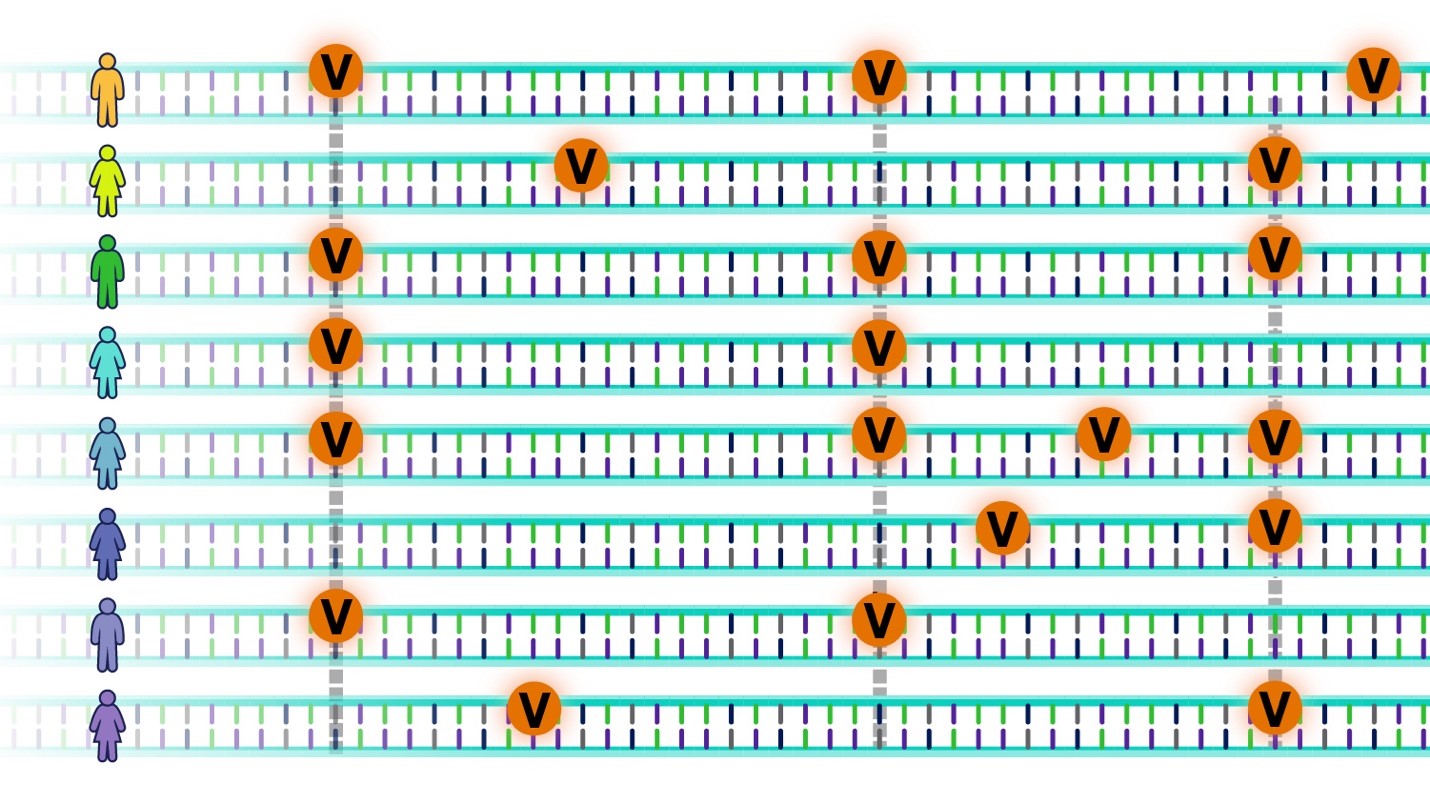
Image 1. The letter “V” indicates the genetic variants scattered throughout the human genome. Source: Polygenic Risk Scores (genome.gov)

However, despite this similarity there are parts of the DNA code that differ between people, called genetic variants (image 1), and they are scattered throughout the human genome. These DNA differences are what really interests Dr Meaburn as they might explain some of the variation in how we think, feel, and act, or why some of us develop health conditions. In the talk, Dr Meaburn described how behavioural genetic research has shown that there isn’t a single gene (or DNA difference) that can explain differences in human intelligence, personality, or susceptibly to mental health conditions such as depression. These complex (or multifactorial) traits and disorders are the result of lots (and lots!) of common genetic variants in combination with our different life experiences.

The talk then described a method called genome-wide association studies (or ‘GWAS’) that have been hugely successful in identifying the specific DNA differences that relate to complex human behaviours and traits.  The GWAS approach requires very large numbers of research participants – typically tens of thousands of people – who donate both DNA and information about their health and behaviours. Interestingly, while GWAS have identified many of the genetic variants that contribute to differences in human health and behaviour, Dr Meaburn emphasised that each of the variants found explains just a tiny amount of the differences we see amongst people. As a result, we now know that complex mental health conditions such as depression are polygenic; any single genetic variant does not cause the disorder, rather many of them together can increase or decrease one’s predisposition to depression.

Dr Meaburn went on to describe how polygenic scores – the sum of the effect of all genetic variants that can either increase or decrease risk to develop a disorder – could potentially be useful for identifying individuals more (or less) susceptible to a wide range of human behaviours or health outcomes (image 2).  However, it is important to keep in mind that polygenic scores will never be a ‘crystal ball’, as while DNA differences are important, we know that our environment and life experiences matter too.
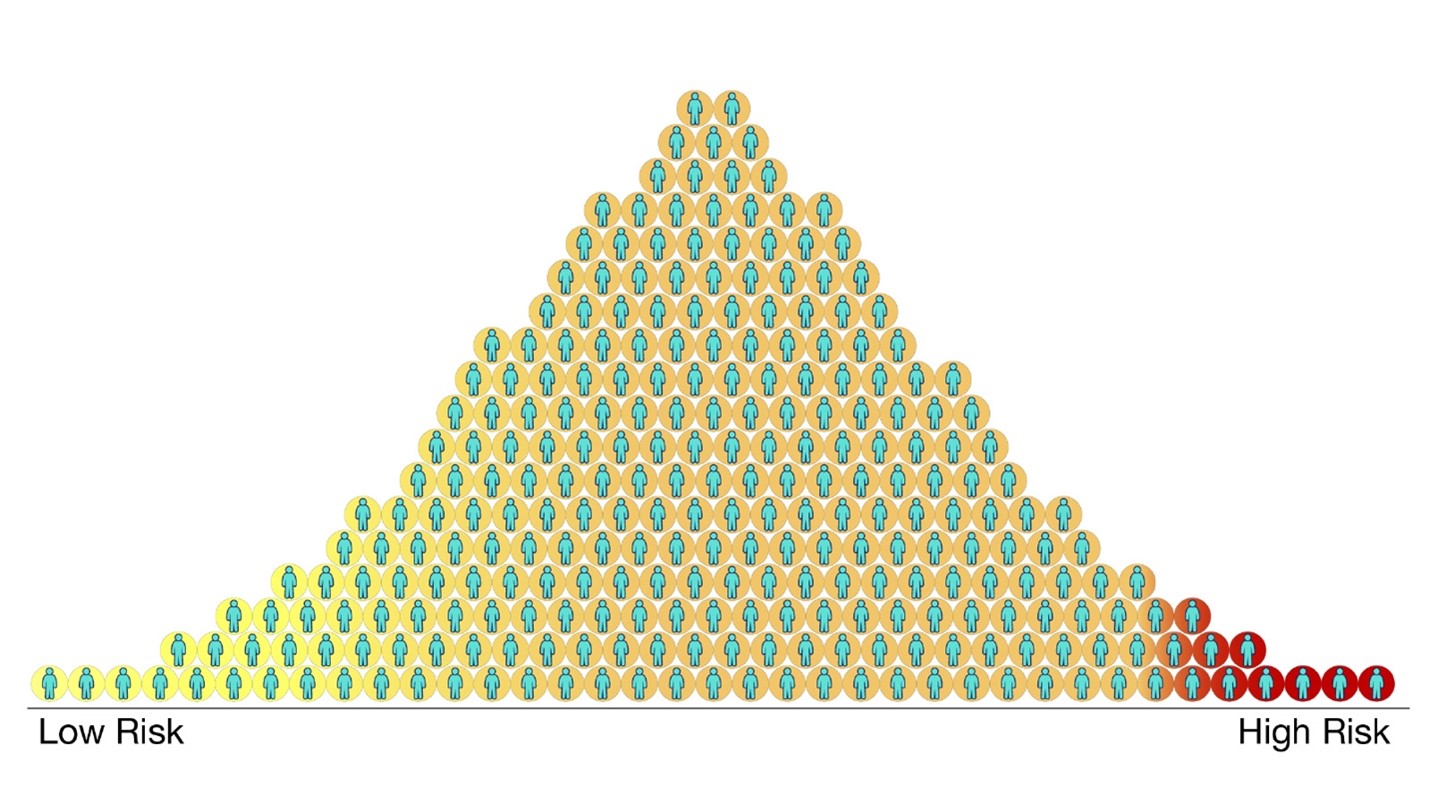
Image 2. Polygenic scores can help us identify someone’s genetic likelihood to develop a specific disorder or trait. Source: Polygenic Risk Scores (genome.gov)

The take home message from the talk is that the DNA sequence you have inherited from your parents is an important piece of the puzzle in explaining what makes you, you. Your own unique DNA code plays a role in shaping your development and nudging your health in certain directions.  In the last ten years GWAS research has shown us which DNA variants are important, and the real challenge for the next ten years is understanding how they lead to differences between us in how our brains work, and how we interact with others and the wider world around us.

Further Information

Science Saturdays: Coughing up a lung, pollutants in our air

In May, Birkbeck’s School of Science held ‘Science Saturdays’, a programme of free online talks every Saturday, open to a global audience. In this blog, Tina Wright, Birkbeck PhD student, gives an overview of the talk she attended about pollutants in the air and how they affect the physical wellbeing of humans.

The Science Saturdays talk, ‘Coughing up a lung: pollutants in our air’ delivered by Dr Katherine Thompson, Reader in Biophysical Chemistry, observed how the environment influences physical wellbeing, more specifically, how the atmosphere and its composition of gases and particulate matter, which includes pollutants, interacts with a monolayer of molecules (surfactant) at the air-water interface of the lung to cause respiratory problems.

The content of the talk was a boon to the global cause of tackling climate change and its subsequent effects on worldwide mortality and morbidity rates. It provided information on how to investigate exactly what is happening on a molecular level and systemically in our bodies.

Our atmosphere, pollution and photochemical smog

Our atmosphere predominantly consists of nitrogen (N) and oxygen (O2) along with trace amounts of unnatural and naturally sourced gases, the former being sourced from human processes, for example, car exhaust fumes. These may be from petrol or diesel motors. Petrol motors release some water combined with lots of carbon monoxide (CO), hydrocarbons from incomplete combustion of fuel and nitrogen oxides (NOx) which includes nitric oxide (NO) and nitrogen dioxide (NO2). Diesel motors burn fuel differently, therefore generate a different composition of exhaust gases, such as CO and hydrocarbons, but also release tiny particles that may be dangerous for human health, dependent on particle size.

As I’ve already mentioned, there are some natural sources of trace gases that add to our atmosphere and these include green plants that emit organic pollutants, called volatile organic compounds (VOCs).

Photochemical smog is pollution present on sunny days and has a distinct character. Nitrogen dioxide (NO2) features as a brown/orange gas, visible on the horizon on a clear day. A combination of this with volatile organic compounds (VOCs) and sunlight produces ozone (O3). It is vital for life to have O3 in the stratosphere as it absorbs short wavelengths of light that may damage our DNA, however, when present in the troposphere as a secondary pollutant, the VOC-NOx-O3 relationship keeps its concentration high during warmer months, therefore, adverse effects may occur, notably at the air-water interface of the lung.

Lung physiology, function and properties on a molecular level

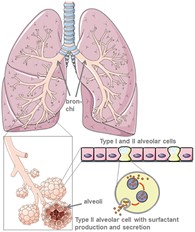
The lung is composed of the trachea, bronchi, bronchioles and finally, millions of alveoli, which are tiny sacs that increase the surface area of the lung for gas-exchange of oxygen (O2) and carbon dioxide (CO2).

Our bodies are wet systems but if the alveoli were lined with pure water, the surface tension (cohesive forces between water molecules), would be too high for expansion of the lung after compression. This issue is resolved by the action of surfactants present as a film on the lung interface that are composed of lipids, proteins, and cholesterol. Its importance is reflected by premature, newborn babies that lack lung surfactant and consequentially, experience difficulties breathing.

Diagram of the human lung. Credit: Frontiersin.org.

What happens when pollutants reach the lung interface?

Dr Katherine Thompson’s research focuses on the interaction of pollutants with the lung. A single layer of molecules (monolayer) of lung surfactant, similar to when it is found on the surface of the lung, may be analysed by the reflection of light. For example, a technique known as Brewster Angle Microscopy, allows the observation of the organization of molecules at the surface or interface, a simile of the lung.

A monolayer is very thin, therefore, the wavelength of light chosen for the reflection experiments should be shorter than the thickness of the monolayer. The wavelength of x-rays (photons) are very short, therefore, it can be used to look at these reflections. Photons may hit a surface and ‘bounce off’ to a detector, comparable to a gymnast jumping and landing on a mat, then coming away. This will give information, in the case of the gymnast, on the thickness of the mat or in the experiment, the single layer of molecules.  These experiments may be undertaken whilst the lung surfactant is simultaneously exposed to ozone and a thinning of the monolayer can be observed from rearrangement, breaking and bending of molecules at the surface. Physiologically, this may lead to inflammation of the lung.

This research is of paramount importance in the modern world, where the extent of the damage to our environment, and the subsequent effect on human health, needs further investigation and awareness raised to all.

Further Information

Never betray your dreams, they are yours!

Aygun Badalova recently graduated with an MSc in Cognitive Neuroscience and Neuropsychology. This is her #BBKStory of growing up in a low-income family in Azerbaijan, and how she taught herself fluent English to fulfil her life-long dream of studying in England.

Aygun Badalova

My desire to study abroad in England started when I was studying at school in Azerbaijan in a small, tiny town called Lerik. It is located in a mountainous region where there are only three secondary schools, and there were families around us whose children could not go to school at all. At that time, many girls in our district only went to school until aged 15 or 16, because of financial issues and social and cultural problems – most parents are still reluctant even now to let their girls leave for university. However, despite all the challenges, my mind was different and I always believed that I didn’t belong there. I had only one goal and mission: to study hard and leave my hometown for a better future.

Coming from a low-income family struggling with financial issues and hardships, my dream to leave felt impossible. There were days we couldn’t even have dinner. We used to wear our relatives’ clothes and when my father could buy something that was celebration for us. Because my father was our only breadwinner, he used to work all day and night just to cover our basic needs. My mother was brilliant housewife, despite our poor lifestyle she always taught us how to be brave and encouraged us to keep our heads high no matter what happened. Because I had four younger siblings, I knew I had to be their role model and I was like another parent to them. I am truly happy that I had a great family and a strong belief in a better future!

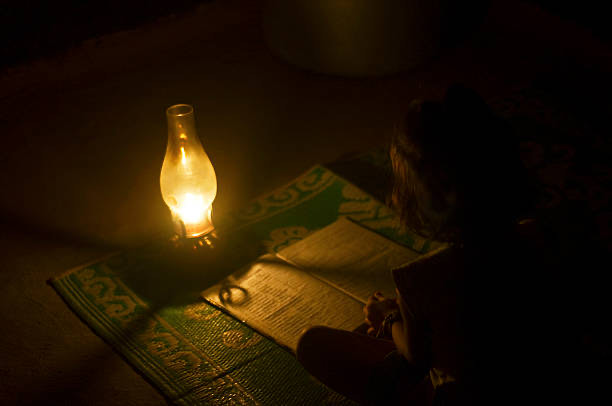
When I used to say “one day I will study in England”, everybody around me smiled at my naive desire. But there was a feeling deep-down in my heart which made me work very hard. My passion for England and the language made me study English – no one could believe that I became fluent by myself. I still remember the hard days: on the cold winter nights, with the dim light of a lamp, I used to open my books and believe. Believe in my dreams…

After finishing high school I left Lerik to study at a university in Baku, the capital city of Azerbaijan. At university, my love for the English language presented many fantastic opportunities for me. I worked as a translator for many important events and internatonal companies. Later, I taught English to professionals and I even wrote an English book for self-learners when I was working at the Azerbaijan National Academy of Sciences (ANAS) as a research assistant and interpreter.

Years passed, and many things changed, but my desire was always the same. Two years ago and after hundreds of struggles, I finally arrived in the UK to pursue my dream. It was a period of my life when I was working back at home and my family did not want me to go away. They thought I didn’t need to go, and they also were not comfortable that I’d be alone and far away from them. It took a while to make them agree to my decision.

Studying for a Master’s degree in the UK and getting my degree was not easy. My field of study required strong mental and physical strength and there were financial needs which I needed to fulfil by working. Learning about how the brain functions and how it changes in different mental disorders was really breathtaking and interesting. I also worked in healthcare settings and got a chance to see patients who suffered brain disorders. Moreover, I made many great friends who always supported me.

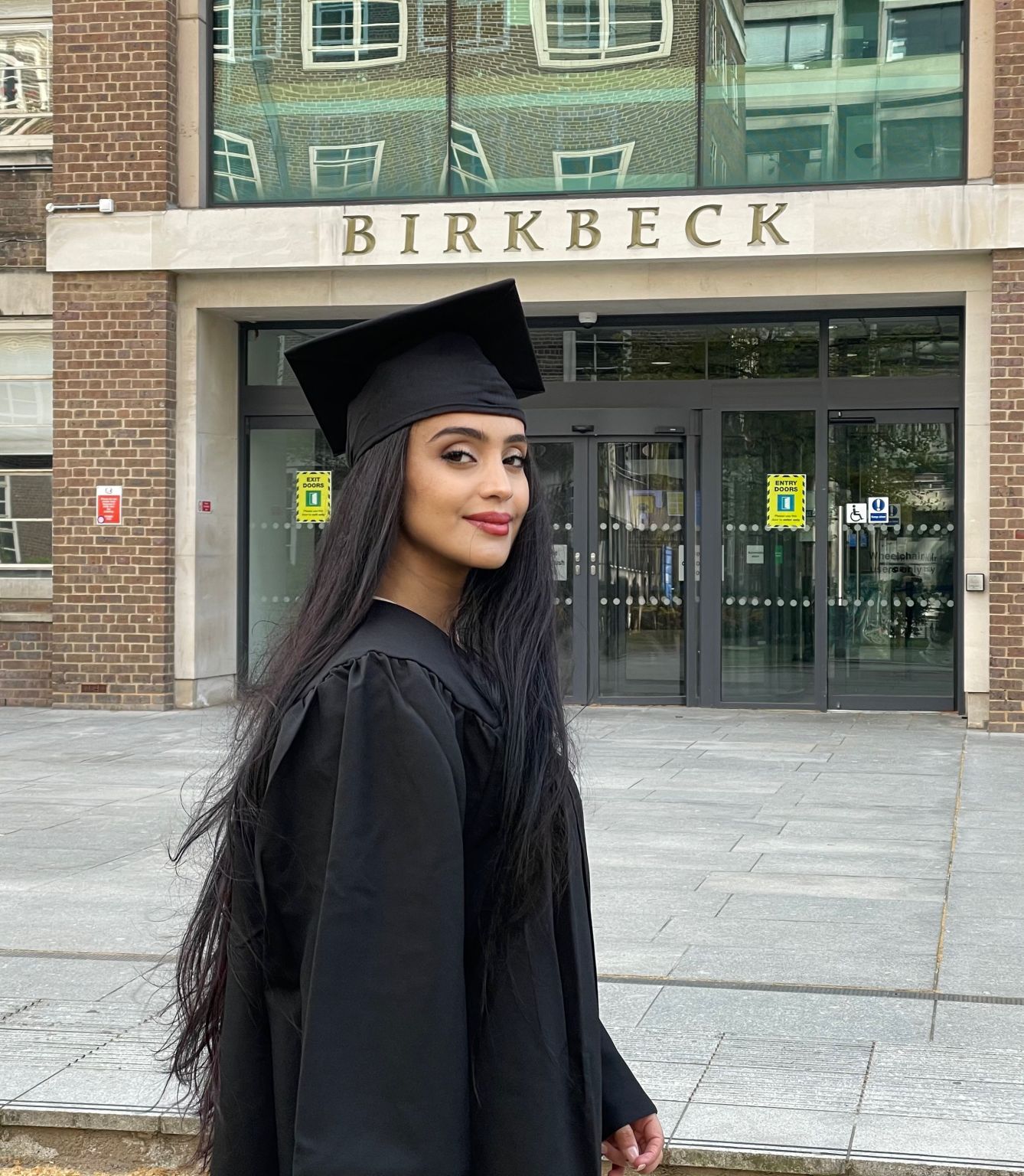
During my studies I met a lot of experts, amazing people and the great environment at Birkbeck has made me who I am today. Our professors’ approach to us was really impressive – they explained everything and were always willing to answer questions. My supervisor Dr Eddy Davelaar was one of these people who always supported me. I have been influenced by such great people and have become a better listener, as well as kinder and less judging.

After lots of research, unfamiliar topics, sleepless nights, weekend library days and assignments I have finally graduated! I would like to thank Professor Nazanin Derakhshan who constantly motivated us to achieve. One of her favourite quotes was: “Don’t look at where you are, look at where are you came from. Then you will see how far you have come.”

My aim for the future is to be a well-known neuroscientist and neuropsychologist and contribute to the treatment of Alzheimer’s and anxiety disorders in future. I am living in London now, doing my research and working in healthcare settings. I am also a Cognitive Behavioural Therapy Counseller, working with people with different mental problems and I love my job. I’m also pleased to say that all my siblings went on to achieve degrees from prestigious universities.

I’d encourage others to never give up on their dreams! Don’t let anyone or anything make you to feel that you are not enough. Believe me, if I can pass thousands of miles and come for my dreams, you also can. I am just at the beginning of my amazing life.

Further Information

“It’s never too late to achieve your goals and ambitions and don’t let anything get in the way.”

Netty Yasin spent her life advocating for her daughters and her community, before deciding to pursue her life-long ambition of a legal career. This month she graduated from the Qualifying Law Degree (LLM); this is her #BBKgrad story.

Netty Yasin

Netty always had ambitions of a career in law, but life got in the way of her dream. She had intended to return to education once her two daughters (born 16 months apart) were in nursery, however when her youngest daughter was diagnosed with Autism Spectrum Disorder, learning difficulties and a speech and language disorder, Netty channelled her energy into ensuring her daughter was able to thrive.

When her daughter was of school age, she found that the independent special school she was attending was not helping her progress, so she took matters into her own hands. “I could not find a school that suited her complex needs, so I found an American programme that really resonated with me because it didn’t set unjustified limits on what she could achieve. I did it myself, set up a classroom for her in one of our bedrooms and I taught her all day everyday while my other daughter was at school and she started to make really amazing progress.”

After home-schooling her daughter for six years, Netty was able to secure funding from the local council that meant that she could hire people to take over the day-time teaching. She then set about finding a role for herself, taking on a series of volunteer roles and eventually a full-time position as a Special Education Needs and Disabilities advisor, a job which she describes as rewarding. However, for Netty, her love of the law was never far from her mind and it was a conversation with her eldest daughter that spurred her back on to the path she had always intended to take. “We were talking about careers, one of those deep mother-daughter chats, and I was encouraging her not to limit herself and to pursue her dreams… she turned to me and said well, why don’t you just take your own advice. It was a lightbulb moment!”

Although she describes Birkbeck as a welcoming place, she recalls the challenges of her first year, having to balance studying with full-time work, and caring for her daughter and her mother who has Alzheimer’s disease. In addition to that she felt nervous about starting education at that stage of her life. “I had the sense that maybe I had left it too late. In the beginning I was so insular and nervous.”

To get past this, Netty threw herself into university life wholeheartedly. She  spent the weekends on Birkbeck’s mooting programme, even after initially suffering from a bout of stage fright in a practice session, she went back again and again, eventually entering two competitions and achieving second place out of six teams in the sole team competition.

Netty Yasin throwing up her capNext, she took hold of her fear of public speaking and made her debut at the Bloomsbury Theatre in the play, Othello on Trial, as part of a week of events for the School of Law’s 25th anniversary celebrations. Also, through her Birkbeck contacts she even spent some time volunteering with the survivors of the Grenfell Tower fire, an experience that she describes as ‘profound’, and took up the opportunity to have career coaching sessions that boosted her resolve in her future plans.

In her second year, Birkbeck’s careers service Birkbeck Futures put her in contact with Aspiring Solicitors, a leading diversity platform that helped her get commercial legal work experience at American Express and Sky while she was studying.

When asked about her favourite modules, Netty exclaims, “I am the nerd who enjoyed everything!”, even taking the time to voluntarily audit other modules in an effort to soak in as much as she could.

For many 2020 was defined by the COVID-19 pandemic, however for Netty, it was an unexpected illness that further tested her resilience. “In February 2020, I was hospitalised after suffering a sudden terrible headache and lost vision; it was really terrifying.” With doctors unable to provide a diagnosis, she suffered debilitating headaches for six months, while still being determined to finish her course. “I worked when I could, even if that meant waking up at 2:30am and working for four hours, taking a nap and then getting up with my daughter. I just did what I could to get through it and then, in a completely unexpected scenario, I got my highest ever mark in one of my exams.” In the end Netty surpassed her own expectations and achieved a distinction overall.

With her illness now behind her and her Master’s degree in hand, Netty is looking forward to qualifying as a commercial solicitor. This summer she’ll be completing a summer vacation scheme at a global law firm with the hope of obtaining a sponsored training contract at the end of it.

Undeterred by her age or circumstances, Netty believes that pursuing her ambitions came at the right time in her life and in closing reflects, “I can look my daughters in the eye and say I am doing what I am telling them, it’s never too late to achieve your goals and ambitions and don’t let anything get in the way.”

Further information: