Category Archives: Humanities and Social Sciences

The Booker at Birkbeck: Atonement

Ian McEwan, the best-selling author of over twenty books, came to Birkbeck to discuss the process of adapting a novel into a film with Atonement screenwriter Christopher Hampton and Birkbeck Lecturer Dr Agnes Woolley.  
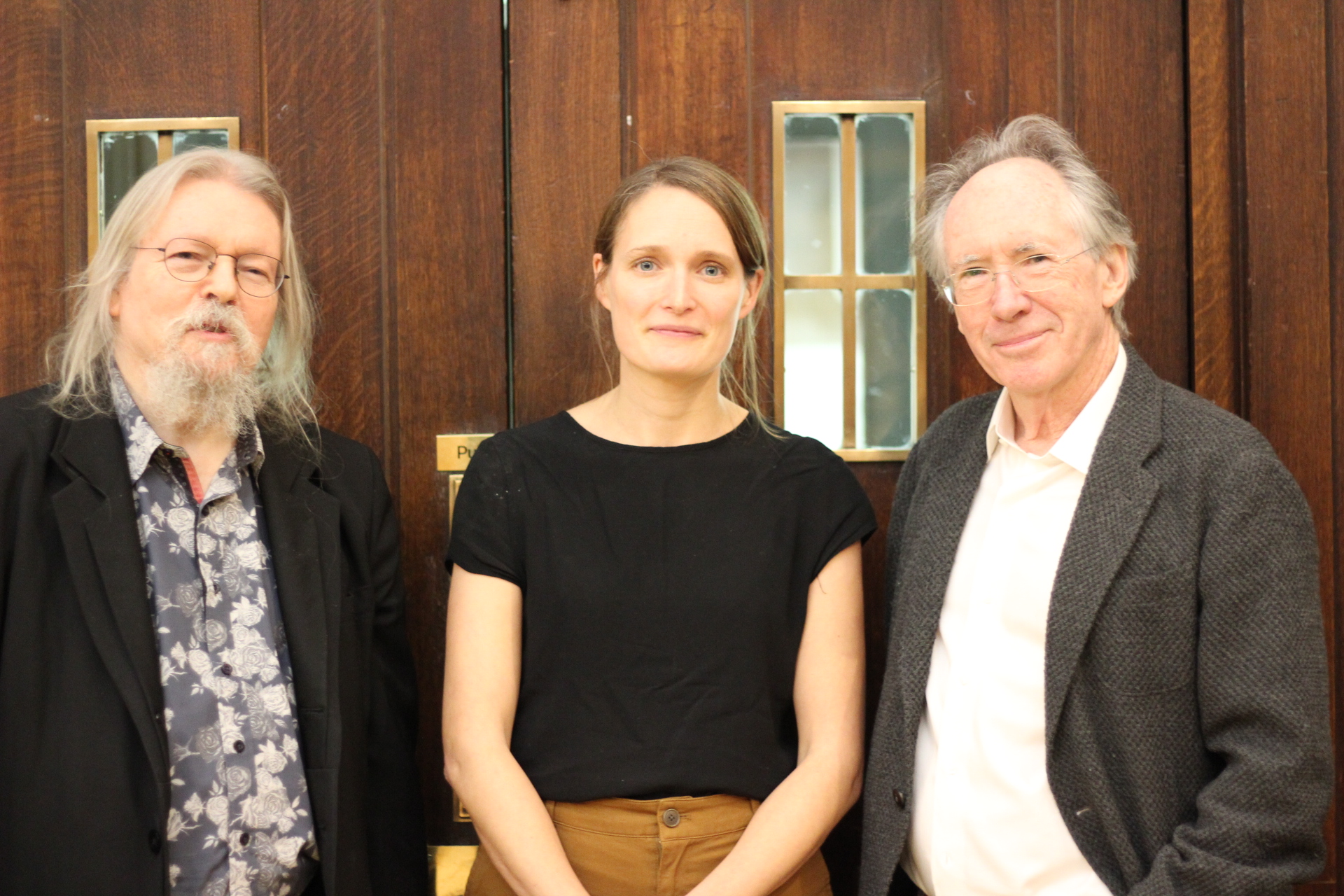
L-R: Christopher Hampton, Agnes Woolley, Ian McEwan

Ian McEwan joined Birkbeck’s students, alumni and wider community to discuss his Booker Prize shortlisted book, Atonement, alongside screenwriter Christopher Hampton, with whom he adapted the title for the big screen. The discussion was mediated by Dr Agnes Woolley, Lecturer in Transnational Literature and Migration Cultures at Birkbeck. Focusing on the collaboration between the writers, they discussed the process of adapting a book for cinema, and the unique challenges and opportunities this brings to storytelling.

Atonement is set in three time periods; 1935 England, Second World War England and France, and present day England. It hinges on the fateful mistake of upper-class Briony, who as a child witnesses – and misinterprets – a series of events which lead her to falsely accuse her family’s housekeeper, Robbie, of raping her cousin, Lola.

“Sometimes powerfully in people’s lives,” explained McEwan, “believing is seeing. It’s part of the reason the police no longer rely on identifications from line-ups. Memory is very malleable.”

Robbie, who is truthfully in love and beginning a relationship with Briony’s sister, Cecila, is imprisoned; and the lives of all three are irreparably damaged by the lie. Following his release, Robbie joins the army, and is seemingly able to reunite with Cecilia prior to fighting in the war. In 1940, Briony visits Cecilia to atone for her actions, while Robbie is home, on leave from the army. Cecilia and Robbie both refuse to forgive Briony, who nonetheless tells them she will try to put things right.

McEwan, an accomplished screenwriter himself, turned down the job of adapting the title for film declaring himself “in a long term sulk” about the process following a particularly excruciating previous experience. This decision, he says, was vindicated when Hampton came on board, who himself said he had become enthralled with the novel while reading it on holiday: “I scarcely left my hotel.”

The ending of Atonement, wherein the reader learns that Briony is the author of the preceding story – and that Cecilia and Robbie were in fact never able to reunite before their premature deaths – was an “overwhelming” challenge from a screenwriting perspective. “Part of the success of the film,” said Hampton, “was that after going through a lot of labyrinths [to tackle this], what we ended up with was much more simple.”

He remembered one possibility they explored involved Vanessa Redgrave, who plays 77 year old Briony, appearing throughout the film observing her ‘characters’ and narrating different parts; but in the end they kept the three-part structure of the book, with the final section seeing Briony’s older self, a successful writer whose health is in decline, explain that the fictionalisation was her atonement: it finally allowed the lovers to be together.

McEwan noted that “the breadth of the imagination in the adaption” was complemented by the “fidelity to the source material.” He added that while he wouldn’t dare to intervene with the filming, there is a certain “chaos” to film sets, and where things are filmed out of sequence, the author can be useful as they “always know what’s going on in the psychology of a character’s head.”

McEwan is one of the most adapted novelists working today, a testament to “how well his novels work as dramas,” according to Hampton. “Even Atonement, which is a very ruminative novel, is very dramatic.”
Before the event, McEwan attended a prize-giving for a creative writing competition at Birkbeck, and kindly presented the awards to the winner: Richard Roper for his short story The Carousel of Progress; and the runners-up, Matthew Bates (Another Language) and Marienna Pope-Weidemann (Dandelion).

The Booker Prize has been the UK’s leading literary award for over 50 years. Every autumn, Birkbeck hosts an evening with a Booker Prize nominee, which gives students, staff and alumni the opportunity to hear from, and pose questions to, a celebrated writer.


Find out about Birkbeck’s previous Booker events, with authors including Ali Smith, Kazuo Ishiguro and Hilary Mantel. 

”With the right motivations you can shift your life for the better”: young father works nights to achieve degree success

Marco Murdocca’s ambition to change his career led him to pursue a degree in Psychology at Birkbeck. Like many students he juggled a full-time job, working night shifts throughout his four year degree. Now with a new job and a young family, he reflects on how his hard work paid off.

After deciding on a career change Marco thought that Birkbeck’s evening taught degrees would enable him to fulfill his ambition while supporting his family. He was impressed by the quality of the teaching in the psychology department and inspired by the original mission of the College’s founder, George Birkbeck who he said, “intended to give an opportunity to the working class to gain further education and better lives. That really resonated with my situation and further convinced me to choose Birkbeck.”

Like most students, Marco faced the challenge of fitting in his studies with an incredibly busy schedule. During the week he worked in The Victoria, Grosvenor Casino and for the last two years of his degree he looked after his pregnant wife and eventually their son, Dante. Marco reflected: “Four days a week I would have been at university by 3pm to prepare for the lecture, and then I attended the lecture from 6pm to 8:30pm and after that I would go to work for a 10pm to 6am shift to finally end up in bed at 7am. For four years.”

Marco progressed well through his studies finding support from his lecturers, particularly his project supervisor, PhD candidate Isabella Nizza, who he said “has been great supporting me and pushing me over my limits and made the project a very formative journey.” But also from his fellow classmates whose varied backgrounds meant that as a group they pushed each other to get things done.

Ultimately, Marco’s source of inspiration was his family. “At the start of my journey, changing my career and upgrading my life was the leading drive. Towards the end, it became my wife and my son.”

His hard work has paid off as soon after completing the course Marco got a job as a consultant at The Business Transformation Network, a company that provides brand amplification to businesses from the HR tech landscape, where he is involved in attracting new partners to the network and sustains relationships with those already a part of it. He has not ruled out a Master’s degree in the future, but understandably for now he will be focusing on his new job and his family.

Marco’s parting words of advice for anyone thinking of a career change: “I would say, go ahead and get a degree and take ownership of your future. London has a wealth of educational opportunities to take advantage of, irrespective of age, gender, religion, sexual orientation and life commitments. What I realised is that with the right motivations and mindset you can achieve big and shift your life for the better. A bit of luck also helps!”

Further information:


“Birkbeck’s policy of not requiring specific grades and instead assessing my ability meant I had the chance of getting a degree”


Godlisten Pallangyo received a limited education in his home country of Tanzania. Despite not having an abundance of resources at his disposal in his early life, he demonstrated a will to finish school and study politics at university.

Born into a poor family in rural Tanzania, Godlisten was limited by the lack of resources available to students who were not able to afford to pay for their education. At the end of the school day and at the weekend, Godlisten would help his parents with farming their land.

Despite these challenges, Godlisten passed primary and secondary school. However, when it came time to progress to A-Levels his family could not afford to pay for his education. He went out and supported himself financially so he could complete his studies, while also supporting his younger brother at school.  Unfortunately, Godlisten did not get the grades needed to get a place at a university in Tanzania, but he never gave up hope of getting a university education.

Ten years later, Godlisten was living and working in the UK with ambitions to study politics. He said; “I became interested in politics from an early age, as growing up in Tanzania, I wanted to learn more about how decisions were made both at global and national levels.”

Even though Godlisten’s grades would have disqualified him from some university courses, Birkbeck’s inclusive policy meant that his application was assessed on future potential, not just past attainment. He commented: “I think it is very important for universities to recognise the potential in students rather than just looking at grades as many people don’t get the same opportunities as others educationally and so don’t achieve the right grades to progress. Birkbeck’s policy of not requiring specific grades and instead assessing my ability through set assignments meant I had the chance of getting a degree, something which I never thought I would achieve.”

When he first started at Birkbeck it had been ten years since he had written his last essay so his first assignment was a challenge. He recalled: “I was not used to reading long articles and books as I am quite slow at reading and it took me a while to get used to it. Learning how to structure an essay and develop an argument, when you come from an education system that just teaches you to listen and repeat information rather than think creatively was definitely a challenge!”

Godlisten found support from his lecturers and tutors who were able to help students from non-conventional educational backgrounds and was aided by the flexibility afforded to students through evening teaching, which he said allowed him to “plan my time well ahead of each term in order to ensure I attended all my lectures and complete my assignments on time.”

For Godlisten, taking the step into higher education was a worthwhile one that will hopefully see him fulfil his ambition of influencing political change in Tanzania. His parting words of advice for anyone unsure about returning to education: “If you’re thinking about getting a degree I would wholeheartedly recommend it. It may seem like just another three years of reading long books but I gained so much more than just writing essays and achieving good grades. I got to meet people I would never otherwise have met, increase my confidence and broaden my thinking.”

Further information


“I envisioned the day I could at last say, ‘I graduated from university’”

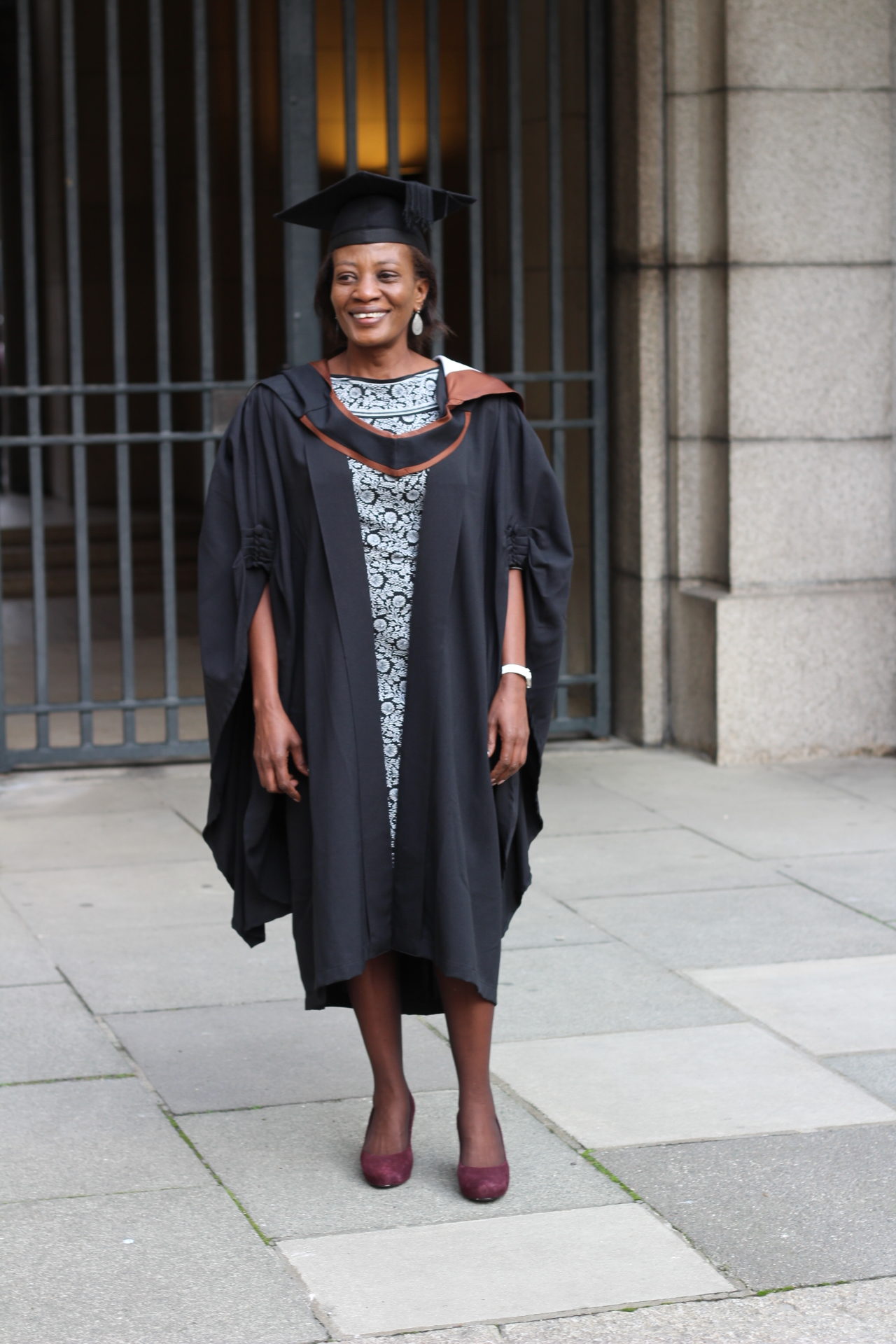
Esther became homeless when family tragedy and funeral expenses meant she couldn’t afford her rent. However, she was determined to graduate from her BA Creative Writing and English programme at Birkbeck, writing assignments on trains, buses and a night shelter. Today she achieves that remarkable feat. 

Growing up in Kenya, Esther Wangui’s passion for literature was carved through Sunday School, where she studied the Hebrew scriptures, and weekly cinema trips, where she developed an interest in script-writing. When she came to Birkbeck to study Creative Writing and English she became interested in form, critical creative writing, and unpicking literature with her classmates in seminars.

However family tragedy struck when her step-son died by suicide in the first year of her degree. The funeral expenses meant she was unable to pay her rent, and she was evicted by her landlord after falling into a month of arrears.

She says: “Homelessness is not something one can share easily, so I didn’t tell my friends or fellow students. Staff at the shelter were very supportive, cheering me on. And although my class tutor did not know I was homeless, he was always very supportive.

“It was difficult at first. I felt stupid, ashamed, and angry at myself. I was staying at a night shelter in Kingston, so I had no privacy, nowhere to cry, no friends to share the downs with… I just kept moving towards the end of my degree. I come from a small town in Kenya which is home to numerous world-class athletes. I used to compete for my high school so I know to always keep my eye on the finishing line.

“The greatest challenge was being woken up early every morning, having to leave the shelter at 10:00am and returning in the evening, cold and tired. I craved what Virginia Woolf called a ‘room of one’s own’. While I was homeless, I even ‘slept’ at the airport several times, but mainly I read or wrote poetry. I was constantly lacking sleep and at times, fatigue affected my concentration. I thought of doctors and world leaders dealing with huge problems and was inspired to carry on, but I envied them for having a bed to go back home to. I could not afford to call my family in Kenya to share my problems. I prayed, I learned from others, and I thought about the fact that I had waited all my life to go to university. It was such a privilege to get an education at Birkbeck.

“I wrote most of my assignments on the long train and bus journeys, and on weekends I worked from the Kingston University library, watching the winter turn to spring and then to summer. I envisioned the day I could at last say, ‘I held on, I tried my best. I graduated from university.’”

Now back in secure accommodation and excited for her future, Esther has started a Master’s degree focused on Near & Middle Eastern studies and Hebrew. She hopes to one day learn all four of the main Middle Eastern languages and go on to work in that region.