Category Archives: Humanities and Social Sciences

The Windrush Betrayal

Zeljka Oparnica, PhD student in the Department of History, reports on journalist Amelia Gentleman’s talk about the Windrush Scandal that took place as part of the Department of History, Classics and Archaeology’s Discover the Past lecture series that welcomes Birkbeck students, alumni and guests.

The Empire Windrush in 1947.

The Empire Windrush in 1947.

Amelia Gentleman’s reportages in the past two years covered a series of immigration issues that became known as The Windrush scandal. In this talk, she covered the background of both her reporting and the results it had provoked.

Professor Jan Rueger, Head of the Department of History, Classics and Archaeology Department greeted the audience and introduced the speaker and her book, stressing an important historians’ credo: “People’s voices matter, individual lives matter, and persistent research and adept covering of injustice can make a difference.” Amelia Gentleman began by reflecting on her background in history. That was a great introduction to the talk that followed the storylines of individuals leading to the discovery of a systematic fallacy, showcasing the background of “big history.”

What led to the series of reportages was a single case which came to Gentlemen through an NGO in November 2017. It was a story about a woman who came to the United Kingdom in her early childhood and was detained and about to be deported to Jamaica at the age of 61. For about two years prior to her detention, she had been receiving letters from the Home Office warning her about her illegal status. What at first glance seemed to be an oversight by the Home Office, turned out to be just the first among many isolated cases. The day when the article was printed in the Guardian, Gentleman received a call from the son of a man in a similar situation facing deportation. The individual cases started to line up and it became evident there was more to the series of what seemed like lone, disturbing cases. Her emphatical but sober writing, followed by amazing photo portraits, incited readers’ reactions and brought the well-needed attention.

Amelia Gentleman with her book 'The Windrush Betrayal'

Amelia Gentleman with her book ‘The Windrush Betrayal’.

Beyond talking to a number of affected individuals, Gentleman also referred to immigration lawyers, law centres, and PMs from areas with high immigration rates. As the stories received ever more publicity and caused a public uproar, the Home Office reacted to individual cases, and ministers offered half-hearted apologies. There was a rush to resolve the most prominent cases, and it was difficult for all the people invested in helping to connect the dots.

After months of research, Amelia Gentleman came to a true historical revelation. Behind the dozens of comprehensive individual reportages were around 500,000 cases of undocumented people who were born in the Commonwealth countries and came legally, as imperial citizens, to the United Kingdom in the period between two Immigration Acts, namely 1948 and 1973. The lack of personal documents, such as passports, went hand in hand with what Gentleman called “the general British papers distrust.” Namely, even today 17% of British citizens do not possess passports, and in the previous decades, the number was much higher. It became apparent that the trigger was the so-called Hostile Environment, the Tory anti-immigration policies that came to power in the early 2010s. It became apparent how the citizenship of thousands of people depended on the unjust context of the present.

The stories reached their peak in 2018, overlapping with the seventieth anniversary of the arrival of the ship Empire Windrush at Tilbury Docks in Essex. Since those affected by the new Hostile Environment policies were the descendants of the people who arrived in the same period, and it seemed like an appropriate name for the scandal Gentleman’s reportages.

However, Gentleman still feels bitter-sweet about the outcomes of her work. As a direct result of the stories’ publication, Home Secretary Amber Rudd resigned in April 2018 and a public promise was given to all affected that they could claim compensation from 200 to 572 million pounds. Up until today, over eight thousand people affected by the scandal have been granted citizenship or papers that confirm their full legal status. The number of detainees in deportation camps has also decreased. However, only 32 people have received some compensation, and many of those who have a right to compensation have either died or are very old. The Hostile Environment policies have not been repealed nor debated. With this sobering overview, Amelia Gentleman ended her talk by underlining that the list of tasks is long. For both journalists and historians.

In the well-established Birkbeck tradition, the talk sparked a comprehensive discussion that lasted for another hour.


The Map is not the Territory: Re-imagining Place, Reweaving Story

Natalie Mitchell, a first-year MA Contemporary Literature & Culture student, shares insights from Professor Marina Warner’s lecture that took place as part of the celebration of the 100-year anniversary of Birkbeck joining the University of London.

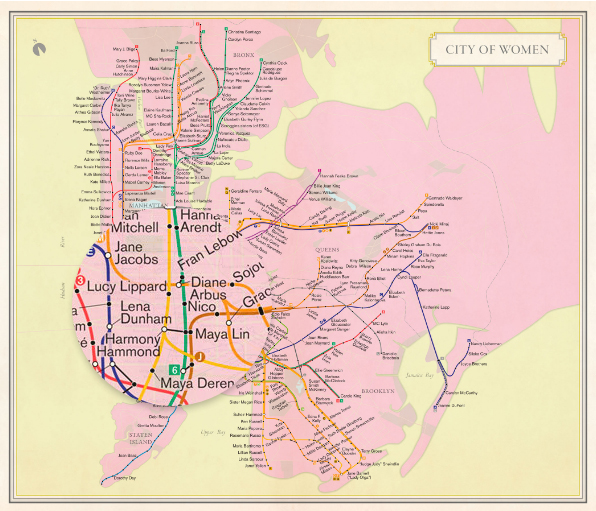
City of women map by Rebecca Solnit and Joshua Jelly-Schapiro

Rebecca Solnit and Joshua Jelly-Schapiro, ‘City of Women 2.0’, 2019. Courtesy: the artists

Professor Dame Marina Warner took her audience on a fascinating journey through the role of mapping in storytelling and memory, in her lecture, which forms part of the 100 Years of the University of London lecture series. Using Alfred Korzybski famous axiom ‘the map is not the territory’, which suggests that a map cannot encompass the true quality of a place, Professor Warner considered the re-imagining of place and how mapping can become a rebellious act.

She began the lecture considering the many roles of cartography in territory making, defining borders, resources, military and governance, and how this informs our memory of place. The map attempts to ‘actualise history’ through naming, marking and dividing, but the construction of history is a type of narrative. A point Professor Warner emphasised through the words history and story, which are the same in many languages. As such, mapping can control the narrative of a place and becomes an important tool for colonisers, although it may bear little resemblance to the reality of a place by its indigenous people.

Adam Dant – Shoreditch as New York – 2018

The activity of creating maps can also realise fiction, such as the detailed fictional maps in the novels Gulliver’s Travels and The Lord of the Rings. Similarly, star maps give mythical gods a presence in reality through the stargazer’s eye and theme parks and Disney castles parody real locations through the child’s imagination. In this way, the fictional locations of stories can become real locations; these narratives ‘folding back’ onto the actual.

Professor Warner went on to suggest that the map can function in time as well as space, making the past present. This was particularly notable in Emma Willard’s mapping of aboriginal tribes in America and her Progress of the Roman Empire, charting time using the course of the Amazon river. These reworkings of maps can also perform a ‘historical resistance’ as seen in Layla Curtis’ NewcastleGateshead collaged map of all the places renamed after those cities, which highlights the colonial activity of claiming places through naming. Such use of cartography revealed the potential rebellious nature the renaming of maps can perform.

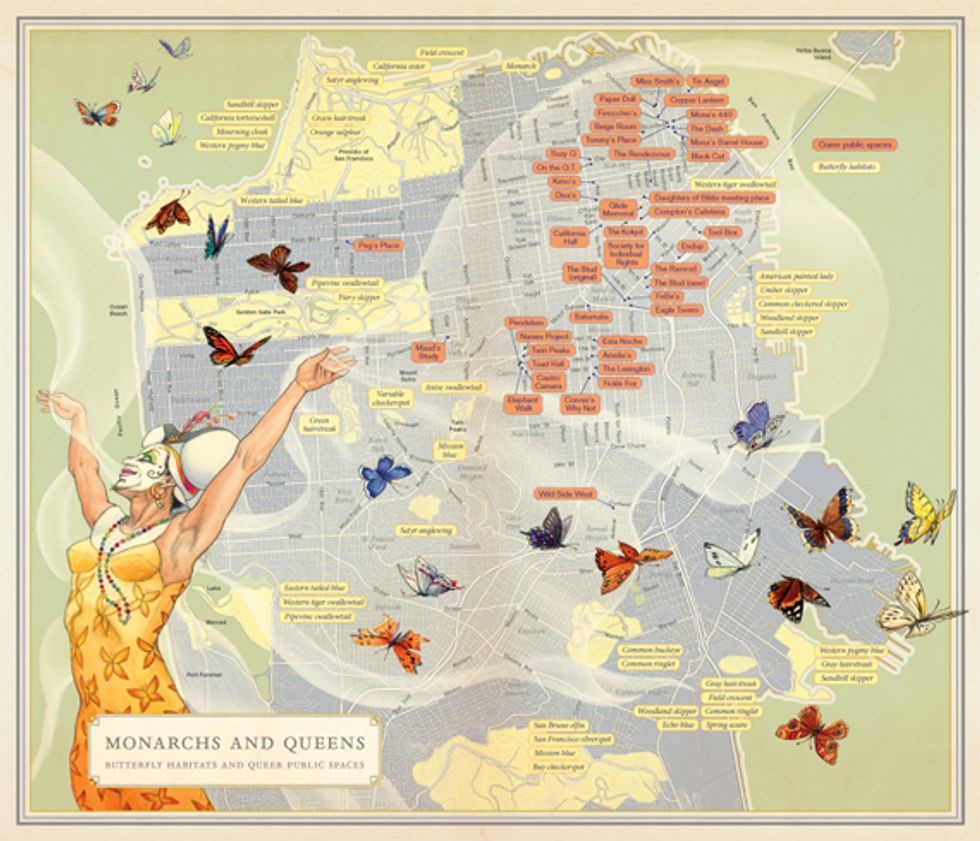
Artist Mona Caron and cartographer Ben Pease - Monarchs and Queens - 2010

Artist Mona Caron and cartographer Ben Pease – Monarchs and Queens – 2010

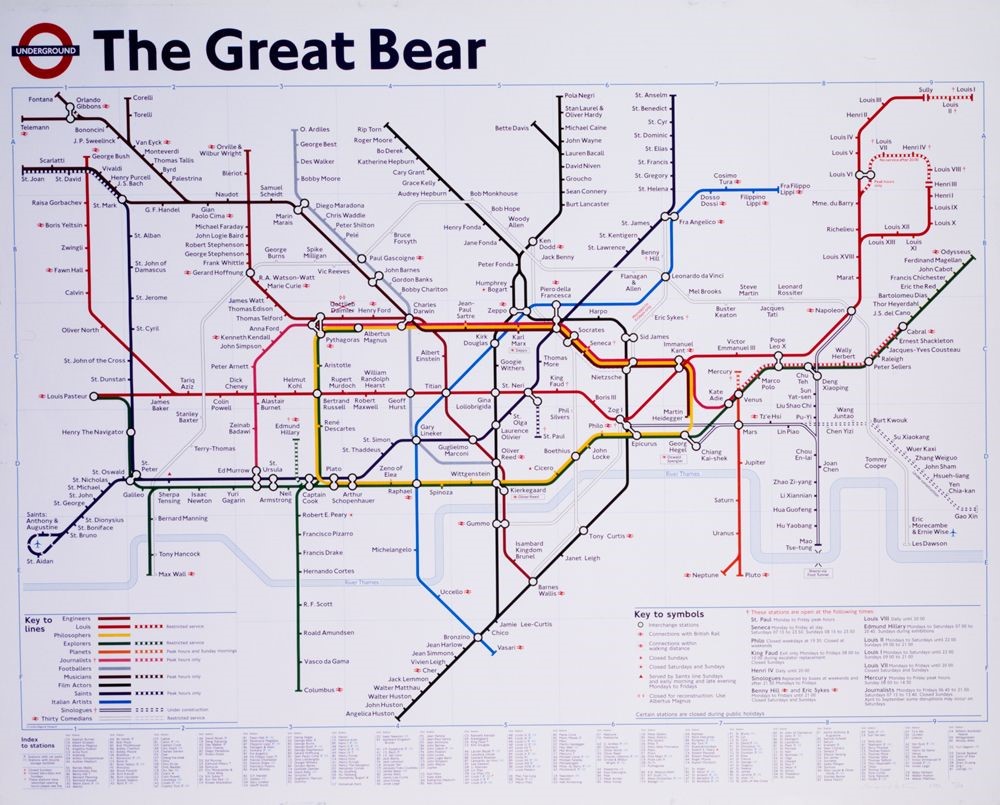
This type of resistance was expanded further by Professor Warner through many recent examples of the renaming and reworking of maps and places. In Paris in 2015, Osez le Feminisme flyered the city’s street signs, renaming them to notable women from history. Artists have also reimagined places via the redrawing of maps, such as Rebecca Solnit’s and Adam Dant’s maps, which create a visual narrative, questioning the authority of the map and returning to a cartography blending art and science. Similarly, Simon Patterson’s iconic reworking of the London tube map in his work The Great Bear renamed the stations after a myriad of famous and forgotten figures from history. Through each of her examples, Professor Warner showed how the reimagining of the map ‘makes the familiar unfamiliar’ and how a sense of place can be reclaimed by those in situ.

Simon Patterson - The Great Bear - 1992

Simon Patterson – The Great Bear – 1992

Professor Warner’s lecture was bookended by her recent work with a collective of young migrants in Palermo, Sicily, through the Stories in Transit workshop project Giocherenda. These workshops involved the young people developing stories of the city using the figure of The Genius of Palermo, a 15th century icon who has become a synonymous symbol of the city. The workshop took place around the city, where the young people placed the historical figure in different locations. Through this, they could develop their own sense of their new home in Palermo, but through the use of the city’s history. She expressed how it was the children who wanted to use mapping in their story creations and in doing so created a sense of belonging in an unfamiliar place.

Professor Warner concluded her lecture by emphasising the importance of continuing to create stories. Storytelling is an action and a way of history-making and in the days of fake news and big data, it is even more paramount.

Further information: 


William Matthews Memorial Lecture: ‘European Journeys, Medieval and Modern’

Dr Marion Turner’s lecture on Chaucer’s writings and journeys reframed the quintessentially English writer as a great European poet and source of inspiration beyond the continent.

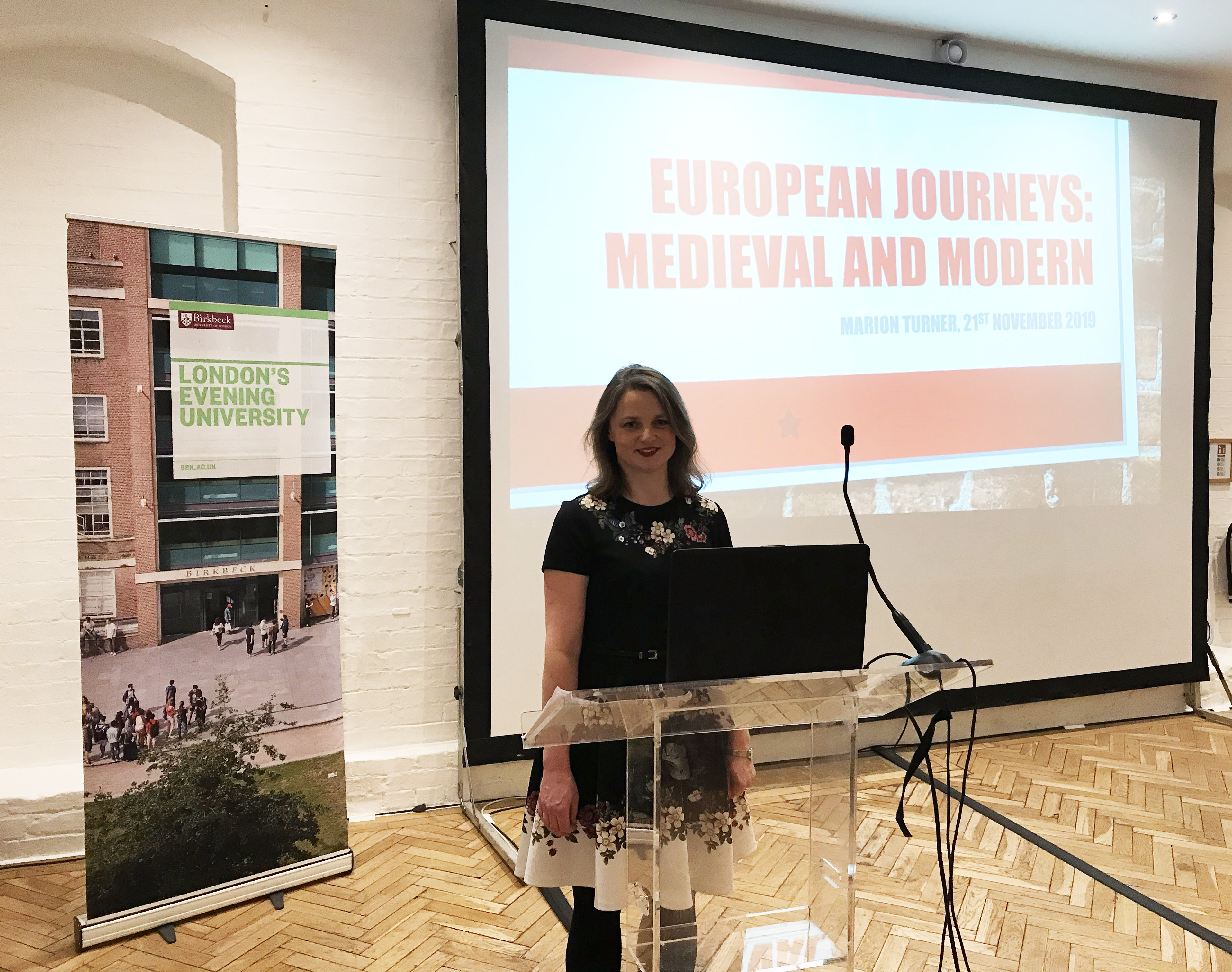
Dr Marion Turner took an audience of Chaucer enthusiasts on a journey through the poet’s works for the 2019 William Matthews Memorial Lecture. Following on from her own travels around Europe, where she contrasted the medieval with the contemporary, she demonstrated how Chaucer weaved his journeys through Europe into his works of poetry. Geoffrey Chaucer was an English poet and author, whose most famous works include The Canterbury Tales. He is often thought of as ‘the Father of English Literature.’

During her research, Dr Turner endeavoured to go on a physical journey through contemporary Europe in order to retrace Chaucer’s journey through Medieval Europe, to understand his interests, works and what gives the writer appeal beyond the borders of England.

Early on in the lecture, Dr Turner shared the impetus of her travels; being approached to write a biography of Chaucer’s life. She lamented that, upon sitting down to write the book, the plan she sketched was not very different from any other biography written about Chaucer. Frustrated, she set out on a walk to help her find ways of approaching the structure of the book, when she came to her ‘road to Damascus moment’; the idea to approach Chaucer’s work through his travels through Europe in the fourteenth century as a way of understanding the writer in the reader’s imagination.

Dr Turner reflected on numerous characterisations of Chaucer as an English poet firmly rooted in the English imagination and identity. She used the example of UKIP aligning Chaucer’s Wife of Bath’s Alisoun with the party during the 2013 election, thus painting her as an English archetype. But this trope is challenged by the numerous writers of colour, particularly women, who have taken Chaucer’s work and adapted it to create stories in their own contexts.

What’s more, through her travels she found that Chaucer’s stories came from distant places made up of diverse demographics. Particularly Navarre, located in the northern region of Spain, where Chaucer visited and saw members of the three main religions living harmoniously. She highlights that in the medieval period the most educated of the population were multilingual and that Chaucer himself would have been influenced by French, Italian and Latin poetry, which he enjoyed.

Chaucer’s travels through Europe also highlighted to Dr Turner the importance he places on perspective in his work, and it is this transition of perspective that characterises much of his poetry. She gives the example of the prominence of birds and someone who can only see from the ground as a way of demonstrating these different perspectives, which will inform an individual’s thinking on any given situation.

The lecture concluded with a reflection on Chaucer’s views of time and crossings, the place of crossing being “a place of magic, darkness and possibility” – an ongoing action in which the past infiltrates the present, much like the persistent influence of Chaucer’s works on writers across place and space within the literary canon.

The William Mathews memorial lecture is an annual lecture on either the English language or medieval English literature.

Further Information:

“My disability does not have to halt my career options in the way I thought they would”

After an accident left Esther Adegoke with a disability she sought to complete her studies in Politics at Birkbeck. Last week, she graduated with a First.

Esther doesn’t recall exactly what sparked her interests in studying politics. Just that her sisters who had studied politics at AS level would come home and discuss topics from their classes, topics that piqued her interest more than any of the GSCE subjects she was studying at the time.

After completing her A levels she opted for a degree in Politics at the University of Leicester. In the beginning of her third year she was involved in an accident that left her using a wheelchair and in need of a full-time care team, meaning she could no longer study in Leicester.  Determined to continue her degree, Esther looked for options in her home city of London where she came across Birkbeck, “what gave Birkbeck the winning edge for me was the evening classes, it was more practical having lectures at 6pm because it fit my routine as opposed to morning lectures and seminars.”

At Birkbeck, Esther found new topics that sparked her interests in Politics further and in different ways. “My favourite course, funnily enough wasn’t a module taken under the politics department but actually the psychosocial department called, ‘racism and antisemitism’. I found it interesting because it did something unique in that it challenged us to investigate the commonalities and differences between anti-black racism and antisemitism. Of course, I had seen instances of the two racisms being studied separately, but never together.”

Fortunately, Esther had the support of her family and friends who were pivotal in helping her complete her work.  “My mum accompanied me to every lecture and seminar I attended and my sisters often read my essays.” The College’s Disability team were also instrumental in allowing her to complete her course. She recalled: “My disability officer Mark Pimm and scribe Yvonne Plotwright were a massive support to me. Mark went above and beyond to ensure that my points were taken seriously and Yvonne was extremely thorough in her note-taking, ensuring I didn’t miss any vital information from my lectures and seminars.”

The accident left her unable to speak for long periods of time before her voice became exhausted so she used EyeGaze to help her craft her essays. EyeGaze is software that enables the individual’s eye to control the mouse and keyboard of a computer. She explained: “I took to it rather quickly, I used to use it recreationally and even then I was told the hours I would spend on it were unheard of. Without Eye Gaze I wouldn’t have been able to complete my degree. “

Now Esther has graduated with a First Class degree, recognition for all of her determination and resilience. She says of her achievement, “It felt amazing, I was over the moon with my result and without sounding arrogant it was even more rewarding because I knew I deserved it. I worked so hard for it so it was special to know my hard work had actually paid off.”

Unsure of what she will do next, Esther still feels positive about her future. “My experience at Birkbeck with the assistance of Eye Gaze has really given me the confidence to say that my disability does not have to halt my career options in a way I previously thought they would. I have often said that I have no plans to return to study after my undergraduate degree but never say never; at least I know it’s a case of if I want to go back as opposed to I can’t.”

Dr Ben Worthy, Senior Lecturer in the Department of Politics said: “Here at the Department of Politics, we are all so proud of what Esther has achieved and honoured to have been able to help her in her studies. She’s not only been a model student but an inspiration to us all. We also want to say a big thank you to everyone around her, especially the disabilities office and her family and friends who supported her along the way.”

Further information