Tag Archives: research

Hopscotch in the Archives: Reflections from the Ben Uri Researcher in Residence

This post was contributed by Dr Lily Ford, of Birkbeck University of London and researcher in residence at the Ben Uri Gallery. This article was originally posted on the Creativeworks London blog

Dr Lily Ford

Dr Lily Ford

In the summer of 1915, a group of Eastern European Londoners gathered around a charismatic newly arrived émigré and pledged their commitment to nurturing and disseminating Jewish art.

By the end of a July night at a Whitechapel restaurant, they had officially formed the ‘Jewish/Yiddish National Decorative Art Association Ben Ouri’. The Ben Uri has lasted a century, weathering changes of location, of emphasis, of context and indeed of name, yet always held together and steered by the passion and dedication of a small group of enthusiasts.

When it comes to finding out more about the society’s early years – my job as Researcher in Residence – the drawbacks of this endeavour are evident. Who archives a labour of love? All those involved in setting up the Ben Uri were already keeping their own small businesses going, and the society’s meetings were scheduled around busy lives, on Saturdays and Sundays, often at 9pm.

The minutes of these meetings were recorded at times conscientiously, and at times sporadically, with gaps going from a few months to a few years in duration. They were written in haste, and, between 1916 and 1924, in Yiddish. The society’s paperwork from this period – letters on headed paper, pamphlets and programmes, even major endeavours such as the inaugural Ben Uri album – survives in a haphazard manner. It is impossible to trace all the society’s activities in this period; instead, I play a game of hopscotch, leaping over the gaps to land on the primary and secondary evidence that is available, and inferring links and connections.

Judah Beach

The First World War cannot be blamed for this patchy record-keeping, though of course Ben Uri’s first three years of existence took place in a London deeply affected by events on the continent: not just the conflict with Germany, but the Russian Revolution and its implications for British attitudes towards the large minority of Eastern European Jews mostly resident in the capital.

It was I think, far more that Ben Uri committee members were always too tied up in the here and now – how to expand the art collection, who to appeal to for funds, where to find an institutional home – to bother with archival protocols. The one exception to this, and the reason that any work at all can be done on the society’s early years, is the Polish-born tailor and founder committee member Judah Beach.

It was Beach who penned the minutes that have, somewhat miraculously, come back to the Ben Uri after spending decades at YIVO in New York, where they were sent in the 1970s. Beach, too, was the only member in this period to collect cuttings about the society from London’s Yiddish press, which he pasted into an album, alongside scraps of correspondence and fragments of speeches. And it was Beach who offered the society’s growing collection of artworks a home, at his own residence in West Hampstead, during the many years between 1916 and 1929 when the Ben Uri had no base of its own.

Increasing access to the society’s history

Luckily for us, Beach had his counterparts as time went on, and the Ben Uri’s archive for the fascinating period of the 1930s, and for the second half of the twentieth century, is more complete. There is significant scholarship in existence already on these later periods, much of it the work of curator Rachel Dickson and head of collections Sarah MacDougall. The writer and historian David Mazower conducted his own investigations into the mysterious founder of the society, Lazar Berson, which took him across Europe to find the only known example of the Ben Uri’s first publication from 1916.

But recent developments have enabled increased access to the society’s history: over the last eighteen months the archive has been closely scrutinised and catalogued by a dedicated archivist, Claire Jackson, and the Yiddish material has been translated by a team of postdoctoral experts under Dr Helen Beer at UCL. This has provided a rich set of resources from which to reconstruct some of the stories and circumstances around the activities of these art-loving Londoners one hundred years ago.

The challenges

This is not to say that researching the Ben Uri is without its frustrations. From a documentary perspective, the founding members are difficult to profile. While some, notably the jeweller and Yiddish writer Moysheh Oved, published several books including an autobiography, in English, most of the active figures were less prolific, and less confessional.

Beach’s only published output, apart from contributions to Ben Uri catalogues, is a collection of Yiddish short stories (which had previously appeared in Yiddish literary journals), not available in English. Some of the names which appear most often in the minutes as keen contributors to the society’s activities between 1916 and 1926 – Miss Margolis, Madame Dr Zarchi, Mr Chechanover, Mr Lush – are absent from any other records I have been able to consult.

The challenges of transliteration from Yiddish add a layer of confusion: not only is the English spelling of a name decided by the translator or record keeper, and may vary each time it appears, but furthermore, Ben Uri members signed off with different versions of their names depending on the context. Judah Beach was the anglicised form of Yehudah Pshibish, which Beach sometimes used, but a third version of his name, Bietsch, is used in relation to his Yiddish literary work. Moysheh Oyved or Oved was a penname adopted in 1917 by Edward Good, who regretted having anglicised his name from Edouard Goodak when he set up his first business in London, but both Good and Oved are used interchangeably in Ben Uri’s minutes. Indeed one programme from 1922 lists him twice, as Edward Good, Ben Uri treasurer, and as Moysheh Oyved, poet.

Ben Uri’s brand of ‘national’ Jewish art

In a way, Good/Oved’s inhabiting of both roles tells us much about the complexion of the Ben Uri at this time, as an outlet for an immigrant community necessarily focused on establishing a secure living and a social and economic place in London. It was an outlet that permitted the expression of a deeply felt cultural and spiritual identity, one different to that of the more assimilated and non-Yiddish speaking Anglo-Jewish community of Central, North and West London.

Ben Uri’s brand of ‘national’ Jewish art was not straightforwardly Zionist, though the society maintained a relationship with the Bezalel School of Art in Jerusalem, and considered at one low point in the 1920s sending the collection there for good. It was by nature not religious, and always in contention with the orthodox Jewish veto on figurative art. It was, rather, concerned with expressing, as Lisa Tickner has noted, ‘a secular Yiddish culture under diasporic conditions’[1].

It is this remit, of furnishing a diasporic community with the cultural resources necessary to formulate and reflect upon identity, that makes the Ben Uri such a relevant organisation today. The present situation, in which the Ben Uri celebrates its centenary with a six-month residency in Somerset House, was certainly beyond the expectations of the founding committee, though not beyond its ambitions.

I hope that my own research, to be presented in July, will help reveal some of the fascinating conditions under which this story began one hundred years ago.

Out of Chaos: Ben Uri: 100 Years in London, runs from 2 July – 13 December 2015 at Somerset House.


Dr Lily ford did her PhD, ‘Airminded: the cultural impact of flight and aerial photography in 1920s Britain’, in Birkbeck’s Department of History of Art, finishing in March 2015. As a Birkbeck postgrad student she was eligible to apply for a Researcher-in-Residence grant in December 2014.

This allows an early career researcher from any of Creativeworks London’s partner universities to team up with a cultural institution/SME and spend up to six months carrying out a research project together.

The Ben Uri gallery was seeking a researcher to look into some newly translated archival material and find out more about their foundation 100 years ago in Whitechapel, and since the period mapped well with that of Dr Ford’s PhD research it was an ideal opportunity to explore a totally different aspect of early twentieth century cultural life.

She has been working with the gallery’s archive part time since February and will finish in July, when she will deliver a paper with her findings in their exhibition space and, with them, look into publication possibilities for a long article. 

Creativeworks London brings new collaborative research opportunities to London’s creative businesses. Comprising thirty-eight London-based universities, colleges, museums, libraries and archives, together, the members have unrivalled skills and expertise that can be of benefit to businesses who are interested in exploring areas such as entrepreneurial development, emerging markets, new ways of engaging London’s diverse audiences, and the development of digital resources and media content.

Find out more:

[1] Lisa Tickner. Modern Life and Modern Subjects: British Art in the Early Twentieth Century. New Haven and London: Yale University Press (2000) p. 165.

The importance of Web Science

Richard has a BSc in Physics from University of Leicester and an
MSc in 
Advanced Richard Brownlow copyInformation Systems from Birkbeck. He has over 20 years’ experience in industry as a Software Engineer and Software Project Manager and is currently studying for a PhD at the London Knowledge Lab where he is a member of the Weaving Communities of Practice Project. His research is in the design of tools to help domain experts integrate heterogeneous data sets.This post was contributed by PhD student Richard Brownlow. 


Annually at Birkbeck, the Department of Computer Science and Information Systems celebrates the work of its founder, the late Dr Andrew Booth, who was a pioneer in computer hardware and machine translation. Hosting this year’s Andrew Booth Memorial Lecture was the London Knowledge Lab, a unique interdisciplinary collaboration between two of the UK’s most prominent centres of research – Birkbeck and the UCL Institute of Education.

This year, we were honoured to have Professor Dame Wendy Hall present. She has played a foundational role in the development of the Web, the Semantic Web and Web Science, with her current research focussed in applications of the Semantic Web and in exploring the interface between the life and physical sciences. Along with being the first person outside of North America to be elected to the post of President of the Association for Computing Machinery (ACM), she has also been hugely influential and inspirational in promoting women’s careers in computer science.

Along with Professor Hall’s lecture, a broad range of London Knowledge Lab research was on show in the Department, for staff, students, alumni and guests from other institutions and across the industry. Opportunities for future collaborations and research were discussed. Some of the research demos included projects relating to Learning Technologies, such as LIBE which supports literacies through lifelong learning with inquiry based education. Other research demos were in the areas of ontology querying and mobile location analytics. I was also given the opportunity to demonstrate some of my own research interests including the knowledge base developed for the Weaving Communities of Practice project.

The importance of Web Science

The magnificent Keynes Library in Gordon Square was the setting as Professor Hall kindly delivered her lecture, captivating the audience with her insight on what the discipline of Web Science means in the context of the history of the World-Wide-Web. This was especially interesting given the foundational role she played in the development of the Web, including her collaborations with other giants of the sector such as Sir Tim Berners-Lee.

internet

Discussing the role of the Web in knowledge creation and sharing and the need to understand it in terms of both its technical and its social aspects, she also spoke on how this multidisciplinary field has come to be known as Web Science and the establishment of the Web Science Trust (WST) in 2006. She went on to describe how Web Science encompasses the theory and practice of Social Machines and how such machines are quite different from Turing Machines, which lie at the heart of every computer.

Professor Hall described the establishment of the Web Science Trust Network of Laboratories (WSTNet), an initiative furthering academic excellence in the field. There are currently fifteen such labs, including two in the UK. She then went on to describe a new exciting initiative called the Web Observatory, through which global partnerships are established to share data sets (both open and closed) along with associated Metadata and Analytics tools. Through these initiatives, Professor Hall described how Web Science aims to understand the origins, current state and possible futures of the Web, and to further the development of new research methodologies.

It is just over 10 years since Professor Hall delivered one of the inaugural talks at the London Knowledge Lab. In her vote of thanks, Professor Alex Poulovassilis – one of the two Co-Directors of the London Knowledge Lab – drew links to that inaugural lecture, firstly in the role of the Web in knowledge acquisition, sharing and dissemination, and secondly in the need to keep historical “memories” of the Web in order to enable the longitudinal analyses required for understanding its evolution and future.

Continue reading

MA Renaissance and MA Medieval Studies Students Visit the British Library

This post was contributed by Nuria Gisbert, a student on Birkbeck’s MA Renaissance Studies

BL_BOOKSBirkbeck’s MA Renaissance and MA Medieval Studies students visited the British Library to familiarise themselves with the institution and its various collections. Prior to the visit, all students had to obtain a reader’s pass.

At one of the library’s seminar rooms, we were made very welcome by two members of the Rare Books and Music Reference Team, Christian Algar and Qona Bright. The Rare Books collection contains pre-1851 items, and is rich in incunabula and post-incunabula. The British Library holds over 12,500 incunabula, one of the largest collections in the world.

The Rare Books and Music Reference Team is composed of six members in total, and offers help and advice to students and scholars with their research, and with using the library’s extensive collections. The team can help with obtaining access to restricted items, offers specific pre-arranged research advice, and much more. The British Library’s Humanities section is particularly large, so navigating it properly can be difficult without some prior catalogue research knowledge.

Once we were all sitting comfortably within the seminar room, Mr Algar gave us an introduction to the institution’s history, and an explanation on how to use its many catalogues and research resources (both print and electronic). The British Library holds several reading rooms, where books may be pre-ordered online and then collected for perusal.

He had also organised an amazing display of unique manuscript and print books relevant to our fields of study. The titles displayed were impressively unusual in many respects, and offered fantastic insight into the period running from the late Middle Ages to Early Modern Europe.

The display included 15th– to 17th-century texts, portraying the shift or transition from manuscripts to printed books. It had additionally been chosen around a specific and very interesting theme: the consequences of power on languages and texts. Students were able to look at and handle most of the titles, which was a fabulous experience, especially with the oldest manuscripts.

To illustrate the effects of power on language development, Mr Algar gave us a short history talk on Cornish texts, and how the language did not make it from a hearing to a reading public, gradually disappearing due to the Tudor regime’s official standardisation and imposition of the English language throughout the country. Some of the books on display were either written in Cornish (including translated sermons), or were Cornish stories and legends that had been translated into English.

We were also able to look at different editions and versions of the Decameron, both in manuscript and printed format. A particularly interesting printed copy in Latin included hand-written margin annotations (presumably made by its owner). These lengthy notes corrected and explained passages that had been amended by the Catholic Church in the printed version. Any passages referring to the clergy or the Church had been removed from the printed version, as these were considered harmful to the dignity of that institution.

Regarding the British Library’s manuscript collection, 80% of these items are readily available for research, whilst others require special access and a letter from an institution. A small number of manuscripts are rated as highly restricted, mostly illustrated medieval volumes, and are best perused using the Library’s online digital version. These restricted items include 15th-century British books, which need special care and conservation for obvious heritage conservation reasons.

The visit, including the lecture and book display, were an absolute success with Birkbeck’s MA students. It will be extremely useful for our studies and future research to be able to access the British Library’s unparalleled collection of books and journals. Special thanks are also due to Mr Algar for preparing such a practical introduction to researching the collection, and for his illuminating talk on the effects and consequences of State and/or Church power and control on languages and the written text.

Invisible Circus: A visit from Jennifer Egan

This post was contributed by Amy Clarke, a student on the MA Contemporary Literature & Culture at Birkbeck. This post was originally published by Birkbeck’s Centre for Contemporary Literature.

At any symposium dedicated to a particular writer, as Dr Stephen J. Burn noted in his keynote here, one of the first questions that will arise is whether or not their work is worthy of such immersive attention. In Jennifer Egan’s case, it quickly became apparent not only that her work would stand the test of such detailed scrutiny and deliver rich discussion, but that despite having somewhere between ten and twelve hours to talk about it, we were in danger of running out of time. Which is satisfyingly ironic, really, given that Egan’s most famous novel, the 2011 Pulitzer Prize winning A Visit from the Goon Squad, is ‘explicitly about time’, as she puts it, having taken its inspiration from Proust’s In Search of Lost Time.

Accordingly, the majority of papers presented throughout the day, irrespective of which of Egan’s novels they focused on, tended to discuss time-related themes in all their complexities: ageing, reliving events, ghosts, music, nostalgia. A recurring issue for many of them was the difficulty of getting a grip on the present, whether that be the contemporary moment or a present belonging to the past, like the 1960s of Egan’s first novel, Invisible Circus (1995). Tellingly, when asked how she felt about the possibility of writing a 9/11 novel, Egan commented ‘I’m not there yet’, the main difficulty being that ‘we’re still trying to figure out what it meant’. This issue of defining the present, which features so prevalently as a theme in her work, is evidently very real for her.

Ruth Charnock gave a very inspiring paper on the idea of ‘reliving the event’ in relation to Invisible Circus, asking what it means to have been there in relation to a past event and how we negotiate what ‘there’ means in terms of time and place, nicely bringing together the two elements that Egan defines as her starting points when writing. Charnock also discussed the seemingly paradoxical notion of being nostalgic for an event that one never experienced first time around, and how this is perhaps caused by the mythologisation of certain periods of history, notably via technological media. This idea, also discussed in Mark West’s paper, struck me as having something in common with the concerns of David Foster Wallace’s essay ‘E Unibus Pluram: Television and US Fiction’ (1993). ‘[The] banal, the naive, the sentimental and simplistic and conservative,’ qualities emulated by sixties television (which subsequently inspire nostalgia), were manufactured, Wallace claims, to underplay the realities of corporatism, bureaucracy and racial tension in that era.

Certainly the subject of television in relation to Egan’s work extends beyond this comparison. A Visit from the Goon Squad, in particular, raises the question of how the media of TV and film have impacted on the contemporary novel. This idea was first introduced at the symposium with the Friday night screening of Episode Five from the first season of HBO’s long running series The Sopranos, another inspiration for Goon Squad. The connection between the two is not immediately obvious; but rather than subject matter, the common ground they share concerns their form and ambition. Egan noted how the episodic structure of television dramas likeThe Sopranos is not dissimilar from that of serialised 19th Century fiction and was, in fact, most likely influenced by that form. Egan is interested in how such an episodic structure allows for a multiplicity of sub-plots and creates a feeling of mystery for the viewer, who cannot trace the narrative arc until the story is completed.

Discussing the ambition of The Sopranos, Egan mentioned how she borrowed from the series its idea of pushing character and narrative to extremes. In the episode screened, Tony Soprano is visiting colleges in rural Maine with his teenage daughter when he spots a man who snitched on the mob years back; he duly tracks him down and brutally strangles him. The juxtaposition of family-based innocence against mob violence – and the fact that, despite Tony’s actions, the viewer still empathises with him by the end of the episode – demonstrate for Egan a skill in composition and execution to which she aspires. Egan herself experimented with this simultaneity of humour and darkness most evidently in her 2006 novel, The Keep.

JE-18

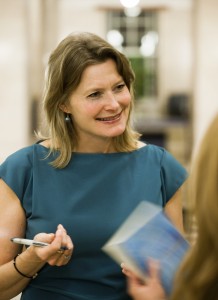
Jennifer Egan at Senate House, London, photographed by Simon Annand.

In a sense, then, Egan is reclaiming for contemporary fiction an episodic narrative form that originally started in Victorian fiction but was, along the way, filched by television. Indeed Egan appears to enjoy the dialogue between literary and screen arts in all its reciprocations, asserting at one point that ‘the advent of film led to Modernism’. However, rather than simply adopting a televisual form for Goon Squad, Egan moulds it so that her work achieves something unique to fiction, less visual, that cannot be directly re-created on film: each of the novel’s chapters has a different voice, ‘tone, mood, world’, from the others. Although she abandoned the idea of writing a chapter in the style of Byron’s epic poetry (for the simple reason that she discovered she was, to her mind, ‘a horrible poet’), Egan borrows from a wide range of literary forms, drawing on the likes of footnoting, power point and speculative fiction throughout the novel.

The issue of whether or not Goon Squad is in fact a novel was only marginally addressed throughout the conference. Valerie O’Riordanpersuasively suggested that the work could be more accurately described as a short story cycle: a view that seems corroborated by Egan’s explanation that she more or less began the work by accident, writing three separate short stories (which later formed three of the chapters) as ‘procrastination before beginning her next novel’. Charting diagrammatically Egan’s disruption of a linear chronology throughout Goon Squad, Riordan discussed how analepsis and prolepsis are also used to great effect in order to problematise further the idea of time. Riordan also considered how past memories can impact on the present, disabling a person’s ability to move forwards towards the future, as in the case of Bennie in Chapter Two.

Rachael McLennan drew on similar ideas of chronology but in relation to identity and ageing, focusing exclusively on the ‘Safari’ chapter of Goon Squad. She legitimised the novel’s fragmented chronology with the assertion that ‘we don’t move through time in a linear way’ and asked the question of how we locate the core self. Is the core self an earlier self or is it always the present self? McLennan also introduced the idea of belatedness, of being out of time in the present, a concept that was echoed a number of times throughout the day and one which seems appropriate when considering the paradox at the heart of Goon Squad: that a novel so beautifully epitomising contemporary America should owe so much to a form typically located in the early 20th century.

Contrary to this complexity and richness, anyone unfamiliar with Egan’s work and reduced to the age old cliché of having to judge a book by its cover alone could be forgiven for thinking, at first glance, that Egan might be a writer of ‘chick lit’. The current UK covers of The Invisible Circus and 2001’s Look at Me, in particular, carry plaudits from ElleCosmopolitan andO, The Oprah Magazine. I say ‘at first glance’ as they are amongst accolades from SalonThe New Yorker and the Guardian, and once you’ve reached the Ulysses epigraph of Look at Me you know that, at the very least, you’re in ‘thinking-chick lit’ territory. Perhaps what this ultimately indicates is that Egan is managing to strike that elusive balance of simultaneity: writing challenging and experimental literature whilst aiming to reach the wider readership most commonly achieved by ‘popular fiction’. If successful, in a century’s time, Egan may be sat alongside Proust in the canon. But only time will tell; and anyway, ‘Time’s a goon, right?’