Tag Archives: business

Pioneer students talk lean business with successful bootstrapped entrepreneurs

Birkbeck’s aspiring entrepreneurs attended the third event in this year’s Pioneer programme, to learn how to grow a business with minimal resources from those who’ve done it.

On Saturday 12 January, Birkbeck’s Pioneer programme continued with over 120 students attending a morning of interactive talks from two successful entrepreneurs on lean business. Having gained tips and advice around innovation and ideation in session one, followed by different types of entrepreneurship in session two, students started to get actions in place to move their business ideas forward.

First up, Carlos Saba, Co-Founder of The Happy Start-up School took students on a journey to finding purpose in their business ideas, after a quick meditation session to get us all focused. Mindfulness and happiness are two areas that weaved their way throughout Carlos’ talk and it was clear that students related to this approach when thinking of their business ventures ahead of them.

Students were set a challenge to think about their ‘Happy Value Statement’, a tool included in the organisation’s Stop Dreaming Start Doing e-course, which is about “communicating what you do in the terms of solving people’s problems or making their lives better.” Carlos reiterated the importance of being more customer focused to help students get a clearer idea of the real value they are offering.

Part two of the session welcomed Julie Creffield, Founder of global fitness movement Too Fat to Run and award-winning blogger, author and life coach, to share her start-up story in successfully bootstrapping her business. Julie’s session provided a great follow on from Carlos, giving students practical examples and advice on getting their business started and beyond with minimal resources.

The big message of the day was to Think Bigger; aiming higher than you initially thought of and setting the bar beyond what you think is possible. Julie works with organisations globally to think bigger, behave better and make more of an impact and this message spurred students to take action after the workshop, ready to push forward with their ventures.

The Pioneer programme, in partnership with Santander Universities, takes students on a journey to develop their business ideas and their entrepreneurial skills. The monthly workshops continue in February with a hands-on pitching workshop.

Pioneer Programme supporting entrepreneurial students at Birkbeck kicks off with a bang

Students on the Pioneer programme began the journey to develop their entrepreneurial skills with an inspiring session on Innovation and left feeling energised and motivated for the year ahead.

On Saturday 17 November, nearly 200 Birkbeck students started their journey on the Pioneer programme, a 7-part course that develops their entrepreneurial skills and knowledge and culminates with a Pitch and Celebration Evening in June 2019.

The programme, in partnership with Santander Universities, began with an inspiring and energetic session on Innovation from serial innovator and entrepreneur Julie Holmes, who motivated the students to pursue their ideas and turn them into reality. In between science-experiment style fireworks and top tips for starting a business, Julie kicked off the Pioneer programme with a bang and prepared the audience for a brilliant programme ahead.

Students also heard from Ambi Mistry at Creative Entrepreneurs, a movement that brings together the resources, roles models and networks creative people need to turn their ideas into successful businesses. Ambi delivered an invaluable networking session to encourage students to collaborate and think outside the box when it comes to making connections for their business ideas.

Jenna Davies, Programme Manager for Pioneer said, “Pioneer offers a fantastic platform for students who have a business idea or who are keen to develop entrepreneurial skills. Julie and Ambi have started this year’s programme in incredible fashion; the students were genuinely buzzing when they left the building.”

Baldeep Hothi, Programme Coordinator added, “The students will benefit immensely from Pioneer and it’s clear that they have already gained so much from this first session. Santander’s support has made this happen and we can’t wait to continue the journey in the coming months.”

Pioneer continues in December followed by a monthly workshop on a range of topics including Lean Business, Start-up Marketing, Funding, Pitching and more.

Further information:

Driving innovation in the UK through collaboration and the Industrial Strategy

Yossie Olaleye from the School of Business, Economics and Informatics reports on a recent conference at the Birkbeck Centre for Innovation Management Research (CIMR) on the UK’s Industrial Strategy.

Innovation and technological advancement lie at the heart of industrialisation. In November 2017, the Department for Business, Energy & Industrial Strategy (BEIS) published the UK government’s Industrial Strategy White Paper, which presents a ‘modern’ long-term plan to boost productivity across the country through innovation, infrastructure development, and collaboration. The Industrial Strategy focuses on the 5 foundations of productivity – ideas, people, infrastructure, business environment, and places – and the government hopes to encourage collaboration with industry, academia, and civil society to create an economy that works for everyone.

Various questions emerged from the debate around the white paper, including how the government will support science and innovation research, and how to drive growth and local inclusion across the country. These questions formed the basis of the all-day workshop on Innovation and the UK’s Industrial Strategy hosted by Birkbeck’s Centre for Innovation Management Research (CIMR) on 23 March 2018. The event brought together a group of policymakers, including Paul Drabwell, Deputy Director of Science Research & Innovation and Dr Rosa Fernandez, Economic Adviser on Local Business Growth at BEIS, industry experts such as Professor Birgitte Andersen, CEO of Big Innovation Centre, and renowned UK academics who travelled from Kent, Oxford and Sheffield to share their latest research and comparative perspectives on the Industrial Strategy.

The objective of the workshop was to explore the trends that led to the formulation of the Industrial Strategy, and the possible outcomes of implementing the Grand Challenges outlined in the white paper, focusing on innovation, collaboration, and local partnerships. While the workshop dealt with several topics, including the impact of Brexit on achieving the strategy’s outcomes, presented by Birkbeck’s Professor Klaus Nielsen, two key themes stood out: local, regional and national engagement to deliver on economic opportunities, and driving innovation through digital skills development.

Paul Drabwell opened the workshop by emphasising the government’s commitment to increase R&D spending to 2.4% of GDP by 2027. He said that the UK “has world-leading science research, excellent universities, and innovative companies,” and it is these strengths that will drive the implementation of the strategy. Increased R&D funding will enable UK universities to continue to excel in international league tables, collaborate more with industry partners, and encourage innovation across the country, a theme which runs throughout the Industrial Strategy. Despite the UK’s strengths, Paul Drabwell noted that there are issues around local engagement in the country, which means that there is a crucial need to drive productivity and maintain a high level of employment. This is a challenge the government hopes to resolve through the £1.7 billion Transforming Cities Fund to improve intra-city transport links and promote local growth within city regions. Dr Rosa Fernandez expanded on this point with a presentation on the role of place in the Industrial Strategy, highlighting that the UK government intends to build on local strengths to tackle the issue of poor distribution of economic activity across the country.

A key question at the workshop was the role of research and the UK’s academic institutions in delivering the possible outcomes of the Industrial Strategy. We heard from Dr Keith Smith at Imperial College London who discussed the need for multinational collaboration to deal with innovation challenges across different industries, and Birkbeck’s Professor Helen Lawton Smith who presented research on the importance of local enterprise partnerships (LEPs) in addressing the challenge of regional inequality in the country. Professor Jeremy Howells from the University of Kent and Professor Tim Vorley from the University of Sheffield focused their presentations on the potential for business schools to convene and work with other social science schools to create solutions for the challenges of productivity and job creation discussed in the white paper.

The takeaway from this workshop was that collaboration – from government, industry, universities, and local communities – is essential if we are to achieve the ambitious objectives of the Industrial Strategy, as well as greater investment in research and innovation to support skills development.

One notable example of such collaboration is the Institute of Coding (IoC), which was announced by Prime Minister Theresa May at the World Economic Forum 2018. Birkbeck is a partner in a consortium of over 60 universities, businesses such as IBM and Microsoft, and professional bodies, to tackle the digital skills gap in the UK through the IoC. By bringing together such diverse perspectives, the CIMR workshop stimulated debate and provided useful suggestions for how academics can work effectively with business leaders and the government to drive innovation in the UK through research collaboration and meaningful partnerships.

Many thanks to all who participated and attended the workshop.

Organisers: Professor Helen Lawton Smith, Professor Klaus Nielsen, Professor Jeremy Howells, and Dr Rupert Waters.

Further speakers:

  • Professor Sharmistha Bagchi-Sen, State University of New York
  • Professor Åsa Lindholm Dahlstrand, Lund University
  • Dr Alexander Grous, London School of Economics and Political Science
  • Dr Carl Hunter, CEO & Managing Director, Coltraco Ultrasonics Limited
  • Professor Ewart Keep, SKOPE, Oxford University Skills
  • Professor Slavo Radosevic, University College London
  • Professor Roy Sandbach, Northumbria University

Further information:


Birkbeck’s day out with the London Venture Crawl

Jenna Davies leads the extracurricular Enterprise activities at Birkbeck and recently took a group of students on the London Venture Crawl, an event aimed at connecting them with businesses and experts.

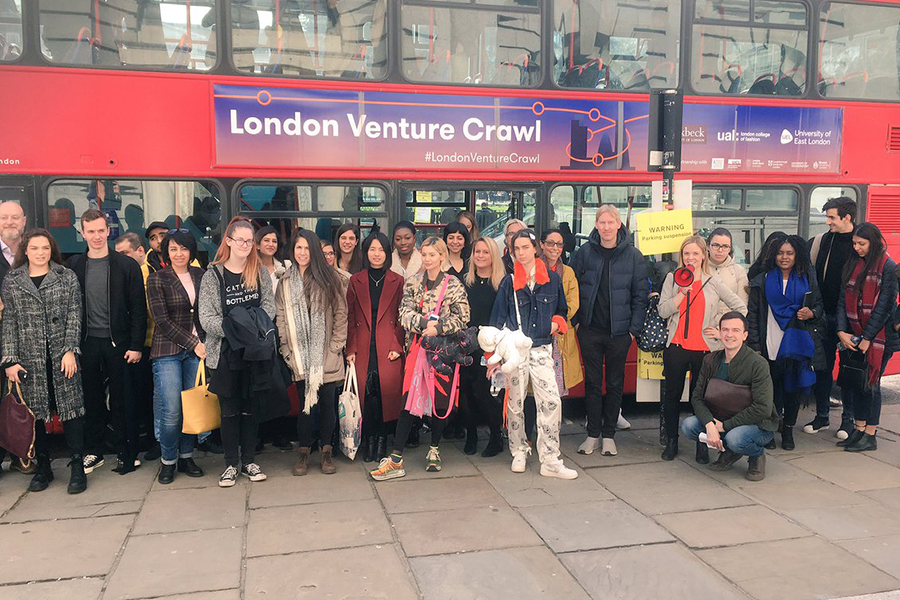
Wednesday 14 March saw a group of entrepreneurial students from Birkbeck join an event that was unlike any other; six double-decker buses, nine London Universities and over 200 students made up the London Venture Crawl and celebrated everything the city offers to budding entrepreneurs.

Birkbeck teamed up with University of the Arts and the University of East London and transported students to a range of enterprising spaces around the capital to inspire them to pursue their start-up ventures, meet successful entrepreneurs along the way and ultimately check out a snapshot of what London offers on the start-up scene.

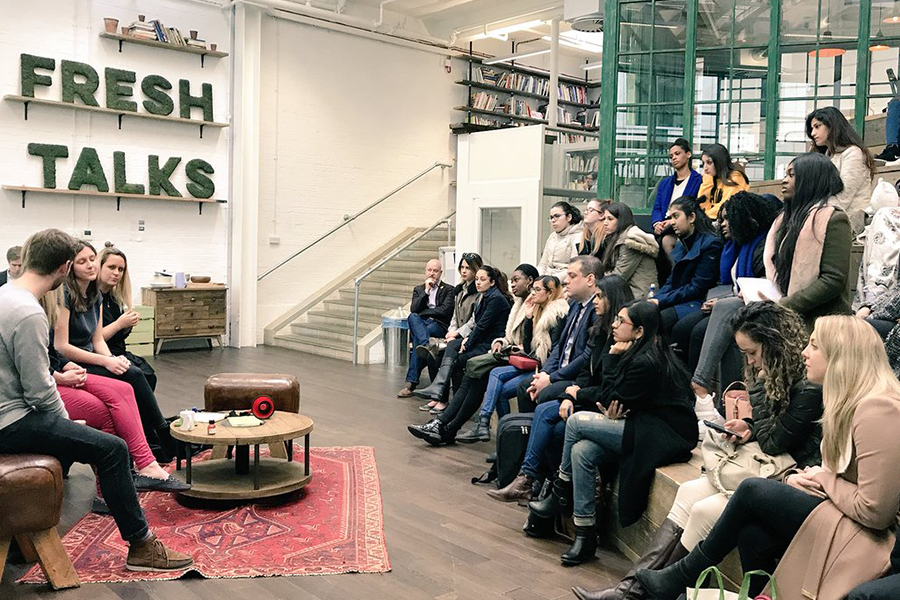
The day started bright and early with students ready for the first stop of the day at Campus London, a Google space in Shoreditch. Hearing from Creative Entrepreneurs, an innovative community of creative individuals, the group woke up and boarded the double decker bus that was to be their mode of transport for the day.

On board, they were greeted by serial social entrepreneur Benjamin Western, Co-Founder of Gaggle and indiGO Volunteers to pump them up for the rest of the journey.

The second stop was at Amazon Fashion, catering nicely for the group as they got an insight into the impressive warehouse where all of Amazon’s fashion items go for checking, photographing and packing. A panel discussion with the top operators gave a glimpse into life at the leading online retailer.

Third stop of the day took the group to Grant Thornton, after hearing from their Head of Growth Finance, Sarah Abrahams. Lunch was served and the students met Crate Brewery Founder Tom Seaton who shared his story starting up Hackney’s well-known venue.

The venture continued on to Hello Fresh, the extremely impressive and relatively new organisation that saw its revenues grow from €2.3m in 2012 to €304m in 2015 – here the students met some of the key players at their London hub and toured the quirky space.

The penultimate stop for the group was Innovation Warehouse, a co-working space and community for digital high-growth start-ups. The students were able to hear from the founder Ami Shpiro along with some of the entrepreneurs within the community.

The final stop brought all six buses together where students from across the nine universities to could network over a pizza and beverage while hearing from the inspiring Lawrence Kemball-Cook, founder and CEO of Pavegen, as well as take part in the cross-bus pitching competition. Birkbeck stormed through to the final, with Business Innovation student Bobette Kenge rounding off the day on a high and ending what was an extremely eventful, inspiring event for everyone involved.

Birkbeck Business & French student Jennifer said: “The Plexal building was fantastic, the talk at Grant Thornton with the Founder of Crate Brewery was great and gave an insight into the different types of investments, investors and how it all works, and Amazon Fashion was heaven to me! I would love to come to a similar event again and meet more people.”

This was an incredible opportunity for our students to network with a huge range of fellow London students, plus receive invaluable advice from the speakers throughout the day. The energetic atmosphere lasted right to the end of the day and was fantastic to see.