Clare Samson, Senior Associate Lecturer in Birkbeck’s Department of Biological Sciences reports on the annual Bernal lecture that was given by Cordelia Fine, Professor of History and Philosophy of Science on Monday 4 February, that explored whether there really is an essentially male and female brain.
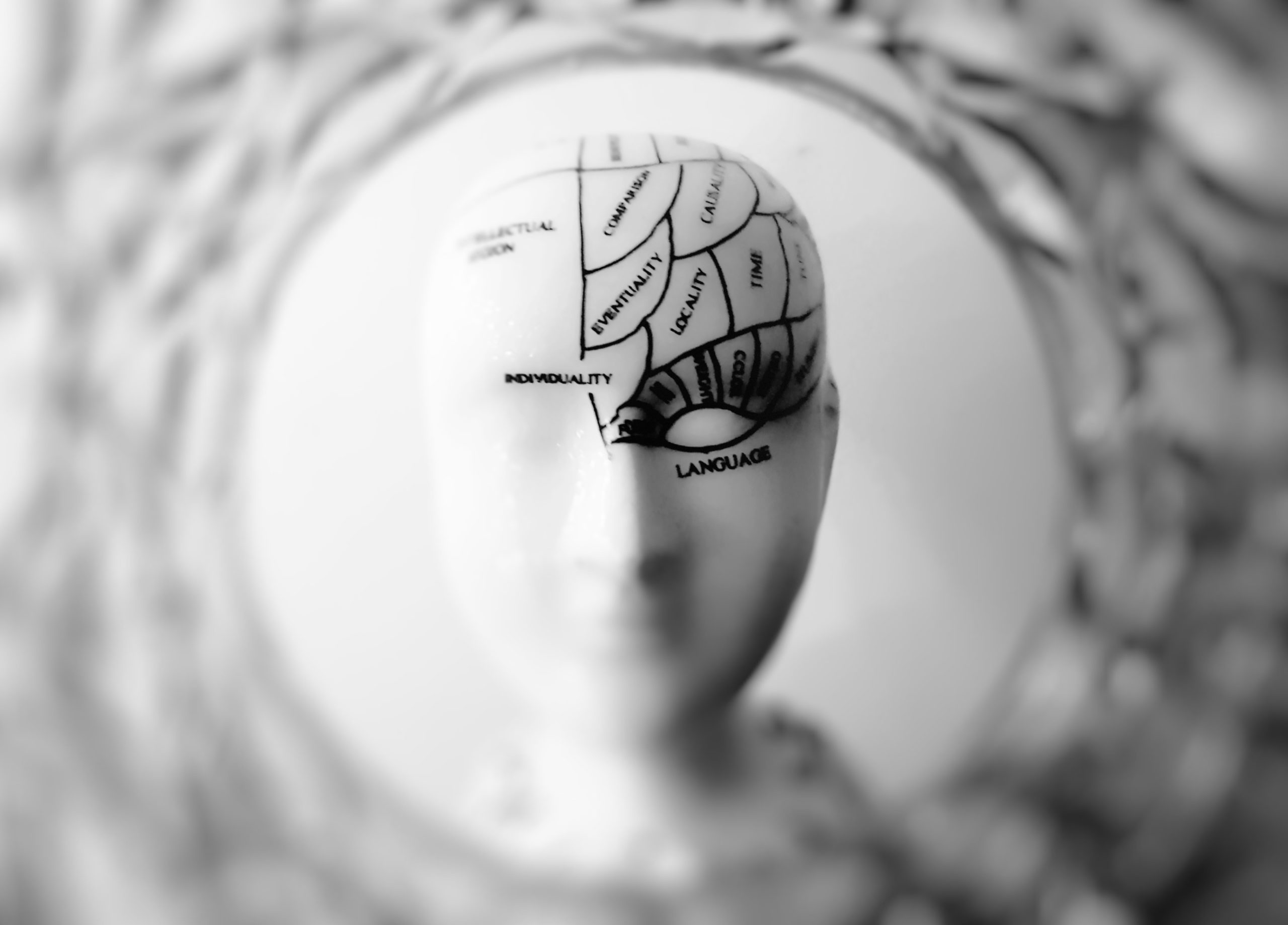
Professor J.D. Bernal is remembered for work on the social consequences of science as much as for his ground-breaking research, and these lectures have frequently focused on societal issues. The choice of Cordelia Fine, Professor of History and Philosophy of Science at the University of Melbourne, Australia as the 2020 lecturer echoes Bernal’s passionate advocacy of women in science; Fine’s choice of title, Fifty Shades of Grey Matter, proved an engaging one. Tickets ran out long before the lecture, which took place on Monday, 4 February 2020; the lecture theatre was packed, and Fine held her audience’s attention throughout.
Fine began by explaining how our 19th-century ancestors viewed the difference between the sexes. Less than 150 years ago, the overwhelming majority accepted that men and women were biologically determined for their different roles. In 1876 a Professor Edward Clarke wrote a best-selling book that suggested that ‘if a woman were to engage in the hard-intellectual labour of higher education, it would divert energy from her [clearly far more important] reproductive system’. Even progressive voices supporting women’s education claimed that it would help them become ‘more interesting wives and better mothers’. Scientific justification for these views often focused on one simple variable: brain size. Since an average male brain is significantly larger than a female one, they argued, one would expect women to be intellectually inferior.
It is easy to argue against that viewpoint, since we are not ruled by elephants or whales. This degree of bias seems bizarre to our ears, yet, as Fine explained, we all – even neurologists and psychologists – look, perhaps unconsciously, through biased lenses. Differences between male and female brains do exist, but they are highly complex and subtle ones. She identified three main biases: androcentrism, in which the masculine view of the world is taken as central; gender polarisation, in which the masculine and the feminine are seen as polar opposites; and biological essentialism, in which traits are seen as innate and biologically (often genetically) determined, rather than arising from both nature and nurture.
Much of the lecture focused on the way in which gender polarisation continues to affect both academic and popular science. This bias is seen in the proliferation of ‘pop psychology’ books, arguing that men are from Mars and women from Venus; that men are like waffles and women like spaghetti; or that there is some innate reason why men don’t listen and women can’t read maps. Academic books setting out reasons for this ‘essential difference’ between male and female brains are still being written, and still sell well.
She presented a case study of a paper in a reputable journal that seemed to show innate differences between the connectivity of male and female brains: that is, the way they are ‘wired’. According to this paper, female brains have stronger connections between the right and left hemispheres of the brain, while male ones have stronger connections between each hemisphere. Fine noted that although the difference was there, it was a tiny one. All the pairs of ‘bell curves’ showing brain characteristics of the women and men in the study overlapped so greatly that any differences would be described as ‘modest’ at most. No differences justified the word ‘striking’ used in the paper’s title, and no correlations were given with behaviour. Press officers, however, see headlines rather than read graphs. Publication of this paper led to headlines such as ‘Men and women wired like different species – expert’ (New Zealand Times); ‘Yes, each sex is really from a different planet’ (Metro, UK); and even ‘Women crap at parking: official’ (The Register).
Gender polarisation is summed up in the idea of a single scale with ‘100% male’ and ‘100% female’ brains at opposite ends, suggesting that they are opposites and, at times, equating the ‘extreme male brain’ with autistic tendencies. It is possible to take a quiz to position your brain at some point between the ‘systemising’ male brain and the ‘empathising’ female one, but the results can be odd: Fine quoted a colleague who found, on taking the test, that he seemed to have ‘no brain at all’. Even popular psychology makes more sense if ‘systemising’ and ‘empathising’ are seen as different characteristics with no relationship to gender. The idea of men as stereotypically problem-solvers and women as collaborators should be consigned to the past. Each community – including the scientific community – will flourish best when it is diverse, open and able to identify and eliminate bias.
Further information:
 Sex differences have been the source of contentious debate in recent years, beguiling scientists, lay people and major stakeholders like the NHS and pharmaceutical companies. There are obvious physiological and anatomical differences between the sexes but cognitive differences are often conveyed through stereotypes – that males have better motor and spatial abilities and females have superior memory and social cognition skills, for example. While there is research to support some areas of cognitive sex difference, recent studies have shown that the magnitude of sex differences has decreased in recent years. This suggests the causes of these differences may have less to do with one’s genetics than one’s environment – that nurture may be just as powerful as nature to one’s brain development. It also provides further evidence for the effectiveness of contemporary social movements to bridge the gap between “women’s roles” as nurturing child-bearers and “men’s roles” as workers.