Birkbeck’s day out with the London Venture Crawl

Jenna Davies leads the extracurricular Enterprise activities at Birkbeck and recently took a group of students on the London Venture Crawl, an event aimed at connecting them with businesses and experts.
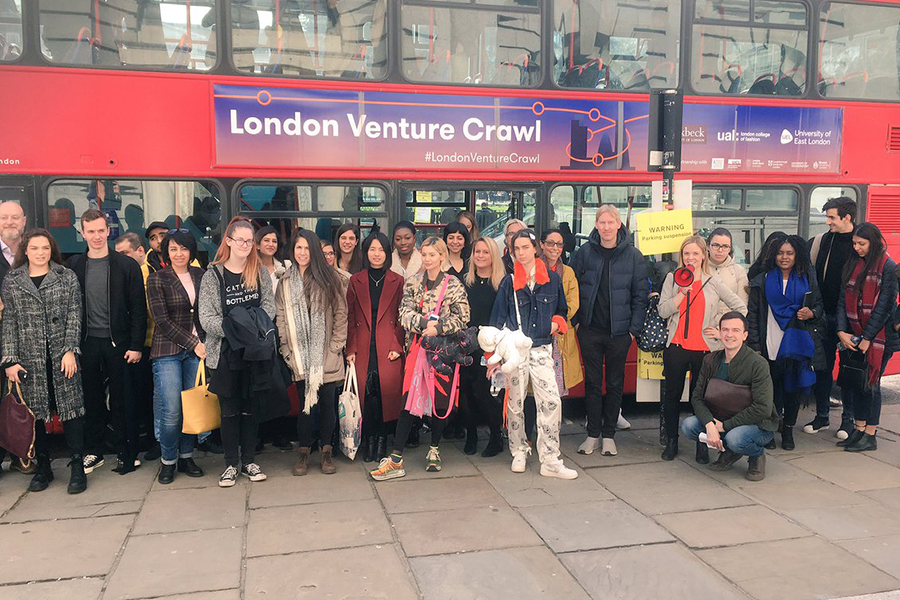
Wednesday 14 March saw a group of entrepreneurial students from Birkbeck join an event that was unlike any other; six double-decker buses, nine London Universities and over 200 students made up the London Venture Crawl and celebrated everything the city offers to budding entrepreneurs.

Birkbeck teamed up with University of the Arts and the University of East London and transported students to a range of enterprising spaces around the capital to inspire them to pursue their start-up ventures, meet successful entrepreneurs along the way and ultimately check out a snapshot of what London offers on the start-up scene.

The day started bright and early with students ready for the first stop of the day at Campus London, a Google space in Shoreditch. Hearing from Creative Entrepreneurs, an innovative community of creative individuals, the group woke up and boarded the double decker bus that was to be their mode of transport for the day.

On board, they were greeted by serial social entrepreneur Benjamin Western, Co-Founder of Gaggle and indiGO Volunteers to pump them up for the rest of the journey.

The second stop was at Amazon Fashion, catering nicely for the group as they got an insight into the impressive warehouse where all of Amazon’s fashion items go for checking, photographing and packing. A panel discussion with the top operators gave a glimpse into life at the leading online retailer.

Third stop of the day took the group to Grant Thornton, after hearing from their Head of Growth Finance, Sarah Abrahams. Lunch was served and the students met Crate Brewery Founder Tom Seaton who shared his story starting up Hackney’s well-known venue.

The venture continued on to Hello Fresh, the extremely impressive and relatively new organisation that saw its revenues grow from €2.3m in 2012 to €304m in 2015 – here the students met some of the key players at their London hub and toured the quirky space.

The penultimate stop for the group was Innovation Warehouse, a co-working space and community for digital high-growth start-ups. The students were able to hear from the founder Ami Shpiro along with some of the entrepreneurs within the community.

The final stop brought all six buses together where students from across the nine universities to could network over a pizza and beverage while hearing from the inspiring Lawrence Kemball-Cook, founder and CEO of Pavegen, as well as take part in the cross-bus pitching competition. Birkbeck stormed through to the final, with Business Innovation student Bobette Kenge rounding off the day on a high and ending what was an extremely eventful, inspiring event for everyone involved.

Birkbeck Business & French student Jennifer said: “The Plexal building was fantastic, the talk at Grant Thornton with the Founder of Crate Brewery was great and gave an insight into the different types of investments, investors and how it all works, and Amazon Fashion was heaven to me! I would love to come to a similar event again and meet more people.”

This was an incredible opportunity for our students to network with a huge range of fellow London students, plus receive invaluable advice from the speakers throughout the day. The energetic atmosphere lasted right to the end of the day and was fantastic to see.
International Women’s Day: womanism, activism and higher education

Dr Jan Etienne, Honorary Research Fellow in the Department of Geography, convened the recent Black Women, Womanist Learning and Higher Education: the politics of representation and community activism conference – the first of its kind at Birkbeck.

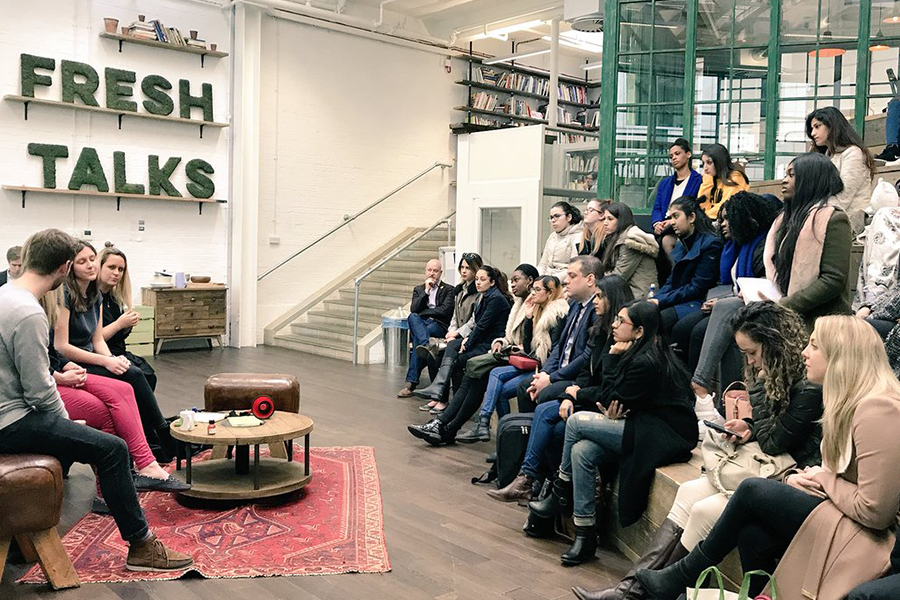
Over 200 women attended Birkbeck’s first Black Women, Womanist Learning and Higher Education conference, which drew together black women activists and academics from various parts of the United Kingdom, across Europe, South Africa and the United States. A further 210 women, who were unable to be allocated tickets, were invited to watch the live stream of the keynote speeches.

At Birkbeck, we already know about the ‘feminist emergency,’ but our conference demonstrates a burning ‘womanist emergency’! The scale of interest in the black woman’s desire to take charge of a lost agenda cannot be underestimated. Such a desire has reached fever levels. Quite frankly, as black women, we are fed up with other’s speaking on our behalf. We are hungry for genuine representation. Finally, we are seeing black sisters speaking our language, standing up for us, taking charge and ownership of our agenda for change.

This conference of black women activists working alongside their black sisters in HE is long overdue and I am happy that Birkbeck is the first higher education establishment to allow this Womanist platform to emerge.  We have a lot to say and a great deal to achieve.

On the day of the conference, a clear message emerged for the urgent need for the black woman in HE to play her part in promoting collaborative, activists’ links in order to prioritise the movement for a free, decolonised education system. The lively, vociferous workshops revealed the reasons for such high levels of interest in the conference.

In a platform presentation entitled: ‘Young womanist voices: our mother’s legacy’, young black feminists: Nombuso Methibela, Dolly Ogunrinde and Jenna Davis spoke on ‘the silencing of black women’s activist’s voices; the power of language to promote activism and the significance of passing on experience steeped in activist’s struggle’.

Nombuso Methibela, an activist and educational researcher from South Africa, talked passionately on the silencing of the voices of black women activists, like African nationalist and grassroots political organiser Hannah Kudjoe, who played a formidable role in Ghana’s struggle for independence.  She stressed: “In the recollection of Ghana’s independence history we rarely hear of her contributions. Kudjoe’s disappearance from public memory and her un-naming have been a focal point of the anti-colonial movement.”

Through her South African experience, Nombuso suggested that: “Black women’s political representation has come out of the collective desire to recognise the experiences of Black women who fought against marginalisation in national liberation movements and black consciousness movements despite their collective disappearance from popular history”.

Dolly Ogunrinde, an outreach worker for an educational charity, highlighted the importance of language and how we share concepts and ideas across generations.

She said: “As an educator, I find my students are very much aware of issues surrounding race and the notion of an intersectional struggle that occurs between race and gender. However, what they don’t have is the language to express that. With the concept of womanism, I was able to finally find a word which encapsulates the ideas that my mother had passed down to me.

“‘Womanism’ is a concept that is now engaging young black women all over the country. And I don’t necessarily think the answer lies in teaching young people about womanism in the sphere of formal education. Instead, I think the answer lies in informal education. We, all of us in this room are informal educators to the young women in our lives.  It is important we share oral histories and popularise terms like ‘womanism’ to provide the next generation of womanist activists the power in language to express their ideas.”

Jenna Davis, a parliamentary assistant, politics student and community worker spoke on the legacy of black women activists, trade unionist and elected officials. “They have left us young black women like me, a huge legacy. Their achievements and sacrifices have made it possible for my generation to believe it’s possible to enter the political sector. They have prepared us for the fight ahead and have shown us how to confront and deal with misogynoir, colourism, oppression and so much else. They have shown us that Black women can come from different walks of life and educational backgrounds and achieve.

“As a young black woman in the political field, my mother has taught me that education is a key that opens many doors. She wasn’t just talking about academia. She was also talking about the power of life experiences. That is why I use my story and experiences to empower other young people about the importance of community activism and encourage them to participate and work for change”.

One participant said: “This day is a cause for celebration because we can see positive role models from across the Higher Education sector who are committed to working with us.  These black sisters are demonstrating their potential to change our lives, remove the oppressive white curriculums and speak to our history.”

The past in the present at international meeting on ancient and medieval Telangana

Dr Rebecca Darley, a lecturer in medieval history from the Department of History, Classics and Archaeology reviews an international conference on the history of Telangana in Hyderabad, India.

In January 2018, researchers from across the world met in Hyderabad, India for the second international congress uncovering the history of ancient and medieval Telangana. The first, held in 2017, had been inaugurated only three years after Telangana became India’s newest federal state and the first new state to be created since India’s independence in 1947.

Though Telangana is administratively a very new state, its claims to an independent identity are rooted in the antiquity and uniqueness of its culture. These conferences, hosted by the Telangana State Department for Archaeology and Museums, now re-named Heritage Telangana, were therefore aimed at bringing together researchers and the public to celebrate and uncover this past. In particular, the focus on the ancient and medieval periods was intended to provide a sense of the depth of this identity beyond the recent rhetoric of an independence campaign which was, for obvious reasons, rooted in modern grievances and modern decisions about how to establish the states of India.

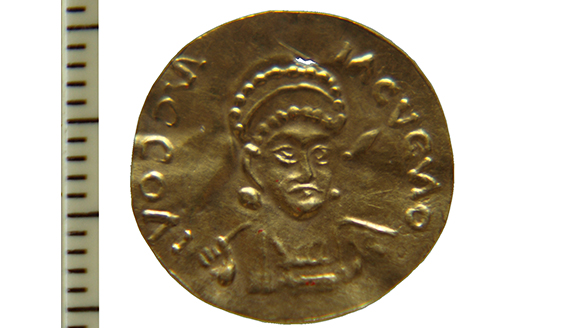
I was very fortunate to have been at the 2017 gathering as well and it was great to meet new people, see old faces and to be back in one of my favourite cities in the world. My own research focuses on discoveries of Byzantine and Roman coins, minted in the Mediterranean region, but exported to south India in the first seven centuries AD. The State Archaeology Museum in Hyderabad has one of the largest collections of these coin finds in India and many were discovered within what is now Telangana. This was the challenge I had set myself; to interpret these ancient finds through the lens of the modern boundaries of Telangana State.

Mine was the first paper after the elaborate and extremely enjoyable opening ceremonies, and it received a very good response. It was a particular honour to be on a panel with P. V. Radhakrishnan and T. Satyamurthy, both senior scholars whose work I have used and admired for many years.

Being the first paper also meant that I was then free to enjoy the rest of the conference – two days of papers and cultural performances. Director of Heritage Telangana, Smt. N. R. Visalatchy has made it her mission in this post not just to raise the profile of cultural heritage in Telangana, but also to expand its definition, and so academic papers were combined with demonstrations of classical dance and folk musical performance. The range and standard of papers was wonderful, as was the public interest shown in the conference. It would be fair to say that academic conferences in the UK rarely attract a substantial public audience, even when they are open and advertised. By contrast, in both 2017 and 2018, the international meetings on Telangana heritage filled an auditorium with a crowd including journalists, members of learned societies, local history enthusiasts, writers and teachers, as well as archaeologists, academics and heritage workers.

Heritage institutions in India, as in the UK, often have to struggle with budgetary constraints, maintenance of buildings which are themselves heritage structures and recording and cataloguing ever-growing collections. The support given by Telangana State to these conferences is, therefore, most welcome and was an opportunity also to see some of the success stories as excavators reported on ongoing archaeological excavations and developing projects.

Hopefully, there will be a chance to meet again in Hyderabad for the third international conference on Telangana Heritage. My own research, in part as a result of this paper, has raised a wealth of new questions about how Roman and Byzantine coin evidence can reveal social practices and state structures in inland India. There remains much more to say and to discover.

Celebrating the cinematic richness of Belgium

Vladimir Seput, a student on Birkbeck’s MA Film Programming and Curating, discusses a recent event looking at Belgian cinema. 

On Wednesday 21 February, Birkbeck Institute for the Moving Image was once again filled with people. This time, BIMI hosted Belgian film lovers (and those who might become ones) who came to watch and listen about the latest trends in Belgian cinema in a special, introductory event to the programme, Focus on Belgian Cinema. With the support of Wallonie-Bruxelles International and Flanders House, film critic and author Louis Danvers and Wouter Hessels, the film lecturer and cinema programmer at the Brussels Royal Institute for Theatre, Cinema and Sound travelled across the Channel to give talks on the state of contemporary Belgian Cinema.

Mr Danvers talked about French-speaking films from Wallonia and Brussels and the often paradoxical situation that they are facing, namely because they cannot reach large audiences even though they regularly win numerous major awards at international film festivals. For example, the Dardenne brothers still hold the record, among a few others, of the highest number of precious Cannes’ Palme(s) D’Or. Even so, their movies often struggle with reaching a significant amount of audiences. Unfortunately, the reasons for such a poor result on the domestic market are, as often, multiple and complex. Besides the fact that the subject of those works is often the gloomy topic of social injustice, which is hardly a crowd-pleaser anywhere, French-speaking Belgian cinema lacks infrastructure that would help in the promotion of films outside their habitual audience. Such infrastructure exists in Flanders, Mr Danvers said, and it would be beneficial to have it in the French part as well. As a result, in 2016 the most successful Flemish film in terms of audience attendance did 15 times better than the most popular French one. However, French-speaking Belgian cinema is a prolific creative industry of a rich documentary tradition and often surreal fiction films, with the latest trend in making films inspired by true events, such as A Wedding (Noces) from 2016, also part of this year’s festival.

Genre cinema is often a key to success if a film wants to reach a large audience and Flemish filmmakers know that quite well. Under the title Belgian Cinema: Made in Flanders Wouter Hessels presented the Flemish film wave which started in 2002 and the conditions that preceded it. Mr. Hessels emphasized five key elements of success of Flemish films in recent years: founding of the autonomous Flemish Film Fund (VAN) in 2002, introduction of the tax shelter in 2003, the project Faits divers by Flemish commercial television VTM, numerous international film festivals in Flanders like Ghent, Ostend and Leuven and the increase in quality of student films realized at five different schools in Flanders. Some of those conditions resulted in commercial and/or artistic successes through the works of filmmakers like Felix van Groeningen, Fien Troch and Erik van Looy, whose film The Loft from 2008 holds the record for the most popular Flemish film (more than one million tickets sold).

After the presentations on French-speaking and Flemish Belgian Cinema, BIMI screened the film King of the Belgians from 2016 made by Peter Brosens and Jessica Woodworth. The film presents a new direction for Brosens and Woodworth who were, prior to this film known primarily as documentary filmmakers. In this satire, they tackled the issue of a Belgian division in an almost farcical way, inspired by the Belgian mockumentary tradition of comedy making, best known from the cult Belgian film Man Bites Dog from 1992. Along with the five latest titles from the Belgian film factory, Man Bites Dog will be shown at the French Institute as a part of Focus on Belgian Cinema.

The event was concluded by a discussion chaired by Janet McCabe, director of the Film Programming and Curating MA at Birkbeck in which Mr Danvers and Mr Hessels talked about different aspects of the creation behind co-existence and shared with the audience their thoughts on encounters between identities, cultures and languages.

Focus on Belgian Cinema runs at the French Institute from 22-25 February.

For more on Belgian cinema, see Wouter Hessels’ choice of most representative Belgian films.