Arts Week 2019: Telling Stories about Syphilis

Christine Slobogin, PhD candidate in the History of Art discusses an Arts Week event about the history of Syphilis.

Image: Syphilis, Richard Tennant Cooper, 1912

Dr Anne Hanley began her talk this Monday with: ‘Welcome everyone, to this afternoon of syphilis,’ going on to give a trigger warning that if any audience member did not want to see ‘ulcerated genitalia,’ then perhaps this paper may not be for them. This arresting introduction set the tone for the entire presentation, rife with images of the ulcers that Hanley had promised but also full of thoughtful discussion on narratives of disease, widespread cultural fear, bleak Victorian literature, and propagandistic film.

The main purpose of Hanley’s paper was to trace the shift in the way that syphilis was depicted in Britain’s public imagination between the Victorian and interwar periods. Because syphilis was such a stigmatised venereal disease (VD), men and women who were infected, as well as their relatives were more likely to suppress their stories about their experiences rather than write them down or describe them in another way. Therefore, historians are often thwarted as they search for patient’s perspectives on what it was really like to experience the pustules, the deteriorating nasal cartilage, and even the sink into insanity associated with neurosyphilis.

A large factor in the stigmatising nature of the disease was that it led either to the grave or to the asylum. And this was the narrative that was espoused by Victorian authors when writing about syphilis. Hanley described how novelists used the illness as a plot point to show the medical and moral consequences of transgressing sexual mores and expectations of the time. These stories told about syphilis often followed a similar trajectory, in which a woman and her children are ruined by the moral wrongdoings of the husband. The woman, expected to be innocent and therefore ignorant of sexual matters, can become an easy victim of a morally-suspect spouse and a rampant venereal disease.

This lack of knowledge was compounded at the doctor’s office once the woman sought treatment for her worrying and mysterious illness. Hanley described various medical men who used dangerous paternalism to justify keeping syphilitic women in the dark about their health. After all, the truth could result in a broken home and the damaged reputation of her husband. Often the treatment of these ill women would carry on under the pretence of a different disease, without the patient knowing the full extent of her condition. But sometimes the husbands prevented treatment from happening or from finishing for fear of the monstrous syphilitic truth coming out.

Women could stay ignorant of the risks and symptoms of venereal diseases in the Victorian era because public health information was scarce. The only stories that were told about syphilis were those in the plots of the novels previously described. But this double standard of men having all of the knowledge and therefore power when it came to syphilitic infection began to shift in Britain in the interwar years. The British Social Hygiene Council was established and with it came advertisements for VD clinics through posters and word of mouth but, most importantly, films.

These cinematic visualisations of syphilis contained narratives distinct from the bleak and fatalistic ones of the Victorian-era novels. These films were often light and entertaining moral tales crafted so that viewers could identify with the characters. In one, Any Evening After Work (1930), a man contracts a venereal disease and considers forgoing treatment until his daughter is afflicted with the illness. While the film does use scare tactics to get people to have themselves checked at VD clinics, the overall narrative is that the little girl will get better, and everything will turn out alright—as long as the proper precautions are taken and help is sought.

This shift from pessimistic written narratives to more uplifting and informational films caused an increase of British people going to VD clinics (with both diagnosable diseases and with false alarms). Both ways of telling stories about syphilis fostered an atmosphere of syphilophobia, but the films fulfilled their propagandistic purpose of improving Britain’s sexual health. Hanley argued that to tell stories about syphilis, we need both the fictional and the medical to understand the full cultural narrative of the disease.

Welcoming the research scientists of tomorrow

Trishant, Jenny and Alex, all PhD candidates in the Department of Biological Sciences, were part of a team who invited local secondary school students to Birkbeck to take part in scientific experiments and to show them the College’s suite of electron microscopes. They recount the experience here. 

On the 29 March, our normally peaceful research institute – the Institute of Structural and Molecular Biology (ISMB) at Birkbeck – became a bustling classroom. We – a team of research scientists from the ISMB Electron Microscopy laboratory – were hosting a group of thirty 14-15-year-olds from Regent High School in Camden to plunge them into the unfamiliar world of biomolecular research. The visitors, who are on their way to taking GCSEs, were taken on a whistle-stop tour of our high-tech research facilities, and even given the chance for some hands-on experiences! This was in no small part to show off our suite of electron microscopes, with our visitors having the rare opportunity to see our brand-new world leading electron microscope, the Titan Krios. We hoped our efforts would enable our visitors to get engaged with the exciting world of research, help them understand more about what goes on at universities, and, most importantly, stimulate their scientific curiosity.

In groups of six, the students were given a taste of all stages of the process of structural biology studies – from preparing biological samples to the final data analysis. Work that would usually take months was showcased within one afternoon to convey the importance and excitement behind the scientific method at each step. After a discussion of cells, molecules, and atoms, students were quick to appreciate the applications of light and electron microscopy. The importance of understanding the underlying principles of living things and the joy of discovery were quickly grasped by the students, who were engaged and inquisitive. They were not shy to ask questions not only about the science, but about the humans behind it – “What does a PhD student do?”, “Why did you chose to become a scientist?”, “What is a typical day in your job like?”. Some openly expressed their long-standing fascination with biology, chemistry, and physics. Others were just beginning their exploration of different disciplines and discussed the impact that scientific developments have had on their lives. Throughout the day, we and our visitors had valuable conversations centered around scientific concepts and beyond.

After much fun and awe for our visitors, our day wrapped up and we were fortunate enough to receive feedback in the form of a board of sticky notes. It was reassuring to read that the students each enjoyed their visit – something that was clear throughout the day. For many of them, this event was the first opportunity on a light microscope, looking at specimens ranging from developing chick embryos to the striped DNA from a fruit fly, or getting close to a behemoth multi-million-pound electron microscope. Both students and teachers spoke with us about the benefits of getting hands-on with equipment and elements of the scientific process, and even asked about opportunities available in higher education. From our point of view, this event was a success in many ways, allowing us to learn from each other and our visitors. We opened a small part of our world of research, and in doing so, we hope we inspired the next generation of scientists.

From one GCSE to a Master of Science degree

Shekira Malcolm had a five year plan which has landed her a ‘dream job.’

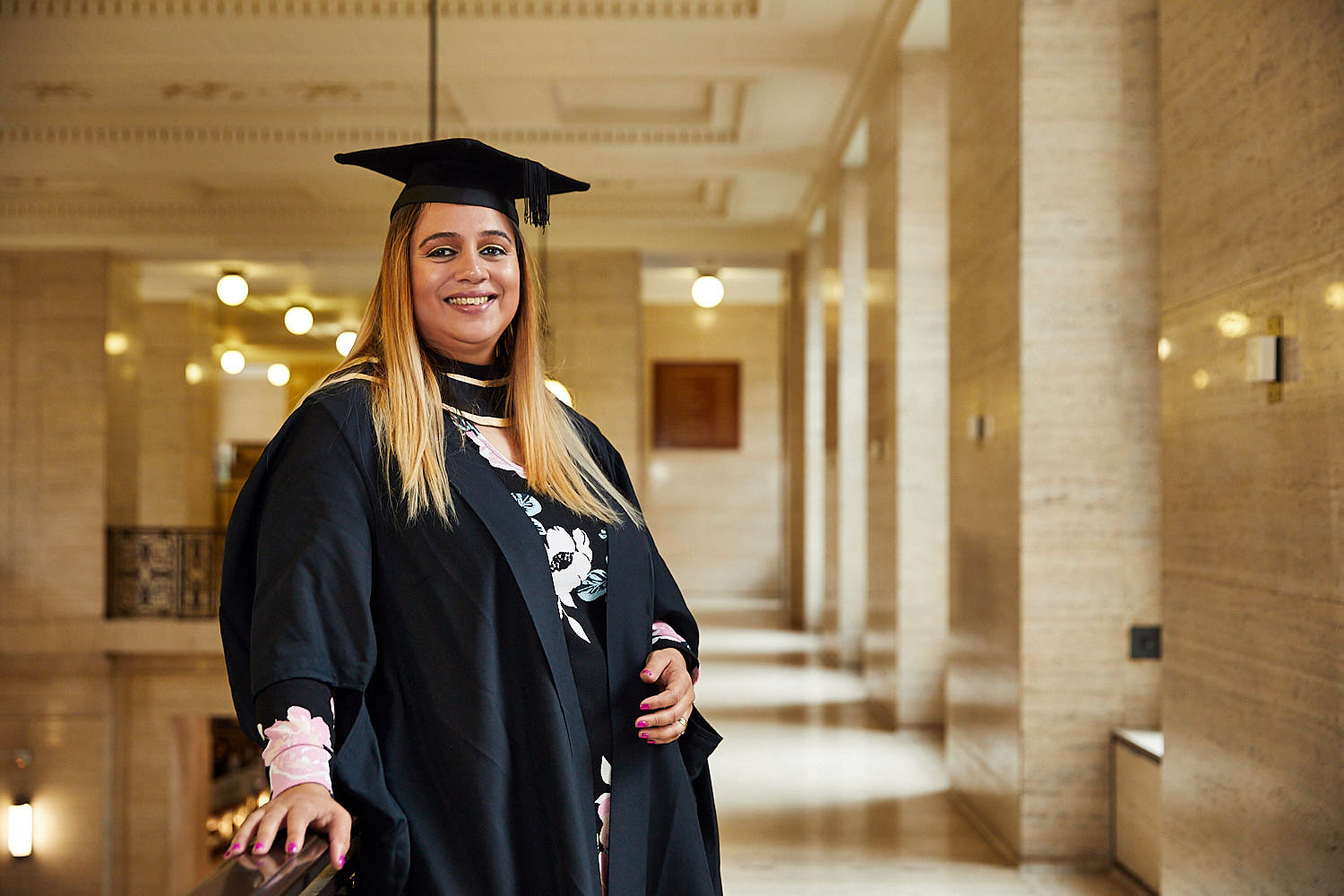
In 2013, Shekira Malcolm sat down and wrote a five year plan that would transform her from a 33 year old with one GCSE to a Master’s degree holder and enable her to have the career that she’d always wanted. Yesterday, Shekira celebrated achieving her Master’s in Human Resource Management at Birkbeck’s graduation ceremonies.

Difficulties during her teenage years meant that Shekira didn’t always pay attention to her education and as a result she left school with just one GCSE.

She went on to gain experience in HR in the public and private sectors and then worked for her husband’s business. But without any qualifications, Shekira always felt that she was at a disadvantage in terms of her career.

In 2013, Shekira started an Access to Social Sciences course at her local FE college, before studying history at undergraduate level and then going straight onto her full-time Master’s course at Birkbeck. She says: “It was hard work. I had several setbacks during my Master’s – including my teenage son being robbed at knifepoint twice, and having to care for my grandmother in the last months of her life.”

Shekira describes her postgraduate degree as a very different experience to her first, as at Birkbeck there were students of all ages, backgrounds, and with varied career histories – a diversity which Shekira really enjoyed. Although many of her classmates were working, Shekira stresses that they were not given an easy ride by the tutors. She says: “The academic level is high – luckily Birkbeck tutors understand that people are juggling university with other aspects of their life and also that many students haven’t been in formal education for several years, so there is support available.”

Shekira also credits her husband for helping her achieve her goals. “He’s had to take up some of the slack at home, so it has been a team effort. At first he was a bit unsure when I told him I was going to study for five years, but he really supported me and is very proud of me now.”

Shekira was the first person in her family to ever go to university, but having seen the satisfaction that studying has brought to their mum, her daughter has now also enrolled in a degree in economics and politics at Loughborough and her son, who is currently studying for his GCSEs, also plans to apply to university. Shekira says, “I was able to help my daughter with her application process and with getting to grips with university-level study. If I hadn’t been to university myself then I would have felt totally out of my depth trying to support her.”

Five years of hard work has paid off for Shekira, who is now the proud owner of not one but two degrees from the University of London. On top of this, gaining her Master’s degree gave Shekira the confidence to apply for jobs that she would never have considered before and in April she was offered her ‘dream job’ in the HR department of a local authority.

Further information:

Survival story: Jodie was diagnosed with cancer four times while studying

For Jodie Cole, who graduated on Thursday 2 May with an MSc Organizational Behaviour, the path to graduation has been longer and harder than she could have envisaged when she applied to study at Birkbeck in 2012, 16 weeks before being diagnosed with stage four cancer. Given a 23% chance of survival, Jodie was determined that she would get the degree she’d always dreamed of having.

For most Birkbeck graduates, receiving their degree represents the culmination of many months or years of hard work.

For Jodie Cole, who graduated on Thursday 2 May with an MSc Organizational Behaviour, the path to graduation has been longer and harder than she could have envisaged when she applied to study at Birkbeck in 2012, 16 weeks before being diagnosed with stage four cancer.

Since then, Jodie has undergone four rounds of cancer and treatment, and will this month be celebrating not only her graduation, but 18 months cancer-free.

In 2012, Jodie had been working in HR for over two decades, and had a college diploma from her native Australia. However, she felt what she describes as a ‘burning passion to obtain this elusive piece of paper, in order to quiet that saboteur voice inside my head and prove to myself that I was as good as everyone else’.

Jodie, who lives in Geneva, Switzerland, explains: “I was the single mother of two teenagers. I never had the time or finances to further educate myself before that – it was poured into the children’s education. Once I was finally able to, in late 2012, as my teenage daughter applied to universities, so did I.”

A few months later, in early 2013, Jodie’s application was forgotten about, as she was diagnosed with stage four cancer; cancer in the breast, liver, ovaries, lymph nodes and bone. She says: “As I lay on the sofa feeling ill from the chemotherapy treatment, an email popped into my inbox stating the university had accepted my application for the Master’s programme.

“What was I to do?  This meant so much to me, and was something I had wanted so badly for so long. I was finally being offered a position at university and the possibility of achieving a major goal – a dream – of mine. How can I do this, yet how can I not?!”

So, despite having no hair, feeling sick, and having cancer, Jodie pressed the button that said ‘accept’.

In October that same year, after 18 weeks of chemotherapy, a double mastectomy and still in the middle of her treatment, Jodie arrived in London as a university student for the first time, for the first weekend workshop.

“I turned up with a gleam in my eye and pride in my heart. I had made it this far, been accepted, got through cancer and was sitting there in a real university lecture hall. The feeling was exhilarating.”

During that first weekend, Jodie met fellow students whose friendship and support was invaluable during that year.

Unfortunately, Jodie’s breast cancer returned before the second year commenced and she had to defer her studies for another double mastectomy and more treatment. Most of her friends continued their studies and went on to graduate without her. Disheartened to be left behind but still keen to complete the programme, she was in the process of enrolling once again the following year when she was diagnosed for a third time with breast cancer. Her studies were deferred again. It took her many months to recover from this round as a more radical double mastectomy was required, followed by weeks of radiotherapy. When she thought there was a light at the end of the tunnel, her fourth diagnosis revealed she had liver cancer again.

She remembers: “I was becoming a broken record at the university admissions department. ‘Sorry, I have cancer, can I please defer?’ That piece of paper felt like it was getting further and further away from reality for me.”

It was in October 2017, while still on chemotherapy that Jodie says she: “threw caution to the wind and re-enrolled for my final year, determined to remain cancer free and complete my Master’s. That piece of paper was like a shiny beacon in my world. I wanted it, I had to have it, I was determined.”

The reality of studying while on chemotherapy was tough. Jodie describes it, saying: “the chemo was addling my mind, making me tired. Plus, I was now working on this alone at home, with no more comrades in arms like my first year. I was distance-learning, logging in remotely to listen to lectures and study at hours that suited me (and the doctors’ schedule). Sitting exams was the toughest part for me as my memory was not what it used to be at all, and then there was the research and writing of the dissertation. I am absolutely sure all of my girlfriends and family were just as pleased and relieved as I was the day I mailed in my dissertation paper.”

When Jodie received her ‘confirmation of award’ letter from Birkbeck it was a moment of intense emotion. She says:  “To me, the piece of paper represents survival. It represents crossing that finishing line and being given the gold medal – for everything I’ve been through in the past six years, and for being alive. That piece of paper means believing in myself, in achieving my goals and that I CAN do anything. That piece of paper is success.”

Further information: