Arts Week 2019: But Are You Doing Anything? Curating, Producing and Managing as Practice Research

Lara Wuester, BA English and Humanities student on the Erasmus program from Munich, reviews the panel discussion “But Are You Doing Anything?” shown as part of Arts Week 2019.

Gestation is “the development of ideas, thoughts and plans.” (Cambridge Dictionary, 2019) For some, gestation is procrastination, distraction, displacement, being bored, lethargic. In terms of the 21st century, it is being unproductive, doing nothing at all. Or at least nothing visible to someone from the outside. Jane Woddis, Rachel Garfield and Lina Džuverović talked about their personal experiences with gestation and the production of art. In the following, a few lessons learned will be summed up.

Gestation is part of the production process.

Jane, Arts Manager and Associate Fellow at the Centre for Cultural and Media Policy Studies at the University of Warwick, presented the interconnection of gestation and production. As a fundraiser, she has seen and analyzed many different approaches to the creative process, from the detailed reflection to the other end of the scale: bold experimenting. Gestation, even more so than production, is a process, that differs from person to person. It can be solitary, it can be collaborative, it can be the writing of a thousand drafts or the perfection of a single one, it can be weeks of thinking, or actually getting things done in a day. The pressure of production does not necessarily have to influence the process of conception and gestation. In our fast-paced world, time to think, to talk, to develop is not valued, the outcome counts. But especially in the creative industries, production needs gestation, gets inspired by it.

Creativity needs boredom.

People today who still have time for boredom and yet are not bored are certainly just as boring as those who never get around being bored. For their self has vanished – the self whose presence particularly in this bustling world, would necessarily compel them to tarry for a while without a goal, neither here nor there. (Krakauer, 1993, p.104)

Krakauer argues that in fact to let ideas thrive and develop one needs to let go of headphones, radio, television, thoughts of the stars, staring at pictures in one’s mind that are superimposed by surroundings and people. We need to just close the curtains and spend time on our own to enjoy legitimate boredom, aimlessness, and restlessness without a goal, which resolves in undirected passion and ideas. In this context, Rachel, artist and Head of Department of Art at the University of Reading, highlighted the importance of the context and surroundings of artists on their practice and work. She mentioned, how much a city can be both enabling and tyrannizing, how one can be controlled by thoughts of funding and audience. How taking steps back, taking time to incubate helps the creative process and the product. That in fact, creativity sometimes needs nothing at all, no inspiration, no input, just closed eyes and boredom.

Academia complements the arts.

Academia and arts both are to some point influenced by funding and research, still, academia can offer a healthy retreat from the arts and offer exactly the distance and objectivity required to explore and reflect upon one’s own work, according to Rachel Garfield. Also, the university offers a space of communication, conversation and meeting of ideas and can support the artist community already existing. But can an artist who is not producing constantly still be considered to be one? Does taking a break, for example working in academia, automatically take away the right to call yourself an artist? Can it not be seen as a legitimate break or gestation process?

Art does not have to be dependent on money.

Lina also mentioned in her talk Stilinović’s essay “In Praise of Laziness” which compares Eastern to Western artists. The big difference, according to Stilinović, is that artists in the West always produced something, were involved in production, promotion, museums, competition and money. Artists in the East were lazy and poor, as they knew producing art was pure vanity. Answering the question of the monetization of the arts, Rachel said that it should not be these contexts that prescribe what you are doing, but far more importantly, your relationship to it shows what really matters to you as an artist.

In conclusion, being unproductive may not be paid, but it should be valued as an important part of production and creativity. Although there is a constant professionalization, monetization and academisation of the arts, it is the individual approach and process of making art and the relationship to external processes, hierarchies and structures that counts. And doing absolutely nothing can sometimes be crucial for doing something.

Thank you, Simone Wesner, for chairing this interesting event, that triggered many more thoughts and questions.

References

Cambridge Dictionary, Cambridge university Press, 2019, < https://dictionary.cambridge.org/dictionary/english/> [accessed:7.06.2019].

Krakauer, Siegfried, ‘Boredom’, Facing Value: Radical Perspectives from the Arts, ed. by. Lauwaert, Maaike and van Westreen, Francien (Den Haag, 2017:  Valiz/Stroom Den Haag), pp.104-119.

Stilinović, Mladen, ‘In Praise of Laziness’, Atlas of Transformation, 1993, < http://monumenttotransformation.org/atlas-of-transformation/html/l/laziness/in-praise-of-laziness-mladen-stilinovic.html> [accessed: 08.06.2019].


Theatre Scratch Night at Birkbeck

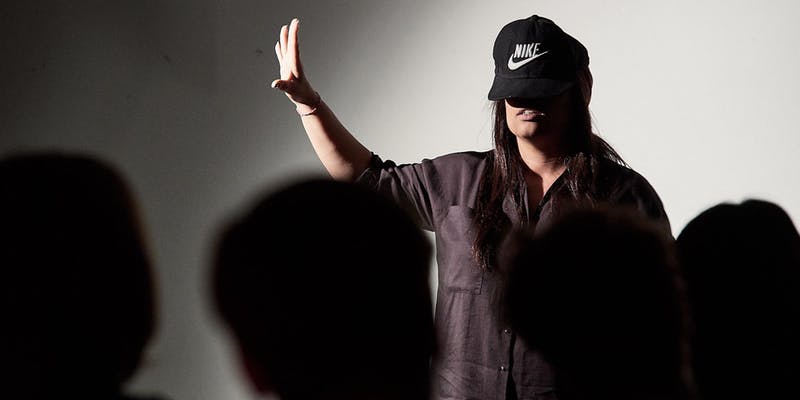
Luke Buffini, an MA Philosophy Student at Birkbeck and co-founder of Lamplight Magazine, reviews the performances shown as part of Arts Week 2019’s Theatre Scratch Night event.

The moment an actor stops taking the situation seriously is simultaneously the moment they are finished being funny. This is not the same as taking acting seriously, or one’s idols, audience or reviews seriously (the last of which always have an inherent silliness to them – except this one of course). These would all be mistakes to the actor, whose very beating heart is her enthusiasm for play. Yet what an actor simply must do to begin with is take every character’s situation with wholehearted seriousness. Without this, nothing interesting or even dramatic can happen, the latter being the stupider and easier to seduce younger sibling of comedy. No matter the silliness or boredom written into the situation, the actor when on stage – that is, the character – must fail to see these things. Every triviality contains the potential for revelation. Each silence, each exchange of eyes is a vertebra in the spine of the story. That’s acting; that’s theatre.

This is a lesson that most of the actors at the Birkbeck Theatre Scratch Night have not yet learned. Victor Mellors and peers were the happy exception to this. Their sketch was a short farce about two politicians stuck in a utility cupboard during the consummation of their election race. It was revealingly similar to another: a post-apocalyptic comedy about two friends trapped in an underground bunker. Both claustrophobic duologues (essentially), inflicted with the absurd and displaying the boredom and frustration of their characters. One ends in reconciliation, the other in confrontation. The defining difference is that Mellors and company do not allow their characters to perceive the absurdity of their situation. They behave with perfect and unironic seriousness in a situation the audience knows to be silly. This moment, for the characters, is the defining one of their lives and they’re spending it in a utility cupboard, amongst the buckets and disinfectant. At one point, Mellors somehow made a throwaway line about ‘having fun with this mop’ into a huge laugh. Here was the reliable convention, the one which mines comedy from seriousness, flaunting itself again.

Once the theatre fledglings had dispersed we were given something by their filmmaking counterparts. First, a short film called Next Floor, by French-Canadian director Denis Villeneuve, was screened, followed by two student adaptations. The Villeneuve was magnificent, with a masterful balance of disgust, absurd humour, political metaphor and beauty. A handful of waiters are scurrying an enormous carnivorous banquet to and forth for a seemingly insatiable group of diners. With increasing frequency, the swelling bellies of the consumers and the piling hoard on the table cause the floor to collapse, sending the banquet down a floor, on which the whole routine resumes. It’s a fantastic allegory for the uniquely stupid and repugnant greed of our age. All readers should spare the 10 minutes or so to watch it. (One student remarked to me afterwards that he had at first thought the Villeneuve was a student production, and was preparing in mind a complaint to the university about budget limits and equality.)

One student adaptation was a touch on the literal side. It edited horrid images of chickens living in disgraceful conditions between bits of the Villeneuve. A true but limited interpretation. Another adaptation I thought more ambitious. That one aroused broader reflections: about capitalism, climate change, environmental plunder and more broadly the shameful state in which blind, relentless growth and competition has placed us. It can only be promising that the artists of tomorrow are treating this frightening dilemma with the critical gaze it demands.

Arts Week 2019: The Trial: The State of Russia vs Oleg Sentsov

Luke Buffini, an MA Philosophy Student at Birkbeck and co-founder of Lamplight Magazine, reviews Askold Kurov’s documentary shown as part of Arts Week 2019.

Oleg Sentsov

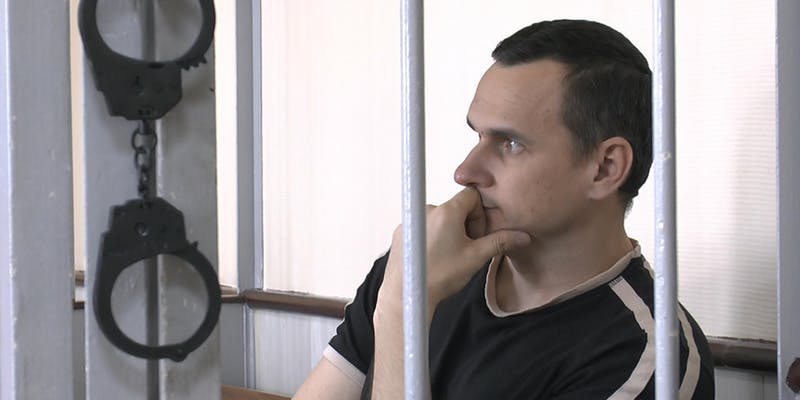
Above all else what a writer wishes to avoid is cliché. Cliché is intellectual laziness; a kind of self-sabotage in the battle for expression. Christopher Hitchens’ main concern when he went to Prague in the days of the Communist regime, was that he not mention Franz Kafka in the write up. Thus similarly, when I went to see a documentary called The Trial, about an infallible regime and its distressingly public display of “justice”, I told myself I wouldn’t either. Franz Kafka would be the first two words in any review of this film. No, not me: too obvious; too boring. Yet Hitchens was forced to (after being arrested without any discernible charge). And when, eleven months into his detention-pending-investigation, Oleg Sentsov stood up in court and pronounced, in a sarcastic tone shrouding genuine boredom, that he knew he would soon be given a 20-year prison sentence because he had been told this was his sentence on the day before his arrest, I also realised I would be forced to mention Franz Kafka.

Such is the nature of totalitarianism. Obvious, boring, cliché. In 1990 the Soviet Union finally ended a 40-year ban on 1984 and rereleased it (with edits, of course). That Russia continues to take this 70-year old satire of itself as an instruction manual is their way of telling you just how little they care about being boring or cliché. In China, 1984 is easy to purchase. However, internet forum enthusiasts endeavouring to reference those four digits, or any combination of words which equates to them, will find their message unpublishable. It doesn’t matter to these regimes that they are so easily comparable to their literary denouncements. The point they want to make is unaltered: there is nothing you can do about it.

This nature, or rather the appropriate attitude towards it, is embodied by Sentsov over roughly a year of footage with spartan consistency. He is weary. Yet not because he has been eroded by incarceration, torture, or intimidation. Weary in the way a precocious, intelligent teenager might be in a class he already has all the answers to. This is the primary triumph of the film, I think: revealing Sentsov’s stamina of mind. Totalitarianism is not merely repulsive and frightening because of the imaginative tortures, daylight beatings or midnight kidnappings. Perhaps the most disgusting aspect is the conquest in the individual mind which it seeks and often secures. For Sentsov, this meant humiliation; torture; threats of death and further torture; testimonies brought against him by way of still more torture; planting of evidence; and the repeated and meaningless extension of his detainment whilst under investigation (justified again and again by Sentsov’s apparent, yet still-dormant, “threat” to Russian civilians). Through all this, Sentsov smiles and peace signs for his supporters in the courthouse; remains stoic and silent when the judge or prosecutor speak; and, in a bizarre display of his enormous talent for irony and bravery, high fives his “co-conspirator” at the eventual announcement of his long-expected 20-year prison sentence.

During the film I kept asking myself; how can anyone continue to get away with such blatant corruption, lies and violations of human rights. I wanted to know how totalitarianism had adapted in the past century in order to continue working so effectively. Neither the film nor the panel of academics afterwards could produce a substantial answer. I returned to the Bloomsbury sunlight thinking that totalitarianism hadn’t had to change very much at all. That it still had the same naked, shameless hatred for the faces under its foot. That humiliating torture was still a reliable currency for acquiring human minds. That if people were afraid enough, it could carry on its nauseating merry-go-round of “justice” for all to see and (enforcedly) cheer.

One more thing hasn’t changed: individuals like Oleg Sentsov – ironic, impenetrable, and at all times ready for their sentence – reveal the silly, odious face of totalitarianism for the rest of us. I hope the reader will join me in writing, mailing or shouting something to the effect of the following imperative: Free Sentsov.

Retinal Justice: Rats, Maps, and Masks

On Thursday 2 May, the Department of Law welcomed Professor Peter Goodrich to give the department’s annual lecture on Retinal Justice: Rats, Maps, and Masks. Professor Goodrich is one of the co-founders of the School of Law at Birkbeck and in 2018 was elected an honorary fellow of the College.

Reader in Law and Political Theory, Dr Elena Loizidou and Professor of Law, Professor Adam Gearey reflected on the evening.

Dr Elena Loizidou: Images in the US are more and more an integral part of judicial judgement and moreover they produce what Professor Peter Goodrich calls an imago decidendi. In his lecture ‘Retinal Justice: Rats, Maps, and Mask’, Professor Peter Goodrich did not only guide us through ways of reading images in judgements, and called for the necessity of having an in court curator of images but gave us a lot to dream for. His powerful, enjoyable and humorous delivery facilitated even more the opening of the imagination.

I could not help, as somebody that is interested in seeing a social, legal and political transformation that at least undoes hierarchies, to imagine a time when judicial ‘pronouncements’ would be made of an assemblage of images that would be specific to the case that the court is handling. I could not stop myself of imagining that this has the potential of undermining the concept of the precedent and how this in turn may see the emergence of a system of adjudicating disagreements without the restrains of law, but emerging out of some other guidelines agreed by parties in dispute from case to case. One always lives in hope.

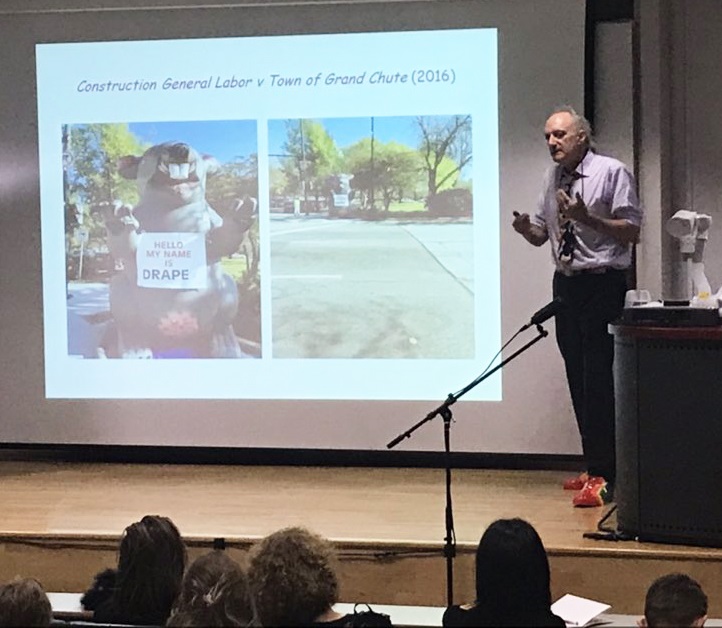
Professor Adam Gearey: Professor Peter Goodrich gave the Annual Law Lecture, ‘Retinal Justice: Rats, Maps, and Mask’. Professor Goodrich was one of the founders of the law school- and is presently an honorary fellow. There was certainly a sense of occasion, as alumni, students, staff and friends crowded into the basement lecture theatre. Peter Goodrich always gives a good show, and tonight was no different. One of the most interesting and important of contemporary legal philosophers, Professor Goodrich is also a fine performer. Sporting rainbow shoes, he paced the stage and banged on the projector screen for emphasis—a scholar and a dandy whose thinking exemplifies the rigour, intensity and playfulness that characterises thinking that is worth one’s attention.

Such a strange title! Professor Goodrich has long been interested in masks—his legal theory (hardly surprisingly) draws on ideas of drama and performance: the mask allows the actor to speak. It is an artifice or a convention that allows an audience to experience the drama as something ‘natural’. If masks allow actors to speak, then law allows subjects to speak by giving them a kind of structure or affiliation: man/woman/child – property owner; legatee, beneficiary, father, mother, citizen, criminal, holder of rights or duties etc. These features of law are ancient- and so- is the court’s concern with images. These are not just the images of law with which we are all familiar- but the way in which the law must adjudicate images. Professor Goodrich’s lecture primarily concerned images given in evidence; increasingly a central part of the court’s business. What conventions must the court invent to allow images to make sense forensically?

Hence ‘rats and maps’. The rat in question refers to an American case in which an image of a giant plastic rodent figured in the court’s reasoning. The maps evoked in the title are representations of title  to land — evidence often lead in property disputes. Retinal justice- then- describes how the court seeks to do justice using images.

Professor Goodrich’s point is that the courts are incredibly bad at reading images– often using them to merely illustrate words- or- misreading them altogether. It may be that the modern technologies of images have outpaced law’s imaginary (the rhetorical and semantic techniques law uses to encode the world in its own terms). But there is something stranger at stake. Images point elsewhere- compromising techniques that set out to control them. Certainly, in some religious traditions, the image threatens the understanding of divine truth. Other traditions carefully guard licenced images and rituals. What if the disturbing effects of images were also at work in law; disturbing the ways in which it judges the world? Professor Goodrich’s point is that this most ancient of problems haunts modern law. To engage with law and images is to think critically about the ways in which law makes claims about its authority and validates its operations. The disturbances wrought by images provoke us to think about different kinds of adjudication, and perhaps to see different kinds of affiliation: different ways of being and living. Professor Goodrich is challenging students of the law to become more productive, more creative and playful—and, perhaps, as well as dressing better—to see things differently: retinal justice.

Watch a video recording of the lecture.

Listen to an audio recording of the lecture.