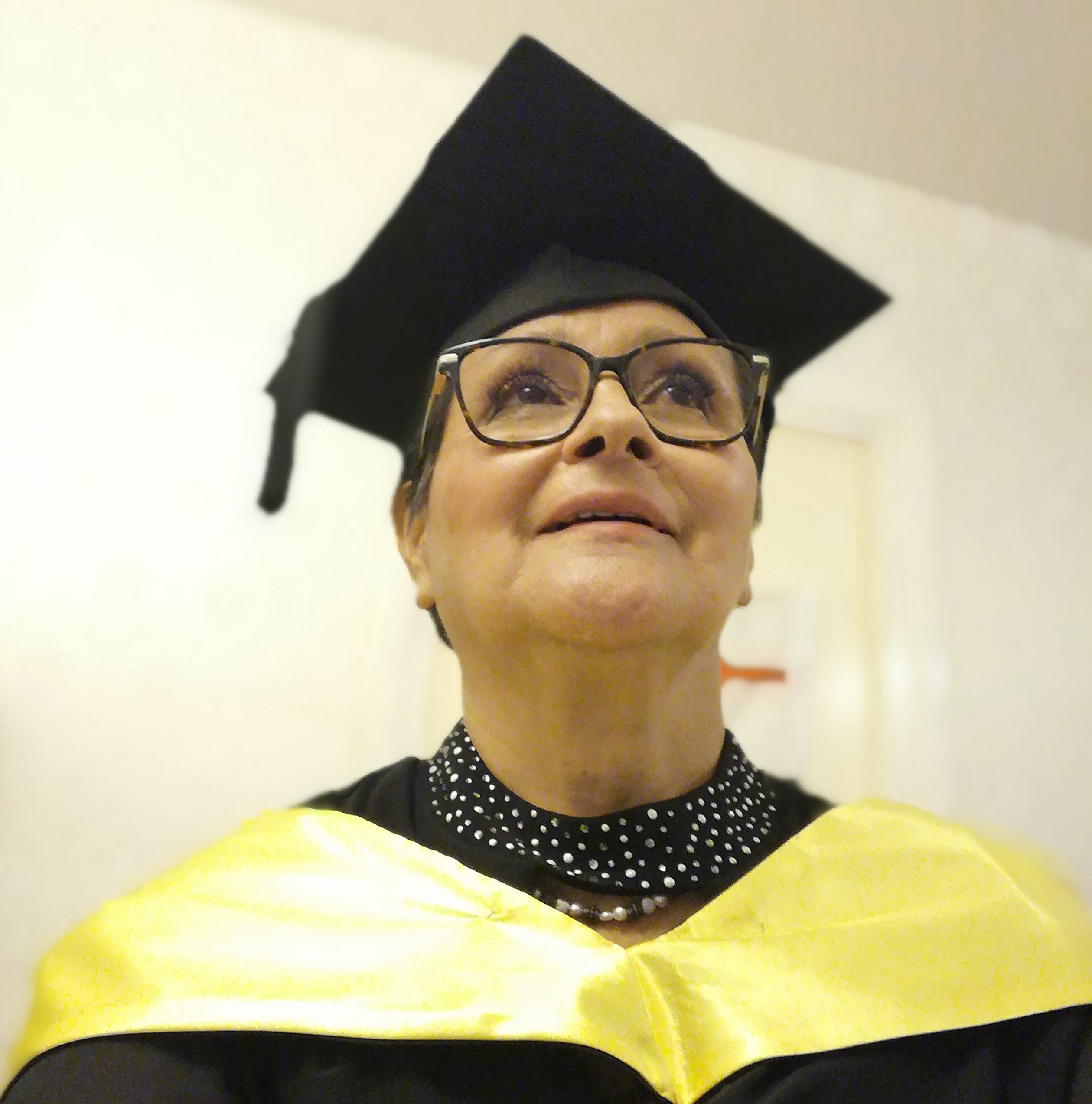
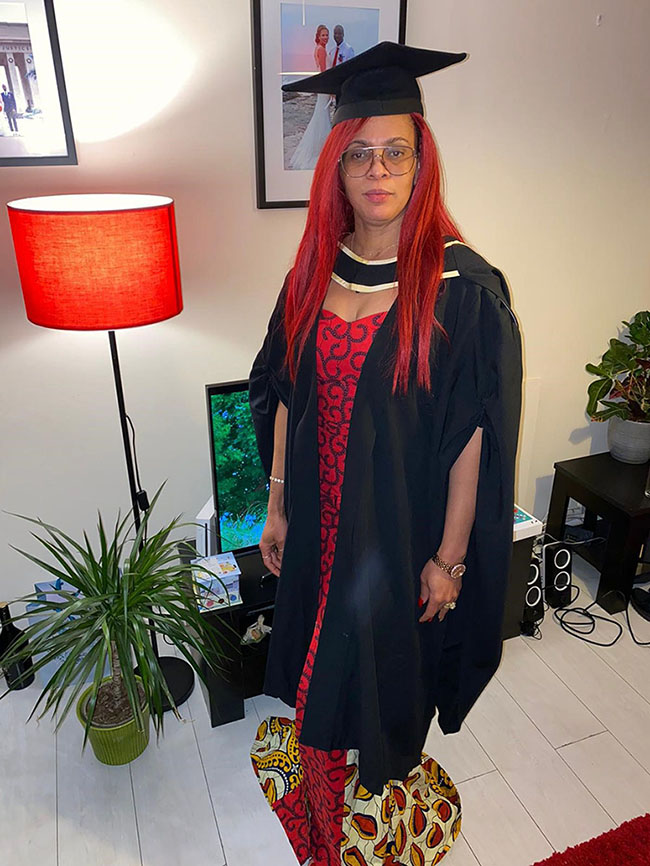
“Doing this degree has completely changed my expectations of what I can do in the future”

Isabella Ghawi faced challenges during studying, including a brain tumour diagnosis, epilepsy and dyslexia. With the help of Birkbeck’s Disability Department and her steely determination, Isabella founded the Birkbeck Biological society and graduated in November with a BSc Biomedicine degree. Here is her #BBKgrad story.

Isabella Ghawi

What made you decide to study at Birkbeck?

I did a lot of research because I left school quite suddenly without A levels as I started to have epileptic seizures.  After a long time, I decided I wanted to go back to university and study to be a neurophysiologist after my experience of working in a hospital.

I was searching for a good access to university course and chose Birkbeck as it had the best one. Unlike all the other places I looked at, it taught actual science. I knew that I wouldn’t just come out with a piece of paper, but I’d actually come out with real knowledge. After undertaking the Higher Education Introductory Course I decided to continue at Birkbeck to study a BSc in Biomedicine.

Did you face any challenges during your time studying? How did you overcome them?

I had a huge challenge in my first year. I already had epilepsy from the age of 18 and I had dyslexia. On top of that in my first year of biomedicine, I was diagnosed with a most likely cancerous brain tumour which meant I had to have a serious operation.

I overcame it, with the help of my family, my church and the people around me, but also with the support of Birkbeck – I’m especially grateful for the help and support I received from Dick Rayne, Mark Pimm and Jackie Saunder and many others. It was a learning curve for all of us, as we implemented new changes that were best for me at the time. So, with the help of all those people, I was able to continue and not just able to continue, but to really excel and exceed my expectations despite many difficulties.

Did you receive any additional College support whilst at Birkbeck and if so, how did this help you?

Birkbeck staff were a huge driving force because they were very understanding and supportive. The lecturers and the administration staff really helped me to develop resilience within myself and I kept going because they were so supportive. I also received a lot of help from the disability team. I received extra training on my computer with programmes that helped me with my dyslexia. There were a lot of assistive technologies that I was given, as well as a support tutor who was great and again, a real emotional rock. I also received a note taker and had extra time in exams which was helpful. Unfortunately, in a couple of my exams I had seizures, which were quite distressing. As a result, towards the end of my studies my exams were split, and I did them in smaller chunks which was extremely helpful. By the time it got to the last year, we had figured out what worked best.

What do you hope to achieve in the future?

Doing this degree has completely changed my expectations of what I can do in the future. Before doing this degree, I didn’t think I would be able to do much, but it’s made me really open to new opportunities. I really hope to continue to work in research, which is something I’d never dreamed of. I had never really done any lab work before this degree, but by the end of three years I was leaving the lab sessions thinking that if I could go back to the lab every day for the rest of my life, I’d be a very happy person. So, I would really love to work in a scientific laboratory.

This degree has also made me think that maybe there could be other things out there that I would be good at that I haven’t experienced yet. Now I’m looking for a job, hopefully in research, to gain more experience and then perhaps go back and do a PhD when I have more experience in the field, because I feel I really need more hands-on experience.

What advice would you give to someone who is thinking of studying at Birkbeck?

I would say go for it and give it a try, you will surprise yourself with what you can achieve. If you have any doubts or problems, there is so much help and support out there. I would also strongly suggest being open about your difficulties from the beginning with the staff.  If you do have a busy life and lot to cope with, for example if you have children, work commitments, health problems or caring commitments, the opportunity of doing part-time is well worth taking.

Studying at Birkbeck is a truly great experience, I would strongly recommend others go for it and give it a try. I don’t think you’d regret it, I certainly haven’t.

Further Information

“I dedicate my MA to my late mother, who was my rock”

Carolyne Megan graduated last month with an MA in Digital Media Design after caring for her late mother throughout her degree. This is her #BBKgrad story.

Carolyne Megan – © Photo by Joel, Peter Dyers Photographic Studio

I had a thriving career at University College London (UCL), working as a Web/Graphics and E-learning Technologist in Psychology and Language Sciences. I loved my professional career very much. Then in 2013, my father had cancer, so I left UCL to help my disabled mother care for him in his last months.

After my father died in August 2013, I applied to work at Imperial College London in the same role as UCL, but in their ICT department. I was extremely lucky as I was offered a job, and started in October 2013, as I was grief-stricken. After I started at Imperial, I was responsible for keeping my frail elderly mother supported in her home with carers. My main concern was to keep my grieving mother safe in her home and looked after by external social care.

In 2014, I paid for myself to do a Postgraduate Certificate in Web Design and Development at Birkbeck. I had a fantastic time, embracing new skills for my web portfolio. I built a great rapport with fellow students and then later attended the graduation ceremony at Senate House in 2016.

During 2013-2015, my mother’s situation deteriorated, and she was not coping well after my father died so I made a decision to leave Imperial in December 2015. In 2016, I sought low paid temporary Learning Technology jobs and by July 2016, I had reached a crisis with my mother. She was unable to look after herself, so her social worker and I facilitated a move to a good care home that was local to her.

It was an extremely painful process to endure in the summer of 2016, as I had to move my mother’s belongings and clothes into cases and take them from a five-bed detached house to one room in a care home. I was heartbroken for her. I promised her that I would spend three days every month in Sussex visiting her. So that became my routine. I sold her house, auctioned her possessions, gave her clothes to charities, her beloved book collection to refuse collectors as book sellers weren’t interested. It was painful process to go through.

My mother took a few months to settle in the home. She had an IQ of 140, despite being disabled by botched surgery and very frail. After she had settled, I applied for a job at UCL, in the libraries team, which was perfect as I have a love of books! My job involved processing new stock before sending the books to Main Library.

In 2017, I was approached by the Birkbeck School of Arts administrator, to notify me that there was a new MA in Digital Media Design. I was told that my credits from my previous course would enable me to do less modules to get the full MA. I really couldn’t afford it as I was on low pay. But my mother gave me a wonderful gift. She told me that she felt that I had given up my career to care for both her and my late father, and she wanted to pay the fees, so I could continue to ‘stretch my brain’ as she called it.

I wasn’t sure if I had it in me to do an MA, but I jumped at the chance to try. I asked my supervisor if I could do my dissertation in 2018, instead of 2019, and he allowed me to do this. With hindsight this was the best decision I made. I received a Merit for my dissertation and I dedicated it to my mother and gave her a copy of the book. She passed it round to all her visitors and it was full of coffee stains and blotches. She told me she was very proud and we were both emotional.

In February 2019, she was admitted to hospital with a blocked bowel and we were told that she was probably going to pass away. She was such a fighter and was sent back to the care home to be in a palliative care room. She was now unable to get out of bed and had to be turned every two hours. Her life was not really a life. She picked up and managed to carry on until July 2019. She overheard someone say that she was never getting out of the bed, so she stopped her fluids, food and medication and died after two weeks at the age of 95.

I miss her every single day, but I am glad she did not have to live in the year of the pandemic, as we would not have been able to have seen one another.

I dedicate my MA to my late mother, who was my rock.

Further Information

“I fell in love with Birkbeck the moment I began studying”

Patricia Bonifaz Carrillo arrived at Birkbeck without a formal qualification, but her desire and ambition to learn saw her complete the Higher Education Introductory Studies course and a BSc Business degree. Here is her #BBKgrad story.

Patricia Bonifaz Carrillo on her graduation day

Patricia, mother of five, left Colombia for the UK 15 years ago, to be closer to her children and grandchildren. She began her Birkbeck journey back in 2016, when she undertook the Higher Education Introductory Studies (HEIS) course (opting for the Business Studies pathway). Patricia became aware of the course because of Bridges to Birkbeck – an initiative in partnership with Haringey Council that aimed to meet the educational and career aspirations of residents in Tottenham. She found the course hugely enriching: “Enrolling on the HEIS course marked a new life for me, taking away the bad and sad memories I had. I studied alongside 19 peers from a rich variety of backgrounds and we all loved the experience of studying and getting to know one another.”

After completing the year-long HEIS course, Patricia enrolled onto the BSc Business degree in 2018, “I fell in love with Birkbeck, and I just thought, if others can do a degree, why can’t I? I felt much more confident in studying at degree level after the HEIS course, and the evening classes and part-time study option meant I could continue working and attend to family duties. I discovered that social inclusion and mobility are at the heart of Birkbeck’s philosophy, and are real facts, not words. I wanted to study business because it is the core activity around the world – everything has to be profitable.”

Patricia enjoyed all of her degree modules and she was very pleased to receive academic support for English and maths during one-to-one sessions throughout her degree. She explains, “I felt very supported at Birkbeck – the English support I received was excellent and really helped challenge me and improve my maths and English language skills. My course fulfilled my ambitions of learning about the economy, microeconomics and macroeceonomics, statistics, philosophy, governance, law for business, sociology, finance, business plans, psychology, research methods, marketing laws and understanding cyber-attacks prevention. The academic and administrative staff from the Department of Management were very caring, efficient and professional.”

She is hugely proud to have completed her degree this year, aged 69: “I’m so happy to have graduated, I never thought doing a degree in the UK was possible for me, and I’m the first in my family to have studied at degree level. I would encourage others to never doubt their skills and abilities, to not be afraid and to apply to study at Birkbeck to help them realise their dreams. The excellent reputation and relationship that Birkbeck has with the biggest employers and the support delivered to its students and alumni really enhances your skills and employability.”

Further Information

Struggle and Strife pave the way for Success

Demelza Honeyborne was born in Wales, taken to Liberia, West Africa aged 2 years old and survived a 10-year civil war, physical assault and years out of education to go on to recently graduate with a degree in Psychology. This is her #BBKgrad story.

The early years in Liberia, ongoing conflict and the battle to stay in education:

My mother was from Liberia. She and my Dad had separated, so she took me to her home country when I was just two years old. Liberia’s 10-year civil war started in 1990 when I was 13 years old and my mother died that same year. My father had left when I was about four, and I had no contact with him so I effectively became like an orphan during the war. Schools were closed due to the war for a few years- I can’t remember the length of closure…probably till 1996, but they reopened at points where there were cease fires so I missed a massive portion of my junior and senior schooling.

At 18 years old, I got pregnant with my twins and attempted school again. I would study during the day and work at a nightclub from the evening until 4am and then start all over again with classes at 8am. I did this for a year or so. I later got a day job which meant I had to go to night classes. My children were taken away from me by their dad’s parents when they were one as they deemed me unqualified to be a mother due to my circumstances (having no parents, being unmarried). However, I got them back when they turned five.  This meant I could work, study and stay off the streets.

A chance reunion with her father and return to the UK:

I had sent a letter to my old neighbourhood in Wales (I could only remember the first line of the address) to see if anyone knew where my dad might be. I didn’t think I’d have any luck but in 1999, the British Red Cross found my father and reconnected us, which is a totally miraculous happening on its own, hence I returned to the UK in 2000.

I worked for a year upon arriving to the UK- two jobs, seven days a week- until I saved enough money to bring my children over. A friend of mine, Brenda, had encouraged me to get back to study but I still had the mentality that I couldn’t dream and achieve. But I had a strong faith…I always remember my Mum would drop me off at Church when she was alive then would come back and get me.

Study goals in sight and enrolment at Birkbeck:

Transport for London, which is my employer, offers free courses; and working full-time with kids meant it was difficult to study outside of work, so I enrolled onto one of the courses. I did my GCSE English and passed with a B grade. The following year I did my Math GCSE and passed with a C. That was around 2014 -2016. During this time, I became a Station Supervisor which meant a change to my shift pattern. I then enrolled at West Kensington and Chelsea college in 2016 and studied Access to Psychology while working at night.

This then led me to join Birkbeck where I studied BSc Psychology and achieved a 2:1 degree whilst still working full-time, including night shifts. My professors were all super-amazing especially Gillian Forester who is super-awesome. It was very difficult but rewarding to know that at my age (43 years old), I could still achieve my dreams. Birkbeck is amazing!

I am currently doing my master’s in Health and Clinical Psychology with Birkbeck. My aim is to go into counselling and volunteer in helping people who have experienced traumatic situations as myself. During the war I was subjected to the trauma of sexual assault which became a norm. There was a war and being alive was most important, with the belief that once I had another day it was okay. I was a survivor.

Counselling and a mission to help others:

I have had different forms of counselling and I have spoken at length to trusted friends and my pastors, so I believe I can better manage my trauma and live a productive life. However, not many of my friends or those who experience similar situations can. Additionally, before coming to the UK, counselling wouldn’t have been something I would use.  As most Liberians even today still believe, to admit any mental illness is a sign of weakness and you can’t tell the world you are hurting, or you will appear weak and a failure. Additionally, people in deprived counties like Liberia do not have access to counselling facilities, so once I qualify, I want to look into offering virtual counselling or volunteering overseas, perhaps attached to a charity.

FURTHER INFORMATION

Study Psychology at Birkbeck.
Learn more about the Health and Clinical Psychological Sciences Master’s degree.