From leaving education at 15, to graduating with a Psychology degree

Anna Green is graduating this week with BSc in Psychology. Here she tells her story of her struggles with mental health growing up, her unconventional education path, and how Birkbeck’s Disability Service was instrumental in her ADHD diagnosis and her achieving a First-Class Honours. This is her #BBKstory.

Anna Green

I grew up in a working-class family, as an only child to a single mother. We moved around a lot, and I went to four primary schools in different parts of the country so I had a very disrupted education which lacked routine and consistency. I think this had quite a big knock-on impact as I found secondary school hard and I struggled to fit in. As a teenager, I could barely concentrate, got into fights with other children and by the age of fourteen was struggling severely with my mental health. Everything became overwhelming, which led to me spending four months in a mental health unit, and later that year, I lost my father to cancer. By the age of fifteen I had left mainstream education for good.

Aged 19, the opportunity to study GCSE’s and A-Levels at college arose and I studied for six GCSEs and two AS Levels. However, I lacked in direction and motivation, and abandoned education once again, working in hospitality until the age of 23 when I decided to give it another shot. I took a free, online Open University access course in People, Work and Society and once I completed that was delighted when Birkbeck accepted my application to study BSc Psychology. I knew psychology was the course I wanted to study because my teenage years were defined by my battles with mental health and I’ve always wanted to use my experiences to help other people going through similar challenges.

University was a turning point for me, as it was when I established my identity and got to know myself a bit more. It was a relief to be settled somewhere and be independent. I made friends quickly through group projects and I really enjoyed being around a range of people from interesting backgrounds. Being in the centre of London, with the British Library and nice pubs in Bloomsbury, meant I could socialise easily with people on my course. My days were busy but rewarding: I spent a few days a week working as a support worker for people who had acquired brain injuries, which was relevant to my degree and an opportunity that I stumbled across at Birkbeck’s annual Careers Fair. I also volunteered for Childline as a counsellor and tutored primary school children maths online through the pandemic. The great thing about Birkbeck is that it really allows you to balance work, volunteering and studying.

Unfortunately, in my second year, I began to struggle in familiar ways. The lack of focus was something I knew went beyond just a disrupted education and at times, an unstable childhood and I was finally diagnosed with attention deficit hyperactivity disorder (ADHD). I found my diagnosis helped me understand myself, but I did find it hard to accept for about a year. I applied for Disabled Student’s Allowance and was granted weekly study skills support and a mentor. Mark Pimm, Birkbeck’s Disability Service Manager, was so supportive and oversaw this process and advocated for me to receive all the help possible, such as deadline extensions; extra time in exams; useful computer software and equipment; study skills support; and a mentor. With the help of Birkbeck’s Disability Service, I was able to graduate with a First-Class Honours in Psychology.

I am grateful to Birkbeck for normalising mature study, providing opportunities for those who may not have perfect grades and factoring in a person’s life experience when accepting applicants. I have met some wonderful people who I’m still in touch with now, and I’ve learned that there is no time limit on education, and sometimes it’s best to wait until you feel ready to give it a go. In future, I would like to do a Master’s in Forensic Psychology and get a place on the Doctorate in Clinical Psychology. I couldn’t recommend Birkbeck enough to any mature student and my confidence has transformed over the last three years.

Further information
Department of Management Meets the Editor with Professor Geoffrey Wood

The Editor of Academy of Management Perspectives and Human Resource Management Journal shared advice with researchers looking to publish in highly-ranked journals.

The Department of Management’s popular ‘Meet the Editor’ series has returned for the 2021/22 academic year, welcoming Professor Geoffrey Wood as its first guest.

Professor Wood is Editor in Chief of Academy of Management Perspectives (ABS 4*) and Human Resource Management Journal (ABS 4*, World Elite), Professor and DanCap Private Equity Chair of Innovation and Department Chair and DAN Management at Western University in Canada.

Opening the session, Chair Dr Muthu De Silva, Assistant Dean for Research in Birkbeck’s School of Business, Economics and Informatics said: “We are really grateful to Professor Geoff Wood for offering to speak to us. As you all know, our key aim is to bring all of you together to meet eminent editors which will help us to together thrive in our research journey. Geoff has published over 220 articles in peer-reviewed journals, so we are very much looking forward to hearing his advice today.”

Advice for researchers aspiring to publish in highly ranked journals

Professor Wood began his presentation with some key advice for researchers:

Editors love novelty, provided that it is within the scope of the journal.

For example, the Journal of Finance is more conservative in terms of theory and methods, but open in terms of choice of topic, while the Academy of Management Journal prefers novelty in terms of theorizing.

Highly ranked journals care about how you calibrate your data.

This includes the scale of the study, for example how in-depth a survey goes, the number of interviews conducted and the quality of data sets.

It pays to do your homework: a journal’s purpose may not be obvious from its title.

In a message echoed from previous Meet the Editor events, Professor Wood gave the example of the Journal of Human Resources, which takes economics papers, to illustrate that it is worth doing some research to ensure your study is right for a particular journal.

The chance of publishing in a four-star journal may be higher than you think.

It is often assumed that a highly ranked journal receives thousands of submissions each year, but the Academy of Management Review receives just 400. The chances of publishing a high-quality paper in this journal are therefore higher than you might expect, but at the same time, leading journals expect papers with scholarly depth, inttrenal rigour, and, when appropriate, a sufficient weight of empirical evidence.

First impressions matter

Professor Wood explained “Referees are like anybody – they’re trying to make sense of a complicated world, so they will look for shortcuts and for the initial impression a paper gives.” He advised making a good first impression by ensuring a strong introduction, conclusion and abstract, and ensuring that any formula and tables in the paper are easy to understand.

Common pitfalls and how to avoid them

Out of date references

Professor Wood explained that this mistake is commonly made by PhD students, who begin gathering data well before writing up their findings. The out of date references make it look as though the paper has already been rejected elsewhere, and, potentially ‘zombie’ papers.

Ignoring referee comments

While it is accepted that researchers may wish to submit a rejected paper elsewhere, Professor Wood cautions against ignoring comments from previous reviewers. The comments are likely to give your paper a better chance of success, but even more so, you may come across the same reviewer at another journal who will be unimpressed if you have ignored their advice!

Failing to cite the target journal

Conduct a careful keyword search in your target journal to ensure you are citing the most relevant references. Not only is it insulting not to cite your target journal; the chances are that your reviewer will be somebody who has recently published in that journal too.

Academy of Management Perspectives Journal: Insight from the Editor

AMP’s Associate Editors have a lot of past editorial experience – typically 8-10,000 citations each – which represents “a lot of knowledge and wisdom coming into your paper.” Professor Wood noted the “career-transforming effect” for scholars whose work has been published in AMP.

He reassured attendees that the chances of getting published in AMP are fairly good, as the journal receives comparatively few high-quality submissions. From the end of the year, AMP will scrap the current system of submitting a proposal before the paper to ensure a more streamlined process for researchers.

It is also worth noting that the journal offers special issues, and would normally expect at least one person within a special issue team to be a very senior and well-established scholar.

Human Resource Management Journal

As a journal of political economy, HRMJ tends to take work that provides some reflections in the broader context of research. It also takes a lot of international work. The journal accepts empirical and conceptual papers, however it does not take organisational psychology papers that do not engage with HR issues. Researchers are not expected to be HR specialists, but they do need to engage with HR literature.

Professor Wood’s presentation was followed by a question and answer session, where researchers had an opportunity to ask more specific questions about the publication process, AMP and HRMJ. One researcher commented: “I think this kind of insight is very important – I don’t usually see editors to share these insights!”

Join us for our next Meet the Editor sessions:

We’re not “made out of sugar”

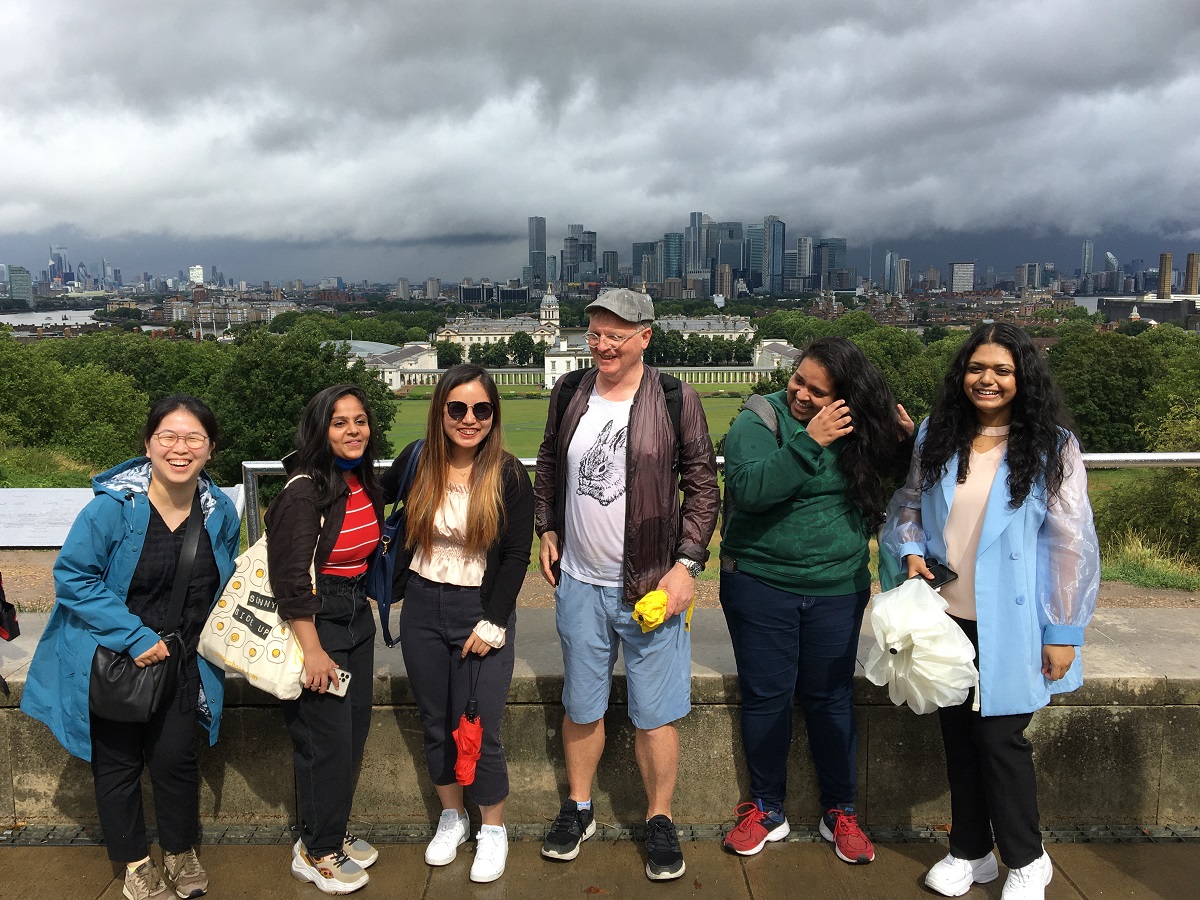
A student from Brazil recently shared that in her country, people who are reluctant to go out in the rain are teased with the question, ‘Are you made out of sugar?’ Last week’s day-out to beautiful and historic Greenwich proved that while they are certainly sweet people, Birkbeck’s international students are not ‘made out of sugar’, willing to brave the pouring rain. Read this account of the day.

International students visiting Greenwich

Our day began early morning at Westminster Pier, to take the Thames Clipper boat service to Greenwich. On arrival, despite the weather, students were keen to put up their umbrellas and enjoy the sights with tour guide Andrew to discover the history and stories behind this fascinating part of London.

In Greenwich Park, Andrew led the group up the hill to see the famous Royal Observatory. Before ascending, commenting on the grey skies and rain, he joked, “Who knows?  Maybe there’s bright sunshine at the top!”

On arrival, a low grey mist obscured the usually impressive views. Even the tall buildings of the nearby Docklands were hidden. However, within a few minutes the mist cleared, the sun shone and students were folding up umbrellas and reaching for sunglasses. Everyone enjoyed the stunning views of London. “What I said earlier was a joke!” laughed Andrew.

International students standing by the Greenwich observatoyTo round off the tour, we visited the famous Goddard’s Pie & Mash shop, where students enjoyed this hearty and delicious traditional London food.

International students at a pie and mash shopAndrew explained that Pie & Mash predates Fish & Chips as a traditional British dish, and that Goddard’s has been a family-run Greenwich favourite for over 130 years.

International students on the tour of GreenwichStudents ended their day in Greenwich full-up, maybe a bit wet, but also happy and, we hope, with some new friends. Sweet!


Office housework collective writing: an Astrea collaboration

This article was written by Kayleigh Woods Harley, project support coordinator in Birkbeck’s Strategic Projects Directorate. She chairs Birkbeck Astrea, a staff network for women, transgender and nonbinary people in professional and support roles. Astrea hosted Uracha Chatrakul Na Ayudhya and Aylin Kunter for a talk on office housework in May 2021 and this will be followed by a series of collective writing workshops to allow members to process their thoughts and feelings about office housework. The goal is to publish the writing in an academic journal on gender and work. In this blog Kayleigh talks about her experience of the first collective writing session in July 2021.

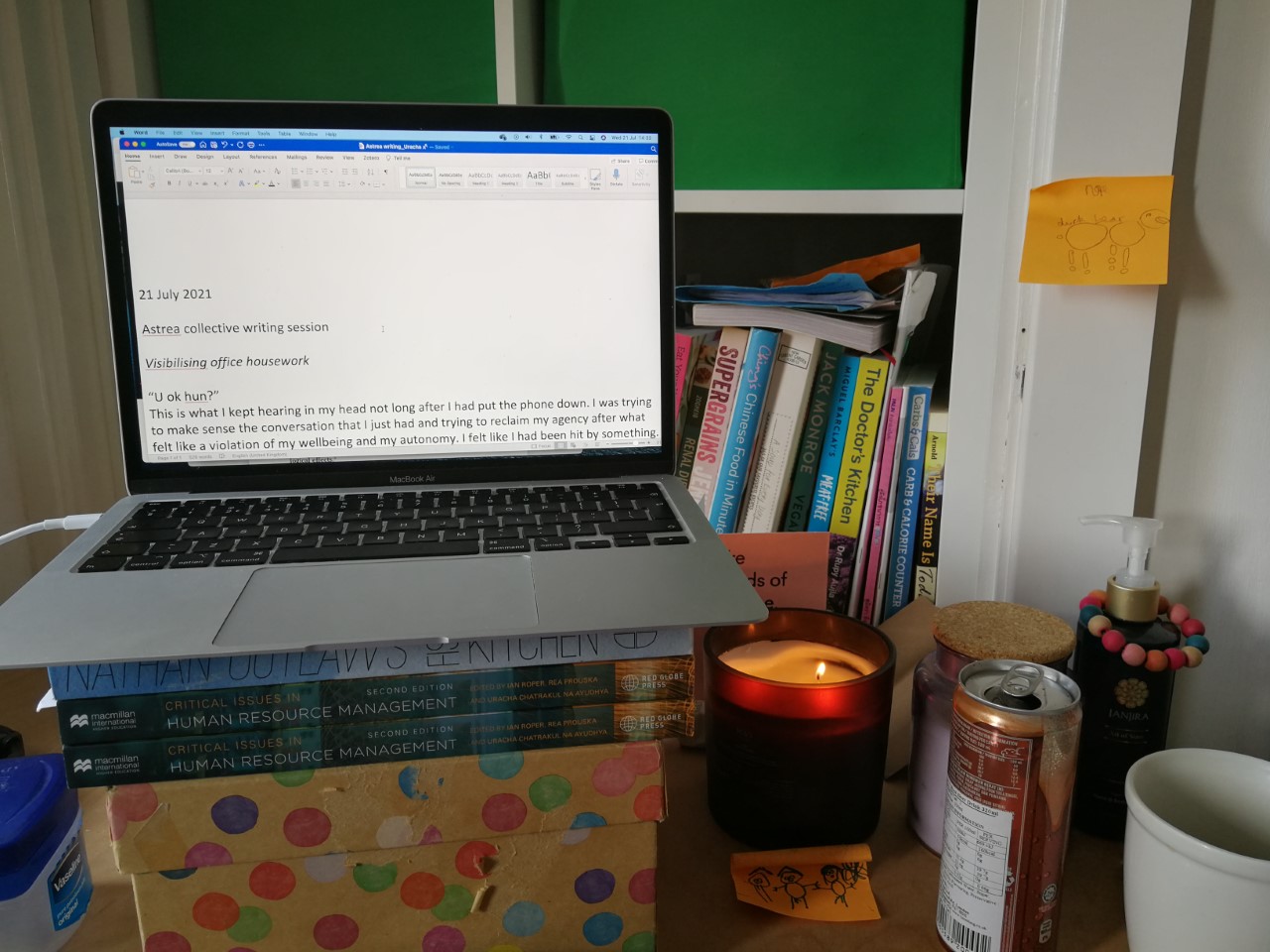
Photo of an academic's desk

I first came across the term ‘office housework’ during an Astrea event in May 2021, led by Aylin Kunter and Uracha Chatrakul Na Ayudhya, two academics who have collaborated in the past on the interactions between gender and work. Their talk was a natural extension of their previous research, but also a departure in that they were proposing to bring Astrea members along with them on a new strand exploring the particular experiences of professional services women, transgender and nonbinary people. I wasn’t familiar with the idea of office housework, nor aware that it tends to be undertaken by those with the least power in the workplace, making it an intersectional phenomenon. I now understand that office housework is all the tasks and responsibilities we carry out which are not part of our job description, nor are they rewarded or recognised as ‘work.’ And the more I thought about it, the more I realised I was doing it all the time.

So when Aylin and Uracha invited Astrea members to a collective writing session where we could think, through writing, about examples of office housework we had undertaken, I prepared a few notes ahead of time. Coming prepared to meetings is something I do often, as an extremely conscientious individual. You could argue that it’s a form of office housework, that feeling of always needing to go above and beyond to make sure you not only ‘turn up,’ but are ready to fully participate in a work-related meeting or interaction.

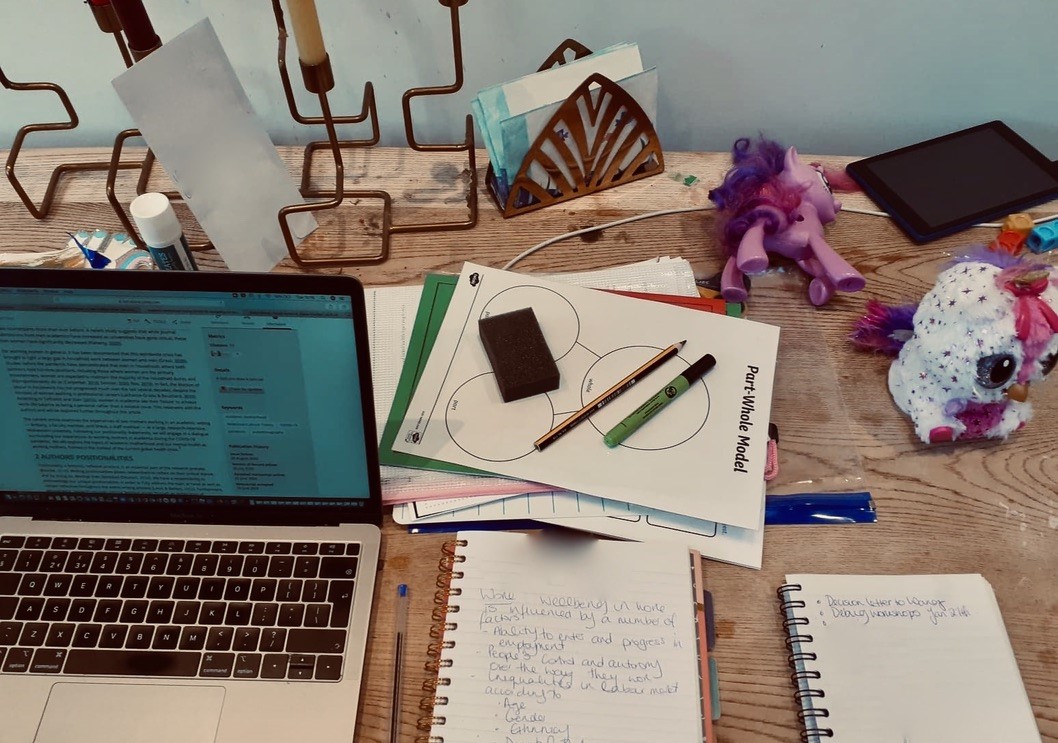
Photo of Aylin's desk

After some friendly deliberation over how to proceed and how long to give ourselves to write something, we muted our microphones and individually began to write. There was no script, no structure. Just write down what you feel, what you think. My mind turned from the stresses and worries of a normal workday and focused on one thing solidly for 30 minutes. It was possibly the fastest half hour of the day, and during that time I was engrossed, my mind completely engaged in the thinking-through of my subject. I was completely myself, by which I mean my authentic self, not my work self. This is a luxury I am rarely afforded.

The others had posted chat messages indicating they were ready to finish and even share their writing. Listening to them read their thoughts was a moment of pure connection. How brave they were for being able to write such honest things and to feel able to read them aloud! They could have chosen not to, and yet we each felt it was important to say what was on our minds, no matter how raw or emotional it might be. I read my piece, too, and felt immediately validated by their responses to it. How often do we take the time to say something uplifting or supportive to our colleagues? (Is doing so another form of office housework?) And yet I felt like the last hour or so had not felt difficult or straining, like a normal day spent at my living room table with my laptop open to my emails. It was a moment of true connection, of seeing and being seen for who I really am.

This feeling was not mine alone. Uracha affirmed, “For one hour today, I found myself being transported out of my daily chaotic work space into a safe and collective space through writing together and listening unreservedly to one another about office housework. It was truly freeing to be connected and to be heard, seen, and held.”

Astrea members can read more about the office housework project and find out when future collective workshops are scheduled on the Astrea SharePoint.