This post was contributed by Guy Collender, Communications Manager at Birkbeck.

Professor Mark Mazower, of Columbia University, and Marlene Hobsbawm, Eric Hobsbawm's widow, at the reception following Mazower's lecture at the History after Hobsbawm conference.

Professor Mark Mazower, of Columbia University, and Marlene Hobsbawm, Eric Hobsbawm’s widow, at the reception following Mazower’s lecture at the History after Hobsbawm conference.

If evidence were needed of Eric Hobsbawm’s widespread and profound impact upon the study of history, the speakers assembled at the History after Hobsbawm conference provided cast-iron proof.

The gathering of such high-profile historians was testament to Hobsbawm’s influence upon the discipline, particularly his emphasis on the importance of social and economic history. It reiterated his ability to broaden horizons, inspire individuals, and, in some cases, generate dissent.

Familiar to students and scholars because of their seminal works, high-profile speakers at the three-day event included :

Mazower – one of Hobsbawm’s former colleagues at Birkbeck – delivered the opening lecture at the conference organised by Birkbeck in association with Past & Present. He described Hobsbawm (1917-2012) as an “inspirational figure” who “loved” Birkbeck  – an institution committed to adult education without the class snobbery that retarded the development of social history elsewhere.

Transforming history

Mazower charted the progression of Hobsbawm’s career and the simultaneous, and often related, transformation of the discipline of history. He explained how Hobsbawm was one of only four historians when he joined Birkbeck’s History Department in 1947, decades before the discipline became the professionalised and globalised profession it is today.

The audience on 29 April at Senate House heard how Hobsbawm’s participation in the International Congress of Historical Sciences in Paris in 1950 led to long-standing ties with French intellectuals, and subsequent cooperation between two prominent social history journals: Annales, and Past & Present. (Hobsbawm was one of the founder members of Past & Present in 1952). Mazower quoted the leader of the Annales School, Fernand Braudel, writing about Hobsbawm in 1968: “In my opinion he is one of the most important historians in the present world.”

Hobsbawm’s emphasis on social and economic history, and his internationalism were mirrored by the expansion of History departments, the increase in social history, and the emergence of world history and area studies in the 1970s and 1980s. Mazower added: “Hobsbawm was, in many ways, at the very centre of some of the critical intellectual and institutional developments of the discipline for several decades.”

The future of history

Professor John Arnold, Head of Birkbeck’s Department of History, Classics and Archaeology, encouraged the audience to think about current trends in the study of History, and, in Hobsbawm’s words, “dream forward.” He referred to “Eric’s extraordinary impact on the study of history” and encouraged argument, discussion and debate over the next two days of the conference. The conference speakers and delegates certainly rose to the challenge. Read more about the conference online on the History after Hobsbawm blog:

Agents of Internationalism: First Internationalism Workshop at Birkbeck College

19 to 20 June 2014

This workshop is the first in a series of events organised under the umbrella of The Reluctant Internationalists, a four-year project which examines the development and institutionalisation of international collaboration in twentieth-century Europe.

The workshop programme is now available at http://www.bbk.ac.uk/reluctantinternationalists/events/

The workshop is co-hosted by Contemporary European History and has three main aims:

  • First, it attempts to look beyond the self-declared liberal elites to identify other groups who built or dismantled international institutions. The workshop aims to shed light on who these (inter)national agents were, and why, when, and with what results they argued that some form of internationalism was practicable, necessary, or unavoidable.
  • Second, the workshop seeks to bring into focus alternative chronologies and periodizations of European history. We wish to revisit and revise the by now standard narrative of internationalism’s rise, decline and rise – from its rediscovery in the aftermath of the First World War, and a new enthusiasm for international institutions in the subsequent decade; to its spectacular failure in the era of protectionism, racial conflict and the destruction of the international architecture; to its triumph in the second post-war era; and, after the worst of the Cold War freeze, the flourishing of a new global era in the 1970s. We wish to re-examine variations of this narrative, and recover nuances and pinpoint different trajectories for different international projects.
  • Third, the workshop seeks to foreground Europe’s place in the history of internationalism. We are particularly interested in how international cooperation has evolved within European nation-states, and how concepts have differed within different parts of Europe and European peripheries.

Each of the seven panels will examine one group with international connections (relief workers, women, children, refugees, collaborators, soldiers, and ‘experts’) and identify continuities and disjunctures in the appeal and application of different internationalist programmes and agendas.

Attendance is free but places are limited. Please contact Ana Antic a.antic@bbk.ac.uk to reserve a space.

David Harvey and Andy Merrifield in conversation

This post was contributed by Rowan Lubbock, a student on Birkbeck’s MPhil/PhD programme (Politics) whose research focuses on the relationship between the peasant movement La Via Campesina and the regional institution of ALBA.

In a packed lecture hall last Thursday night at Birkbeck College, I was lucky enough to see two heavyweights of urban studies and Marxist theory in conversation, largely around the topics of their latest books. Andy Merrifield’s The New Urban Question, and David Harvey’s Seventeen Contradictions and the End of Capitalism set the tone of the conversation, which sought to unravel ‘the urban’ as it exists today.

Merrifield kicked off the evening with an explication of what the ‘new’ urban question entailed. Fundamentally, the neoliberalisation of cities had created a type of ‘neo-Haussmannisation’, a process that transforms public infrastructures into sources of profit for private actors. The term seeks to compare and contrast today’s urban form with the great renovation project of Paris in 1854 by Georges-Eugène Haussmann, which saw a reorganisation of the urban fabric on a gargantuan scale. Like Haussmann’s Paris, today’s urban condition is characterised by a process of gentrification, turning urban centres into spaces of consumption, speculation and leisure. But unlike Haussmann’s project, today’s neoliberal city does not create new ‘values’ (i.e., creation of infrastructure that absorbs surplus capital, expands employment or facilitates new spaces of accumulation); it ‘parasitically’ extracts value from existing public goods. Merrifield asks how it is possible that capitalism is able to reproduce itself in the absence of what it fundamentally requires for its survival – the creation and re-creation of public infrastructures.

The effect this has on the public at large led Merrifield to enquire into the nature of social resistance to these types of privations. Here, a number of concepts were offered: “double agents”, as those who live a type of double life split between the exploitative nature of their workplace and the more egalitarian values they may hold; or “great escapers”, who seek to exit the system altogether (The Coming Insurrection, being one example). These disparate terms reflect the general disorganised form taken by today’s potential ‘sans-culottes’, yet Merrifield cited the potential for ‘rage’, ‘imagination’ or ‘creativity’ for bringing these social forces together.

Harvey’s response was offered in his typical register, which revolves largely around Marx’s three volumes of Capital. This did, however, bring Merrifield’s winding and speculative exploration into a more grounded understanding of how capital circulates within and beyond ‘the city’. Yet at this point of the conversation, the formalism of ‘critical disagreement’ (which Harvey himself noted was an unavoidable necessity) tended to occlude the substantial overlap between each position.

For example, if Merrifield’s ‘neo-Haussmannisation’ is something that is happening in virtually every city, Harvey helped to stitch this picture together by referring to the ways in which cities form a type of global hierarchy through which the differential flow of value is transmitted; from low-wage, low profit margin-based production in China to high profit margin-based realisation of sales in North America, which has become a key feature of today’s global economy. From his observation of the power shift from productive capital (e.g., General Motors) to commercial capital (Wal-Mart), Harvey questioned to what extent today’s neoliberal cities can be considered ‘parasitic’, given that consumption itself is central to the realisation of value and its production. He went on to say that, “if value cannot be realised through urbanisation then capital is in a lot of difficulty” – thus, the city and the “manner of its orchestration” as a market-place delineates the parameters of this potential difficulty. But surely the manner in which neo-Haussmannisation unfolds, as described by Merrifield, points towards a precarious foundation upon which capital attempts to expand without the requisite spatial infrastructures that are needed in order to move beyond an urbanisation process based on property speculation and conspicuous consumption by the world’s richest people.

Nevertheless, the value of Harvey’s political-economic take on the ‘new’ urban question lay in his claim that the structures of accumulation largely produce their own specific forms of resistance, the corollary of which is that we must understand what capitalism is doing if we want to go beyond it. This is indeed a useful approach that helps us to fill in the gaps created by terms like ‘multitude’ and their ‘screams’ against the power of capital. It would have been interesting to hear some alternative suggestions, which Harvey stopped short of, but this was perhaps unavoidable given that his own provisional answer to the problem of anti-systemic organisation boils down to no less than seventeen necessary elements.

What was certainly made clear that night is the scale of the problems we all face as human beings who are subjected to the most in-human forms of social predation. The need to address the contradictions of capitalism and the questions they pose is more vital now than ever.

A video of the event is now available.

Invisible Circus: A visit from Jennifer Egan

This post was contributed by Amy Clarke, a student on the MA Contemporary Literature & Culture at Birkbeck. This post was originally published by Birkbeck’s Centre for Contemporary Literature.

At any symposium dedicated to a particular writer, as Dr Stephen J. Burn noted in his keynote here, one of the first questions that will arise is whether or not their work is worthy of such immersive attention. In Jennifer Egan’s case, it quickly became apparent not only that her work would stand the test of such detailed scrutiny and deliver rich discussion, but that despite having somewhere between ten and twelve hours to talk about it, we were in danger of running out of time. Which is satisfyingly ironic, really, given that Egan’s most famous novel, the 2011 Pulitzer Prize winning A Visit from the Goon Squad, is ‘explicitly about time’, as she puts it, having taken its inspiration from Proust’s In Search of Lost Time.

Accordingly, the majority of papers presented throughout the day, irrespective of which of Egan’s novels they focused on, tended to discuss time-related themes in all their complexities: ageing, reliving events, ghosts, music, nostalgia. A recurring issue for many of them was the difficulty of getting a grip on the present, whether that be the contemporary moment or a present belonging to the past, like the 1960s of Egan’s first novel, Invisible Circus (1995). Tellingly, when asked how she felt about the possibility of writing a 9/11 novel, Egan commented ‘I’m not there yet’, the main difficulty being that ‘we’re still trying to figure out what it meant’. This issue of defining the present, which features so prevalently as a theme in her work, is evidently very real for her.

Ruth Charnock gave a very inspiring paper on the idea of ‘reliving the event’ in relation to Invisible Circus, asking what it means to have been there in relation to a past event and how we negotiate what ‘there’ means in terms of time and place, nicely bringing together the two elements that Egan defines as her starting points when writing. Charnock also discussed the seemingly paradoxical notion of being nostalgic for an event that one never experienced first time around, and how this is perhaps caused by the mythologisation of certain periods of history, notably via technological media. This idea, also discussed in Mark West’s paper, struck me as having something in common with the concerns of David Foster Wallace’s essay ‘E Unibus Pluram: Television and US Fiction’ (1993). ‘[The] banal, the naive, the sentimental and simplistic and conservative,’ qualities emulated by sixties television (which subsequently inspire nostalgia), were manufactured, Wallace claims, to underplay the realities of corporatism, bureaucracy and racial tension in that era.

Certainly the subject of television in relation to Egan’s work extends beyond this comparison. A Visit from the Goon Squad, in particular, raises the question of how the media of TV and film have impacted on the contemporary novel. This idea was first introduced at the symposium with the Friday night screening of Episode Five from the first season of HBO’s long running series The Sopranos, another inspiration for Goon Squad. The connection between the two is not immediately obvious; but rather than subject matter, the common ground they share concerns their form and ambition. Egan noted how the episodic structure of television dramas likeThe Sopranos is not dissimilar from that of serialised 19th Century fiction and was, in fact, most likely influenced by that form. Egan is interested in how such an episodic structure allows for a multiplicity of sub-plots and creates a feeling of mystery for the viewer, who cannot trace the narrative arc until the story is completed.

Discussing the ambition of The Sopranos, Egan mentioned how she borrowed from the series its idea of pushing character and narrative to extremes. In the episode screened, Tony Soprano is visiting colleges in rural Maine with his teenage daughter when he spots a man who snitched on the mob years back; he duly tracks him down and brutally strangles him. The juxtaposition of family-based innocence against mob violence – and the fact that, despite Tony’s actions, the viewer still empathises with him by the end of the episode – demonstrate for Egan a skill in composition and execution to which she aspires. Egan herself experimented with this simultaneity of humour and darkness most evidently in her 2006 novel, The Keep.
JE-18

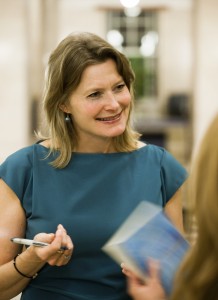
Jennifer Egan at Senate House, London, photographed by Simon Annand.

In a sense, then, Egan is reclaiming for contemporary fiction an episodic narrative form that originally started in Victorian fiction but was, along the way, filched by television. Indeed Egan appears to enjoy the dialogue between literary and screen arts in all its reciprocations, asserting at one point that ‘the advent of film led to Modernism’. However, rather than simply adopting a televisual form for Goon Squad, Egan moulds it so that her work achieves something unique to fiction, less visual, that cannot be directly re-created on film: each of the novel’s chapters has a different voice, ‘tone, mood, world’, from the others. Although she abandoned the idea of writing a chapter in the style of Byron’s epic poetry (for the simple reason that she discovered she was, to her mind, ‘a horrible poet’), Egan borrows from a wide range of literary forms, drawing on the likes of footnoting, power point and speculative fiction throughout the novel.

The issue of whether or not Goon Squad is in fact a novel was only marginally addressed throughout the conference. Valerie O’Riordanpersuasively suggested that the work could be more accurately described as a short story cycle: a view that seems corroborated by Egan’s explanation that she more or less began the work by accident, writing three separate short stories (which later formed three of the chapters) as ‘procrastination before beginning her next novel’. Charting diagrammatically Egan’s disruption of a linear chronology throughout Goon Squad, Riordan discussed how analepsis and prolepsis are also used to great effect in order to problematise further the idea of time. Riordan also considered how past memories can impact on the present, disabling a person’s ability to move forwards towards the future, as in the case of Bennie in Chapter Two.

Rachael McLennan drew on similar ideas of chronology but in relation to identity and ageing, focusing exclusively on the ‘Safari’ chapter of Goon Squad. She legitimised the novel’s fragmented chronology with the assertion that ‘we don’t move through time in a linear way’ and asked the question of how we locate the core self. Is the core self an earlier self or is it always the present self? McLennan also introduced the idea of belatedness, of being out of time in the present, a concept that was echoed a number of times throughout the day and one which seems appropriate when considering the paradox at the heart of Goon Squad: that a novel so beautifully epitomising contemporary America should owe so much to a form typically located in the early 20th century.

Contrary to this complexity and richness, anyone unfamiliar with Egan’s work and reduced to the age old cliché of having to judge a book by its cover alone could be forgiven for thinking, at first glance, that Egan might be a writer of ‘chick lit’. The current UK covers of The Invisible Circus and 2001’s Look at Me, in particular, carry plaudits from ElleCosmopolitan andO, The Oprah Magazine. I say ‘at first glance’ as they are amongst accolades from SalonThe New Yorker and the Guardian, and once you’ve reached the Ulysses epigraph of Look at Me you know that, at the very least, you’re in ‘thinking-chick lit’ territory. Perhaps what this ultimately indicates is that Egan is managing to strike that elusive balance of simultaneity: writing challenging and experimental literature whilst aiming to reach the wider readership most commonly achieved by ‘popular fiction’. If successful, in a century’s time, Egan may be sat alongside Proust in the canon. But only time will tell; and anyway, ‘Time’s a goon, right?’