Lessons learned from the COVID-19 pandemic

International students across Birkbeck came together last week to catch up and discuss the responses of their home countries to the pandemic. Professor Sanjib Bhakta, Assistant Dean (Internationalisation and Partnership), writes about the successful event in this blog. 
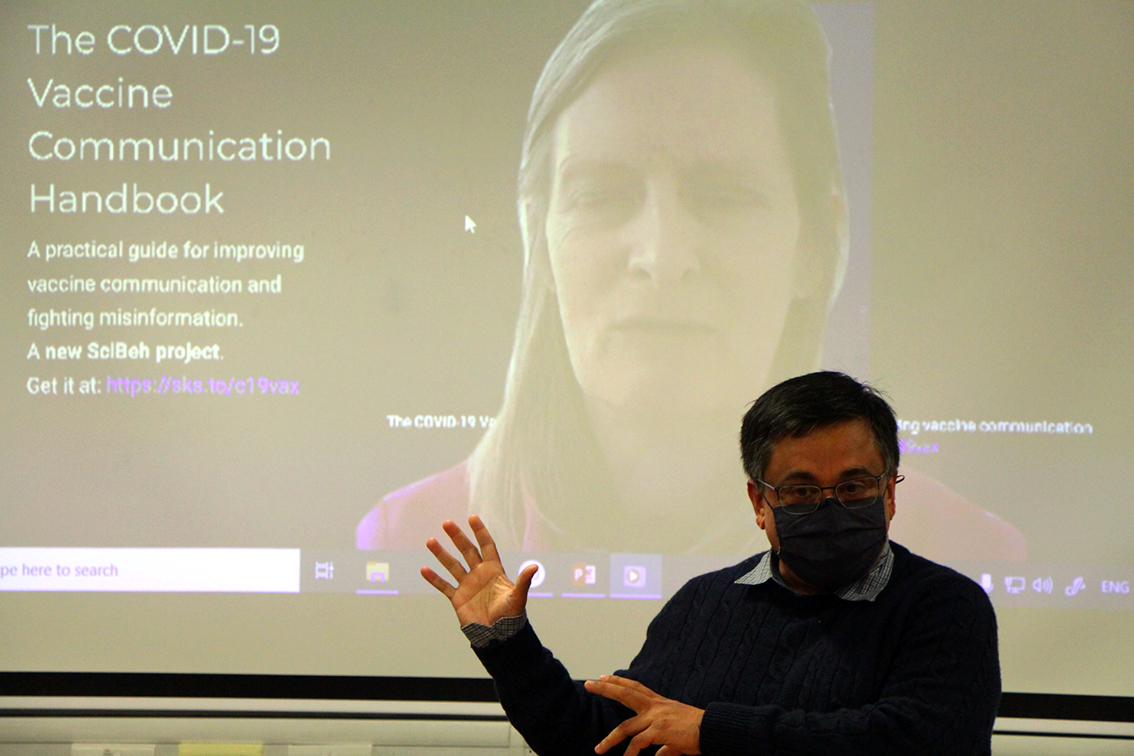
Professor Sanjib Professor introduces Professor Ulrike Hahn. Photo credit: Harish Patel

An afternoon tea at Birkbeck on Thursday 25 November was attended by international students from a variety of Schools, including ScienceArts, and Business, Economics and InformaticsProfessor Nick KeepExecutive Dean of the School of Science, inaugurated the session by welcoming the students and sharing how the School has nurtured a long-standing international culture. He explained how the school has created many fruitful cooperatives through building international alumni networks over the years.  

Professor Sanjib Bhakta, Assistant Dean (Internationalisation and Partnership), highlighted the importance of sustaining cultural roots while studying at Birkbeck. He also spoke on how the planned international students’ experience events throughout this academic year aim to enrich further diversity in Birkbeck’s life-long learning environment.  

Students shared their personal experience of the COVID-19 period in relation to their home countries; how economies, administration and politics have continued to play a crucial role in policy making and implementation of these policies towards tackling the ongoing pandemic differently in various parts of the world. This discussion was prompted by the question – ‘What lessons have we learned from this pandemic so far?’ Everyone enthusiastically participated in the active conversation which was followed by watching an interview with Professor Ulrike Hahn, Professor of Psychology, on the COVID-19 Vaccine Communication Handbook and Wiki. The handbook was published with the aim to demystify the myth of COVID vaccinations and solve the challenge of vaccine hesitancy. We re-enforced how the world is still in the midst of a pandemic and vaccine uptake in London particularly is lower than many other cities in the UK. Everyone appreciated the significance of such an outreach initiative.  

On a lighter note, everyone also shared their hobbies outside their own curriculum and continued chatting while taking sips of tea. Harish Patel, Technical Services Manager in the School of Science, demonstrated his passion for photography and shared his knack with students. All participants were appreciative of such event that created the opportunity for them to interact with other peers in-person.  

Professor Nick Keep said of the event: “It was nice to hear the diverse experiences of students coming from different countries and regions.  Sanjib did a great job of opening up friendly and insightful discussion.” 

 Further information 
A warm welcome to our 2021 Compass Scholars

After another competitive application round, Birkbeck once again welcomed 20 new students onto the Compass Scholarship Programme this October. The students, who are studying a range of subjects such as Psychology, Maths, Business and Politics, are almost at the end of their first term at Birkbeck already. Here’s a look back at their journey so far and some of the things they have been up to.
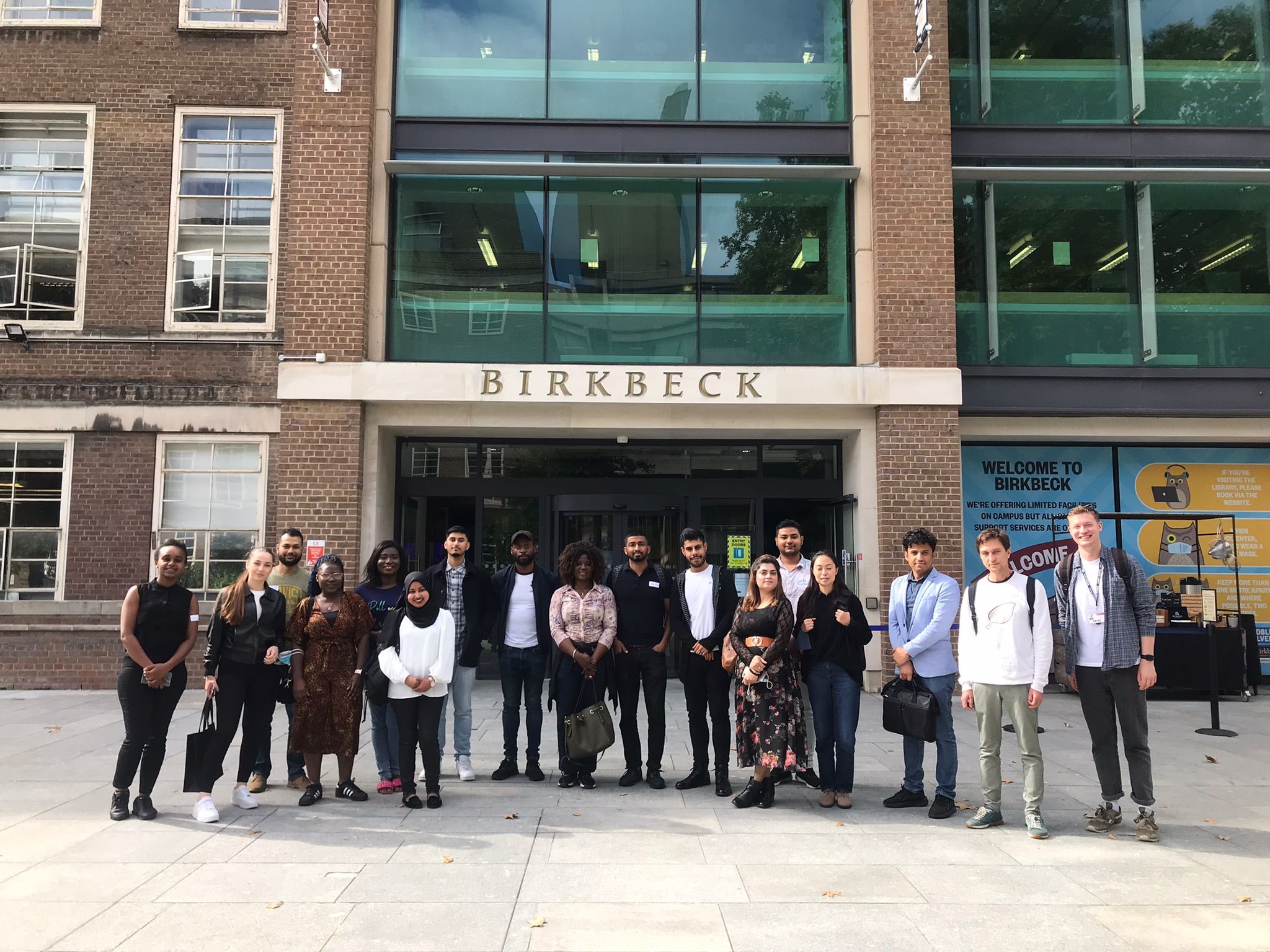
A group of Compass students outside of the Malet Street building

We were kindly hosted by the fantastic Library staff at Birkbeck for our two-day Orientation. In addition to a friendly welcome from the Access and Engagement Department staff who run the Compass Project, our Scholars heard from Birkbeck’s Wellbeing, Study Skills and Library team about the services available to them this year. They also enjoyed some tasty food from Terrace 5, a restaurant in the main building and a tour of the facilities. Thankfully the weather was great and showed off Bloomsbury in its best light during our mini tour of the area.

Following Orientation, our Scholars were introduced to their volunteer academic mentors. Our mentors participated in online training with mentor lead, Luke Williams, over the summer and have been checking in with their students throughout the term. A huge thank you to our mentors as always, for the support and guidance they offer to our scholars.

Birkbeck Students joining our friends at Student Action Refugees at the Anti-Refugee Bill Demonstration on 20 October

Birkbeck students and Compass team holding up signs that say; "Refugees welcome"Some of our scholars have already teamed up with last year’s Student Action Refugees (STAR) committee. In addition to the meetings to plan this year’s activities, they got stuck in straight away through their contributions to the Anti-Refugee Bill rally that took place on 20 October in Westminster. It was lovely to see representation at the rally from so many of our partners in the sector. Birkbeck is proud of its STAR student society and are excited to see what things they get up to this year.

If you would like to find out more about the Compass Project at Birkbeck, see our webpage or email the Compass Project team.

Celebrating the winter solstice at Birkbeck

This month, Birkbeck’s International experience committee and Chinese Students and Scholars Association (BBK CSSA), hosted a networking event to mark “Dongzhi”, the winter solstice. The event gave Chinese students from the broader community the opportunity to share their experiences of studying in London.

In this blog, Di Luo, Chair of BBK CSSA, discusses the importance of the festival to Chinese people and how attendees marked the occasion.

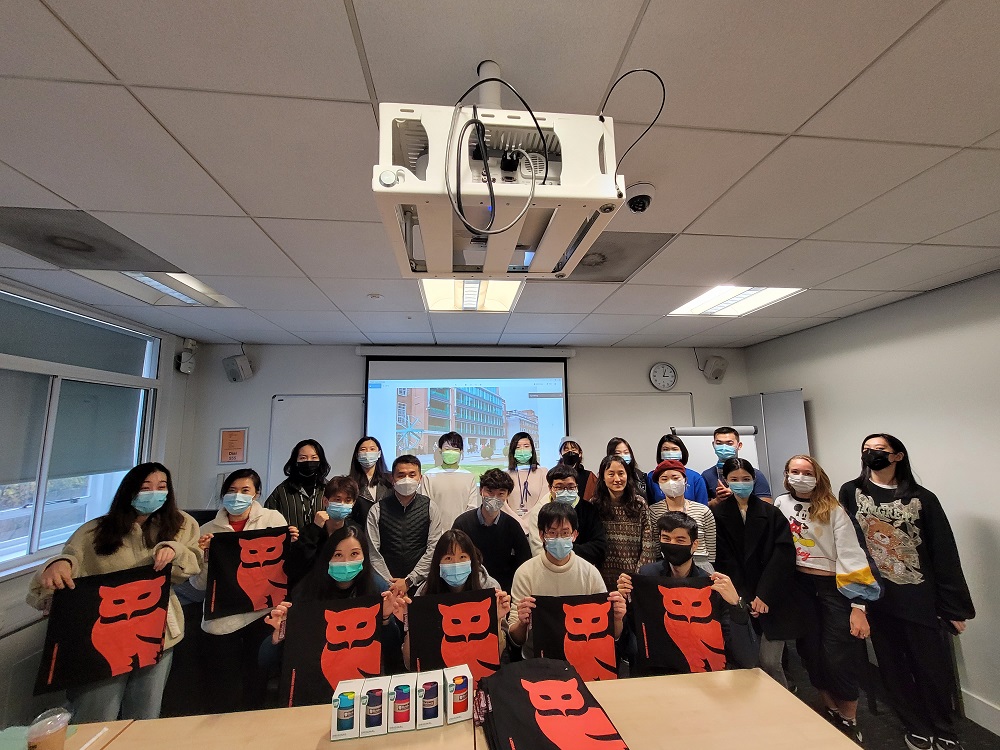
Students in  classroom with masks on, the people in the front row are holding up a branded bag with an orange owl on the front

In Chinese, the winter solstice is called “Dongzhi”, which literally means “the arrival of winter”. The Dongzhi Festival is one of the most important celebrated by the Chinese – as important as Chinese New Year, in fact. It is a time families come together and bond over the preparation of a symbolic dish.

The winter solstice occurs when either of Earth’s poles reaches its maximum tilt away from the Sun. This happens twice yearly, once in each hemisphere (Northern and Southern). In the Northern region of China, to celebrate Dongzhi, people eat fatty dumplings that contain meat and high Yang warming herbs such as ginger and garlic. In the Southern region of China, people gather together to make and tangyuan, a Chinese dessert made with glutinous rice flour, which symbolizes family unity and prosperity.

Due to COVID-19, this year’s celebration at Birkbeck had to be adapted. Nevertheless, we were pleased to see over 25 students from Birkbeck, SOAS, Queen Mary University and Goldsmiths University, who enjoyed the wonderful event. Attendees were served traditional British snacks and Bubble Teas, courtesy of guest Xiaoyu Chang, from Ying Tuan.Hula hoops, cheddar cheese packets and bubble tea on a table

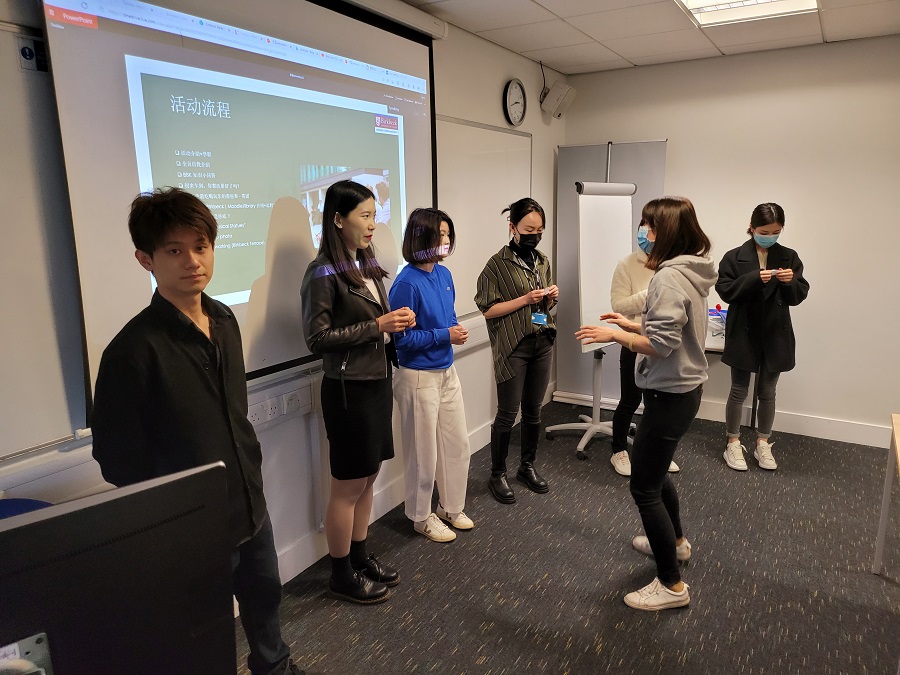
The afternoon included a question-and-answer session with an introduction to the College’s facilities. There was also a session on how to study more efficiently, and fun things to do in London, as well as games and quizzes, such as the “who is undercover” game, and a talent show. Zoe Stephens, an MSc International Security and Global Governance student at Birkbeck, introduced herself in SIX different languages, including; English, Mandarin, Korea, Japanese, German and Dutch! It was very entertaining, and congratulations to Zoe on winning one of the prizes. The event was filled with laughs and the sharing of good wishes for 2022 from attendees.

BBK Chinese students and scholars’ association, hereby, on behalf of all Chinese students studying at Birkbeck and our alumni, wishes everyone a happy and warm winter this year, and the very best of the new year of 2022, which will soon be upon us!

Further information:


How to become and thrive as an impactful scholar 

Birkbeck’s School of Business, Economics and Informatics welcomed Professor Morten Huse for the first in a series of talks on how to conduct rigorous, impactful research.

At a time when academics face increasing and competing demands on their time, how can researchers ensure that they are conducting theoretically rigorous and practically impactful research? 

On Monday 15 November, the School of Business, Economics and Informatics welcomed Professor Morten HuseProfessor Emeritus at BI Norwegian Business School (Oslo) to deliver the first in a series of talks entitled ‘How to become and thrive as an impactful scholar’. The talks draw on reflections from Morten’s award-winning book: ‘Resolving the Crisis in Research by Changing the Game’. 

The session was chaired by Dr Muthu De Silva, Assistant Dean (Research) in the School, who welcomed Professor Huse and colleagues to the event. 

Morten began by sharing his motivations for writing the book that forms the basis of this series, which he described as an “introspective journey”. The book began as part of an ERC Advanced Research Grant Application exploring a sharing philosophy in academia and the concept of engaged scholarship. 

Morten introduced the idea of a “scholarly ecosystem”; a holistic view of academia that encompasses the institution, the community, its audience, messages and communication channels. In particular, he highlighted the importance of the community and transferring from a “publish or perish culture into true scholarship”. 

The key elements in the sharing philosophy are:  

  • Caring for each other 
  • Open innovation 
  • Impact driven 
  • “Life is too short to drink bad wine” 

Open innovation 

Morten argued that open innovation is a holistic process, in which individuals’ scholarly lives cannot be separated from their private identity. It is about the integration of head, heart and hands. 

He explained: “I think we all agree that scholarship goes beyond learning the tricks of the trade. Still, I’m seeing that the most popular sessions in conferences are about how to learn to publish, how to learn the tricks of the trade, more than really getting into the research.” 

Reflecting on his experience at Witten/Herdecke University from Chapter 7 of the book, Morten discussed the importance of open dialogue and contributions from across the academic community to create a communal experience. 

During his time at Witten, Morten began to define himself as a mentor and to use a policy of “starting with the heart”, discovering that the head and the hands would soon follow. 

An impact-driven approach 

Morten shared some examples from Chapter 8 of his book to show the importance of an impact-driven approach. 

Referencing his work on the ‘getting women on boards’ research agenda during the 1980s and 1990s, he explained: “We wanted to be open and share, in that way learning so much more than when we were just protecting things for our own credit. We could risk that somebody worked faster than us in publishing and getting credit: what mattered was that the important things were understood. In that period, we were not afraid of sharing with each other what we were doing, because we were learning so much more and so much faster. “ 

Polymorphic research 

Morten defines polymorphic research as “alternative ways of thinking and doing research.” This involves avoiding formulaic methods as shortcuts to publication and instead pursuing impactful research by challenging assumptions, methods, interpretations and how research is communicated beyond publications to make a change in business and society. 

An example of this type of research is the ‘champagne method’: action research featuring interaction and co-creation between the actor and the researcher. The champagne method involves a holistic approach and requires trust, positive energy and continuous reflection. It represents the integration of research, teaching and action. 

“Life is too short to drink bad wine” 

Throughout the event, the talk returned to the catchphrase “Life is too short to drink bad wine”, which embodies Morten’s philosophy that researchers should spend their time on the projects that will be truly meaningful, with colleagues who share their passion. How to achieve this type of research and the scholarly journey will be explored in-depth in upcoming sessions in this series. 

The presentation was followed by discussion from delegates, which further explored the impact of individualistic vs communal cultures and how to scale-up an open innovation and communal approach. 

Places on session two of this series on thriving in different stages of an academic career are available to book now.