Category Archives: Humanities and Social Sciences

Graduation stories: a family affair

Samiya Lerew graduated with a BA in Global Politics and International Relations at Birkbeck’s Autumn Graduation Week 2017, at the same ceremony as her son Edwin. Here she talks about how she came to Birkbeck and how much it has meant to study as a family.

I can’t thank Birkbeck enough for granting me such a great opportunity to study. For the longest time I’ve been politically active, but never pursued politics academically. Growing up in Mogadishu, I had seen the effects of what dysfunctional nationalism combined with dictatorship can do on the place I call home. So naturally, I wanted to study the nature of politics (which Dr Jason Edwards has described as “the very best things we can achieve in a society, and the very worst things we can do to each other”) in order to help me reach the right conclusions and certify myself as an ‘intellect’!

I came to London as a student in the early 1980s. At that time I was studying English, general office work, Pitman short hand and touch typing (my short hand is non-existent, however, my touch-typing skills stays with me to this day). But I was unable to take my studies further because as soon as I completed my course, my stepfather died. As he was the bread-winner of the family, I had no choice but to find work in order to help my widowed mother.

From that point, I was unable to pursue a full undergraduate degree because I was working full-time for Haringey Council as a rate rebate officer, and was then married with three children (two daughters and a son) with a mortgage on a home in Barnet, north London. However, I did manage to help form coalitions with a number of charities dedicated to problem-solving in the Horn of Africa. I set up the Help Somalia Foundation and in 2004, I attended a UN Human Rights conference; my input has helped to resettle Somali minorities in western countries, I have worked with Minority Right Groups and I briefly chaired AFR (Agenda For Reconciliation). But I have always found it difficult to cut red tape unless I had “BA (Hons)” next to my name.

So, encouraged by academic colleagues in these charities, and realising that it never really is too late, I applied to study Global Politics & International Relations at Birkbeck not long after my 56th birthday. Birkbeck couldn’t have been more welcoming after I submitted my application and took an active interest in my exploits. Studying part-time also allowed me to continue my charity work and activism for the affairs of my country of birth.

I admit that it has been particularly difficult at times to juggle the demanding academic studies, work, activism and house-keeping but I have been lucky to be studying with my son Edwin; he applied to do Government & Politics the same year as me and he became my study pal. Mind you, in four years he managed to dodge all of my classes!

We read Adam Smith, Machiavelli, Karl Marx and Foucault. We regularly exchanged ideas and had conversations about politics and how some of the concepts we studied at the Uni could be used as tools for contemporary world politics. It was great to have him study at the same time – he is also a great friend and a carer.  And we actually graduate at the same time. He’s now doing his MA at the Royal Academy of Dramatic Art and has his theory class at Birkbeck, telling me that all the political philosophers are turning up again!

“You might try and escape politics, but politics will never escape you”, I say to him.
Knowledge without borders

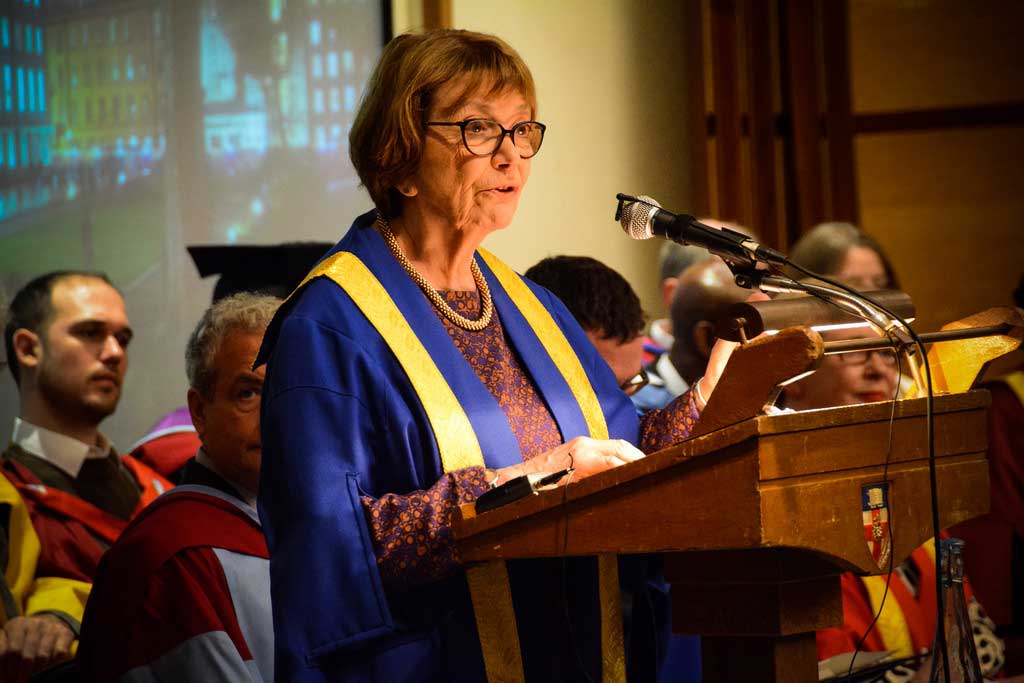
Baroness Bakewell, President of Birkbeck, addresses the College’s newest graduates as she congratulates them on their achievements during Graduation Week.

In her speech, she emphasises that the upheavals of a changing world and the UK’s withdrawal from the European Union should not be allowed to stand in the way of knowledge-sharing and education, and how our new graduates can help to break down borders.

It is always a great pleasure to be with you here and offer my congratulations to you on your success. This is a day you will always remember; a watershed in your lives, your careers, that will have a lasting influence on how you live your future life – where you go, what you do and. most importantly, what satisfaction it brings you.

When I look out across a sea of faces and listen to your names, I am impressed by the range and diversity of our graduates. As for your names – you may notice that I try to catch the first name of each of you as I meet you as you cross the platform. That’s because each of you matters individually to Birkbeck. It’s not always easy; I can’t always get it right. There are some names that are not familiar to my own background in the north of England. But even as I hesitate in my wish to get it right, I take pleasure in knowing what a global reach Birkbeck has. I am always delighted to speak with those of you from places across the world. Birkbeck embraces you within its academic fold. And that goes too for my fellow Europeans.

Indeed, I want to say something more about this sense of belonging and the barriers that inhibit it. These are troubled times, when matters of identity – who you are and where you came from – are increasingly used to define and, indeed, restrict what you can do, where you can work and where you can make your home. The whole of Europe – and indeed the larger world – has a long history of men who drew lines on maps and made laws giving power to those lines. We are the inheritors of those maps, and we both thrive and suffer because of them. Not just in Europe but across the Middle East, Africa, the Indian subcontinent, the Americas  – tribes of mankind have settled and developed, have lived within those lines and traded across them. They are the nation states we have today.

I, the people on this platform and all of you enjoy crossing those lines.  As a young student long ago I remember being woken in the night on the train south by a man in uniform demanding my passport and shouting:  “We are now crossing into Switzerland.” I was thrilled. At the first station I got out to buy fresh Swiss coffee and cakes. It was all so new. I had grown up in a country at war so, of course, only the servicemen of our armed forces got to travel abroad. France, Belgium, Holland and beyond were all occupied by the Germans. I got my first taste of crossing a frontier when I went to France at the age of 16.

I offer these personal reminiscences to show just how much times have changed. And then something important happened: the foundations of what we today call the European Union were created. And something happened in our family, too. Something I had never seen before: my father wept. He wept with joy that never, never again would there be war on the continent of Europe such as he had seen twice in his lifetime: the First World War with its death toll of 17 million. And the Second World War, including the war in the Pacific, with over 50 million dead.

He cried for himself and for his children: they would inherit a safer, more coherent Europe. And so it came about.

But wars did happen, and barriers took on a new significance. In the Middle East, and across Africa, people fled their homelands, crossed legal lines between countries to seek refuge from conflict or to seek a better life for themselves. They crossed frontiers in their millions and, in so doing, changed not only their own lives but the lives of those from whom they sought asylum. One of the outcomes of these shifts has created the world we have today: a world at odds with itself, finding it hard to formulate new rules by which to live – and, incidentally, defying the precepts of many of the world’s great religions which is always to “welcome the stranger”; make him welcome within your gates. People have increasingly become dogmatic, hostile, uneasy about their lives and their homelands.

But there is another – and, I believe, more powerful – impulse at work in the world: and we here today can be part of it. Knowledge is universal. The discoveries of science, medicine, social welfare, anthropology, literature, cultural studies are shared by scholars and institutes of learning around the world. It is crossing lines. It knows no boundaries.   The wisdom of study, the richness of shared understanding, the value of scholarship is something we are taking part in, simply by being here today.

Your remit extends around the world and your future careers will reach into many countries and communities. What we have in common is stronger than what divides us; stronger than the lines on the map; and we are here today to celebrate that shared outlook. Congratulations again to you all.

Orientation 2017: Welcome to Birkbeck

New and returning students joined this year’s Orientation events.

A new year at Birkbeck kicked off with Orientation, a range of events to enable students to familiarise themselves with the campus, get to know fellow students and refresh academic skills to boost their confidence.

It was an action-packed and busy day with nearly 2000 new and returning students signed up to browse the Fresher’s Fayre in the marquee outside the main campus, in order to find out about college sports and societies, ask current students questions about life at Birkbeck, and pick up some freebies.

There were also a range of talks throughout the afternoon on key topics to help students get their years’ off to a great start, on topics from looking after mental health, time management, to preparing for dissertation writing, and campus tours throughout the day.

Thank you to all who attended.

Celebrating the legacy of African diaspora cinema

Dr Emma Sandon reports on the 2017 Black Film, British Cinema Conference, and considers the importance of the June Givanni Pan African Cinema Archive and the crowdfunding campaign to support it.

The 2017 Black Film, British Cinema Conference was recently held at the Institute of Contemporary Arts (ICA), where I joined June Givanni in a discussion on the legacy of the original seminal conference of the same name almost 30 years ago. The conference focused on black film production and drew together a wide range of filmmakers, television commissioning editors and producers, cultural workers, academics and theorists to discuss the impact and politics of black film in Britain in the 1980s.

Givanni is a Guyanese-born, London-based film curator, a member of the Africa Movie Academy Award jury, an honourary Fellow at Birkbeck, and the driving force behind the June Givanni Pan African Cinema Archive. She used materials from the Archive to visually recreate the historical moment of the first ICA conference for the 2017 audience, and to discuss its importance today.

The Archive has partnered with the Department of Film, Media and Cultural Studies at Birkbeck, and is currently crowdfunding to get its catalogue searchable online. It has recently secured two grants from the Arts and Humanities Research Council (AHRC) as part of these fundraising initiatives.

John Akomfrah, filmmaker and artist, commented on the crowdfunding appeal, saying: ‘we tend to think of the past as something gone – a moment gone – but actually the past segues into the present, the past ghosts the present and that’s why archives matter.’

The June Givanni Pan African Cinema Archive offers a key example of the issues in archival practices that need to be addressed today. It holds over 10,000 film and film-related artefacts, collected by June in her role as programmer and curator over a period of 35 years. The collection has grown over several decades of anti-colonial struggle and the emergence of African diaspora cinema, and thus provides an invaluable historical resource, making a significant contribution to our understanding of modern black identities. It showcases the work of black filmmakers, acts as an educational tool for students of all ages, and inspires filmmakers, curators, artists and other cultural workers.

June’s sustained commitment is a political intervention in creating a transnational collection that would otherwise not have emerged out of institutional archives interested in national heritage. Research at the Archive and Public Culture Research Initiative at the University of Cape Town shows the preservation and use of archives is deeply entangled in the politics of race and colonial histories. Calls to decolonise the archive, education and the universities in South Africa, such as the Rhodes Must Fall movement, resonate here in the UK.

Increasingly, archives from personal and subjective collections are being recognised as important to our sense of memory, questioning the idea of objective and rational state-owned archives as repositories of a nation’s history. Many institutions around the world are struggling to sustain the collections they have acquired, and to ensure accessibility to special collections donated to them. As a member of the archive’s Advisory Group, I have been involved in discussions as to how to translate the personal curatorship of this collection into a working infrastructure to sustain the archive and to find it a secure base. Most crucial to this process is its identity as a Pan African cinema archive, which celebrates its political energy in the moment of liberation from colonial rule.

June’s decision to keep her archive independent is to enable its future.

Donate to the crowdfunding campaign to help secure the future, independence and accessibility of the June Givanni Pan African Cinema Archive.