Category Archives: Business and Law

Birkbeck Sport Business Centre heads to Paris for Executive Master in Global Sport Governance (MESGO)

BEI Events and Communications Coordinator Orla Walsh shares the highlights of Birkbeck Sport Business Centre’s recent trip to Paris for Session 2 of the MESGO programme.

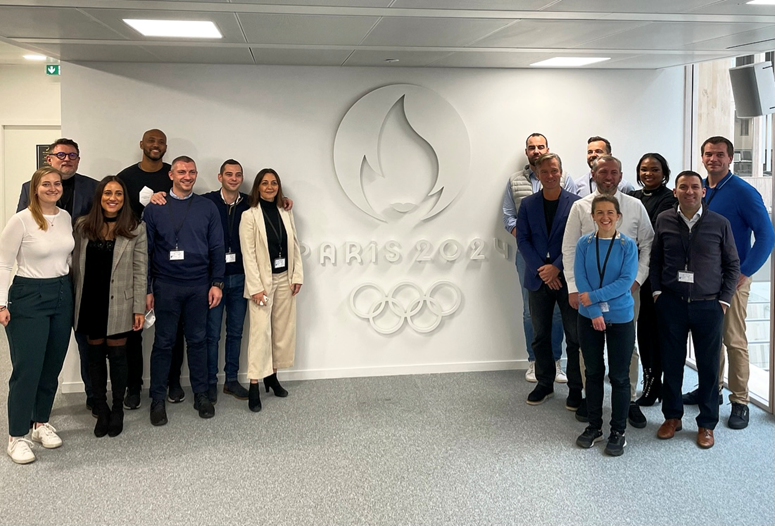
The MESGO VI participants at the Paris 2024 Olympic and Paralympic Games Organising Committee. 

The Executive Master in Global Sport Governance (MESGO) is a unique programme designed for sports sector professionals wishing to master the complex dimensions and the diversity of international practices related to professional sport.

Birkbeck is a founding academic partner in the MESGO programme. The MESGO, now in its sixth edition, is supported by four of Europe’s leading sport federations: UEFA, FIBA, IIHF, and EHF, and the Council of Europe EPAS.

A week in Paris dedicated to Competition Design and Financial Sustainability

Having previously attended their sessions and webinars online, MESGO VI participants were able to meet face to face in Paris, France, for Session 2 of the programme in late November.

The session was dedicated to competition design and financial sustainability and was directed by Sean Hamil, Senior Lecturer in Management and Director of Birkbeck’s Sport Business Centre.

Sean Hamil, Senior Lecturer in Management and Director of Birkbeck’s Sport Business Centre.

The five-day session covered several sub-topics related to governance, evolution of competition design, regulation of international player transfer markets, and diversity in sport.

Each day, we visited a different sporting facility, including the Paris Saint-Germain Football Stadium, the French Football Federation, the Auteuil Hippodrome Racecourse, the Ice Hockey Accor Arena, and the Paris 2024 Olympic and Paralympic Games Organising Committee.

The participants also got the chance to engage in sports events in the evenings, such as a game of basketball and attending a professional volleyball match between Paris and Nice.


Keep up to date with Birkbeck’s Sport Business Centre on LinkedIn and Twitter.

Further Information

Early career researchers in Management receive expert feedback at Birkbeck’s Paper Development Workshop

The workshop invited delegates from universities across the globe to present their work-in-progress research papers to well-published academics from Birkbeck’s Department of Management.

The Department of Management’s Paper Development Workshop welcomed students from institutions across the globe to share their research and receive feedback from well-published academics.

The Workshop was organised by Dr Konstantinos Chalkias, Director of the PhD Management Programme; Dr Muthu De Silva, Assistant Dean (Research) in the School of Business, Economics and Informatics; Dr Neil Pyper, Assistant Dean (Learning and Teaching) in the School of Business, Economics and Informatics; and Mark Thurgood, PhD student in Birkbeck’s Department of Management.

In total, 27 papers were accepted for the event, with submissions from the UK, Germany, India, Spain and the Netherlands.

The workshop began with a keynote address from Professor Yehuda Baruch, Southampton Business School, on ‘Transforming PhD research into publishable papers’. Yehuda advised delegates on how to produce a strong paper and how to capitalise on their PhD research in further publications, reminding students that this is “probably the only time in your career when you’re able to devote a full three years of your life to a big project without competing demands on your time.”

Yehuda encouraged students to think ahead to the kind of role they would like to have after their PhD, contrasting the benefits of teaching vs research-oriented institutions and academic roles vs postdoctoral research positions.

Following the keynote, participants were divided into groups based on their research interests, where they presented their papers to an expert reviewer from Birkbeck.

Prizes were awarded for the best full paper and best developmental paper and all accepted attendees were offered a year of British Academy of Management membership. Congratulations to our prizewinners:

Saurabh Jain, Entrepreneurship Development Institute of India, Ahmedabad

Best Developmental Paper Award for ‘Impact of Service Innovation on Social Media Entrepreneur’s Performance’.

Thanos Fragkandreas, Leo Leitzinger and Marius Liebald, Goethe University Frankfurt

Best Full Paper Award for ‘Is the Linear Model of Innovation Actually Dead? A ‘Topic-Sentiment Analysis’ of Policy Documents.’

Further Information:

How to become and thrive as an impactful scholar 

Birkbeck’s School of Business, Economics and Informatics welcomed Professor Morten Huse for the first in a series of talks on how to conduct rigorous, impactful research.

At a time when academics face increasing and competing demands on their time, how can researchers ensure that they are conducting theoretically rigorous and practically impactful research? 

On Monday 15 November, the School of Business, Economics and Informatics welcomed Professor Morten HuseProfessor Emeritus at BI Norwegian Business School (Oslo) to deliver the first in a series of talks entitled ‘How to become and thrive as an impactful scholar’. The talks draw on reflections from Morten’s award-winning book: ‘Resolving the Crisis in Research by Changing the Game’. 

The session was chaired by Dr Muthu De Silva, Assistant Dean (Research) in the School, who welcomed Professor Huse and colleagues to the event. 

Morten began by sharing his motivations for writing the book that forms the basis of this series, which he described as an “introspective journey”. The book began as part of an ERC Advanced Research Grant Application exploring a sharing philosophy in academia and the concept of engaged scholarship. 

Morten introduced the idea of a “scholarly ecosystem”; a holistic view of academia that encompasses the institution, the community, its audience, messages and communication channels. In particular, he highlighted the importance of the community and transferring from a “publish or perish culture into true scholarship”. 

The key elements in the sharing philosophy are:  

  • Caring for each other 
  • Open innovation 
  • Impact driven 
  • “Life is too short to drink bad wine” 

Open innovation 

Morten argued that open innovation is a holistic process, in which individuals’ scholarly lives cannot be separated from their private identity. It is about the integration of head, heart and hands. 

He explained: “I think we all agree that scholarship goes beyond learning the tricks of the trade. Still, I’m seeing that the most popular sessions in conferences are about how to learn to publish, how to learn the tricks of the trade, more than really getting into the research.” 

Reflecting on his experience at Witten/Herdecke University from Chapter 7 of the book, Morten discussed the importance of open dialogue and contributions from across the academic community to create a communal experience. 

During his time at Witten, Morten began to define himself as a mentor and to use a policy of “starting with the heart”, discovering that the head and the hands would soon follow. 

An impact-driven approach 

Morten shared some examples from Chapter 8 of his book to show the importance of an impact-driven approach. 

Referencing his work on the ‘getting women on boards’ research agenda during the 1980s and 1990s, he explained: “We wanted to be open and share, in that way learning so much more than when we were just protecting things for our own credit. We could risk that somebody worked faster than us in publishing and getting credit: what mattered was that the important things were understood. In that period, we were not afraid of sharing with each other what we were doing, because we were learning so much more and so much faster. “ 

Polymorphic research 

Morten defines polymorphic research as “alternative ways of thinking and doing research.” This involves avoiding formulaic methods as shortcuts to publication and instead pursuing impactful research by challenging assumptions, methods, interpretations and how research is communicated beyond publications to make a change in business and society. 

An example of this type of research is the ‘champagne method’: action research featuring interaction and co-creation between the actor and the researcher. The champagne method involves a holistic approach and requires trust, positive energy and continuous reflection. It represents the integration of research, teaching and action. 

“Life is too short to drink bad wine” 

Throughout the event, the talk returned to the catchphrase “Life is too short to drink bad wine”, which embodies Morten’s philosophy that researchers should spend their time on the projects that will be truly meaningful, with colleagues who share their passion. How to achieve this type of research and the scholarly journey will be explored in-depth in upcoming sessions in this series. 

The presentation was followed by discussion from delegates, which further explored the impact of individualistic vs communal cultures and how to scale-up an open innovation and communal approach. 

Places on session two of this series on thriving in different stages of an academic career are available to book now. 
Changing careers: from coffee shop manager to finance administrator

When Alba DeCarlo left school at 18 she never imagined she would get a degree. Despite that statement, this week she graduates from Birkbeck with a degree in BSc Business and has changed careers from a coffee shop manager to a Finance and Administrator lead for NBC Universal. This is her #BBKgrad story.

Alba with her sister Anna

Alba DeCarlo (R) with her sister Anna Rita DeCarlo (L) who is also graduating this year with a degree in BSc Marketing.

Alba first came to the UK from Italy aged 19, with very little English. She found a job as a waitress and eventually worked her way up to being the manager of a coffee shop from the ages of 21 to 25. While she enjoyed the social atmosphere and physicality of her job, Alba began to feel in need of a change. “I needed to escape the industry, just do something different. Then my mum said, ‘Why don’t you just go to university?’ I had not considered it an option for me but after doing some research I found Birkbeck.”

Since she could not give up work to study, Alba found Birkbeck’s evening model perfect for her: “It was the only university I applied for, so I put all my eggs in one basket!” Luckily Alba was accepted on to the business course that she hoped would expand her career options: “I wanted to study business because I had already gained skills working as a manager but I needed the theory. I wanted to know how businesses are created and run, so that maybe one day I could open my own.” She was so enthused by Birkbeck’s offer that Alba convinced her younger sister to start a marketing degree in the same year.

Alba found the opportunity to study again an enriching experience, “I learned how important it is to socialise and meet people, because before Birkbeck all I did was work, so most of my friends were from there. At Birkbeck I was able to meet people and go to the library and have access to books, everything was just right there for me.” She also benefitted from technology support from the College which enabled her to get a free laptop to use for her studies.

Like many students who come to the College, Alba encountered challenges along the way. SheAlba DeCarlo changed jobs a number of times to adapt to studying, even taking jobs abroad at times to earn enough money. In her final year, she decided to go back to working in a coffee shop and was eventually promoted to the Operational Training Manager of a number of premises. After a year she found out she was pregnant. Not discouraged by this, Alba did the maths and decided that she would still be able to complete her degree without pausing her studies. “I was lucky in a sense because I gave birth during the pandemic when classes and exams were held online which meant I could do everything at home and study – albeit while being very tired!”

True to form, Alba made the leap closer to her business ambitions to a job as a Finance and Administrator lead at NBC Universal before she had even graduated. She started out in the company as a Catering and Event Manager and because of her eye for numbers was eventually asked by the Account Manager to become an Administrator. “The degree has helped me get into finance, and I think it will help me get to where I want to be in the future.”

This week she celebrates completing this phase of her journey and looks forward to learning more and continuing to grow in her field.

FURTHER INFORMATION: