Category Archives: Business and Law

Reflections on hospitality, the hostile environment and the law

Netty Yasin, second-year part-time LLM student, and Patrick Page, Senior Caseworker, Duncan Lewis Public Law discuss the Birkbeck School of Law’s recent residential weekend at Cumberland Lodge, where they took part in discussions and workshops with eminent legal scholars.

Each year the School of Law at Birkbeck hosts a residential weekend at Cumberland Lodge, Windsor, giving staff and students the opportunity to participate in discussions, workshops and lectures with internationally renowned researchers. This year the discussions centred around the themes of Hospitality, the Hostile Environment, and the Law. Two of those who attended reflect on the weekend’s events:

Netty Yasin, second-year part-time LLM Qualifying Law Degree student
The presentations covered a broad range of topics, including the creation of the ‘bad immigrant’, racist narratives in the sentencing of migrants, as well as detention and deportation policies and practices. Speakers included a former barrister, PhD students, a solicitor who shared some harrowing case studies from his experience of representing clients with medical needs in detention centres and even a personal perspective from a former detainee. Although there was a full schedule of seminars, there was also plenty of time to relax and enjoy the beautiful environment of Cumberland Lodge and its surroundings. It was also a great opportunity to network and have informal discussions with the speakers over dinner or drinks at the bar. It was a hugely interesting, informative and enjoyable weekend in a wonderful setting and I hope to return next year. Thanks to the School of Law for organising such a fantastic event.

Patrick Page, Senior Caseworker, Duncan Lewis Public Law
‘You don’t need permission to be anti-establishment.’ This was a response to a question by one of the speakers at the Cumberland Lodge conference on Hospitality, the Hostile Environment, and the Law. The speaker in question had been detained at Yarl’s Wood immigration detention centre, and has since been shining a light on the injustice of immigration detention – what she calls ‘the hostile environment on steroids.’ For me, the answer encapsulated the spirit of the weekend. With its range of lawyers, academics and activists (many, indeed, wearing a number of these hats at once), the programme thoroughly exposed the hostile environment in all its manifestations. We were taken through the way in which the UK government has conscripted civil society in its racialised system of immigration control, how the ‘good migrant/bad migrant’ narratives dominate the legal system, and how executive powers to detain and remove have steadily expanded. Frances Webber, a barrister who has been working in this area for decades, put it simply: ‘it was never good, but it was never this bad.’ But this sombre tone was lightened by a cautious optimism that change is possible, that resistance isn’t always futile. As we saw with the Windrush scandal, those targeted by the hostile environment, like the speaker mentioned above, are increasingly mobilised to expose injustice. In the last talk of the weekend, we were reminded of the words of James Baldwin: “The victim who is able to articulate the situation of the victim has ceased to be a victim: he or she has become a threat.”

Read more of Patrick’s thoughts on the Cumberland Lodge weekend at the No Walls blog

Pioneer Programme supporting entrepreneurial students at Birkbeck kicks off with a bang

Students on the Pioneer programme began the journey to develop their entrepreneurial skills with an inspiring session on Innovation and left feeling energised and motivated for the year ahead.

On Saturday 17 November, nearly 200 Birkbeck students started their journey on the Pioneer programme, a 7-part course that develops their entrepreneurial skills and knowledge and culminates with a Pitch and Celebration Evening in June 2019.

The programme, in partnership with Santander Universities, began with an inspiring and energetic session on Innovation from serial innovator and entrepreneur Julie Holmes, who motivated the students to pursue their ideas and turn them into reality. In between science-experiment style fireworks and top tips for starting a business, Julie kicked off the Pioneer programme with a bang and prepared the audience for a brilliant programme ahead.

Students also heard from Ambi Mistry at Creative Entrepreneurs, a movement that brings together the resources, roles models and networks creative people need to turn their ideas into successful businesses. Ambi delivered an invaluable networking session to encourage students to collaborate and think outside the box when it comes to making connections for their business ideas.

Jenna Davies, Programme Manager for Pioneer said, “Pioneer offers a fantastic platform for students who have a business idea or who are keen to develop entrepreneurial skills. Julie and Ambi have started this year’s programme in incredible fashion; the students were genuinely buzzing when they left the building.”

Baldeep Hothi, Programme Coordinator added, “The students will benefit immensely from Pioneer and it’s clear that they have already gained so much from this first session. Santander’s support has made this happen and we can’t wait to continue the journey in the coming months.”

Pioneer continues in December followed by a monthly workshop on a range of topics including Lean Business, Start-up Marketing, Funding, Pitching and more.

Further information:

The future of management research

A recent workshop from Birkbeck’s Centre for Innovation Management Research and publisher Wiley saw debate about the new directions that research in entrepreneurship and innovation could take, including the potential future role of Artificial Intelligence.
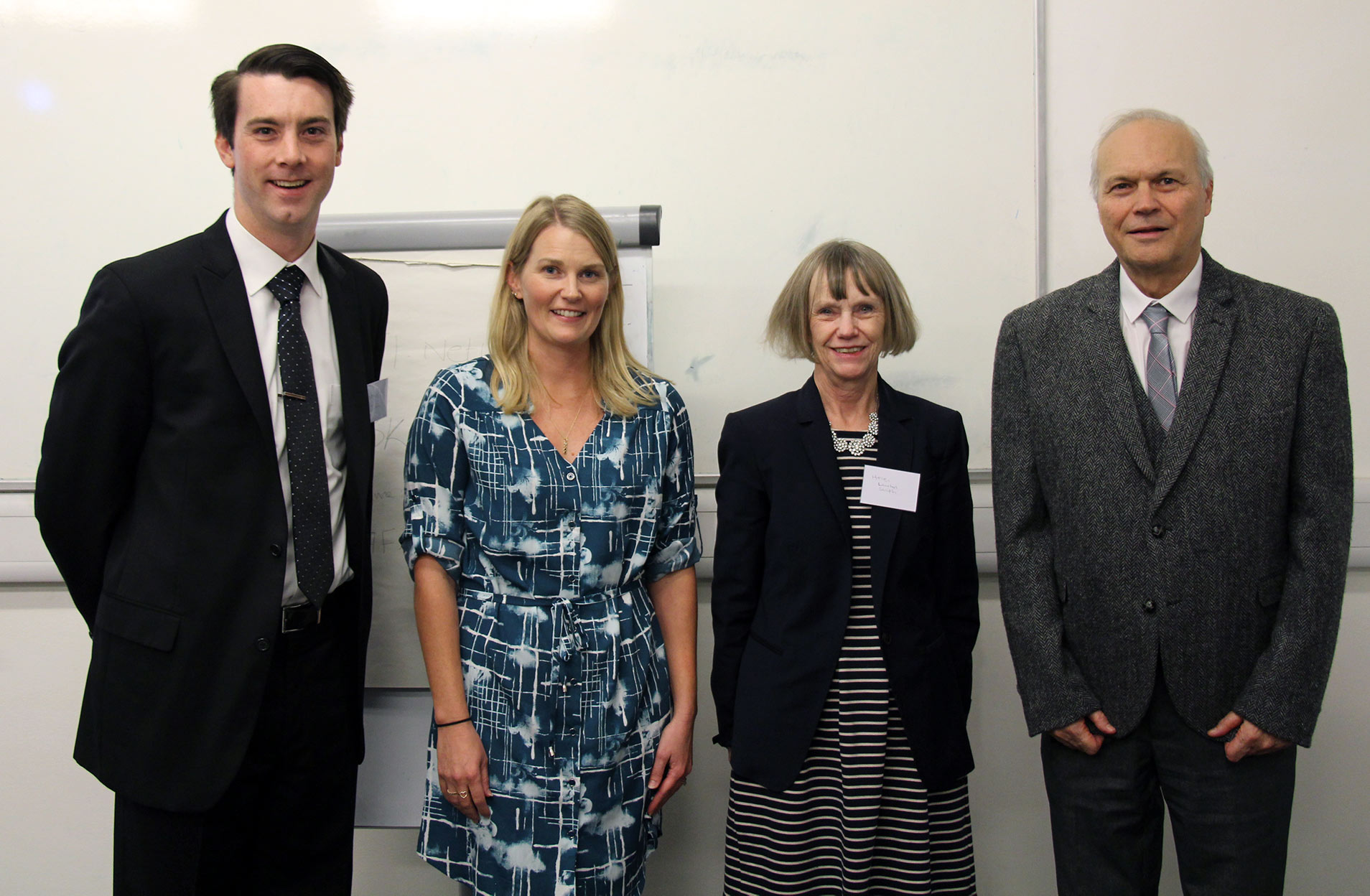
On Monday 29 October, Birkbeck’s Centre for Innovation Management Research (CIMR) hosted a research workshop in collaboration with Wiley, publishers of the Strategic Change: Briefings in Entrepreneurial Finance Journal. Professor Helen Lawton Smith and Professor Carlo Milana in the Department of Management are editors of the journal.

The aim of the workshop was to stimulate debate on new directions in research in entrepreneurship and innovation, in order to encourage new submissions, reach wider audiences, and highlight opportunities for more dynamic research contributions in the field. The workshop also provided an opportunity for current Management PhD students to discuss their research and progress with the audience, demonstrating the Centre’s diverse and unique research expertise.

Future Directions and Artificial Intelligence Research

Professor Carlo Milana opened the workshop with a discussion of the journal’s “business model” – a thematic approach whereby each issue deals with a particular topic, encouraging a variety of submissions that provide different perspectives on key issues in entrepreneurial finance, sustainable business models, and emerging economies, among other areas of innovation management and entrepreneurship. He also expressed his interest in contributions that will address important questions around the future development of artificial and social intelligence; for example, how will artificial intelligence (AI) engage and impact entrepreneurship? Professor Milana concluded his presentation with a list of practical issues with AI, such as technological unemployment, jobs displacement, security and privacy, and the reliability of automated systems.

Continuing with the theme of artificial intelligence in business and management, Professor Damir Tokic (International University of Monaco) joined the workshop via Skype to discuss his research on the implications of AI for executive decision-makers, asking whether AI can replace human discretion. The world’s largest investment management firm, BlackRock, recently announced the launch of the BlackRock Lab for Artificial Intelligence, suggesting that it intends to “keep tapping into artificial intelligence” to improve the financial wellbeing of its clients. Thus, Professor Tokic asks in his research: “Can AI replace the human discretion in investing?

The answer is yes, technically, because AI programmes can use econometric methods to extrapolate historical data and can interpret and use economic forecasts embedded in financial assets, ultimately ensuring market efficiency. However, legislation, unpredictable geopolitics, and the justice system might prevent the rise of “Robo decision-makers”, meaning that while machines can be fed with all possible human knowledge and available data, as long as human imperfections are preserved, AI-powered machines will not be able to replace human discretion.
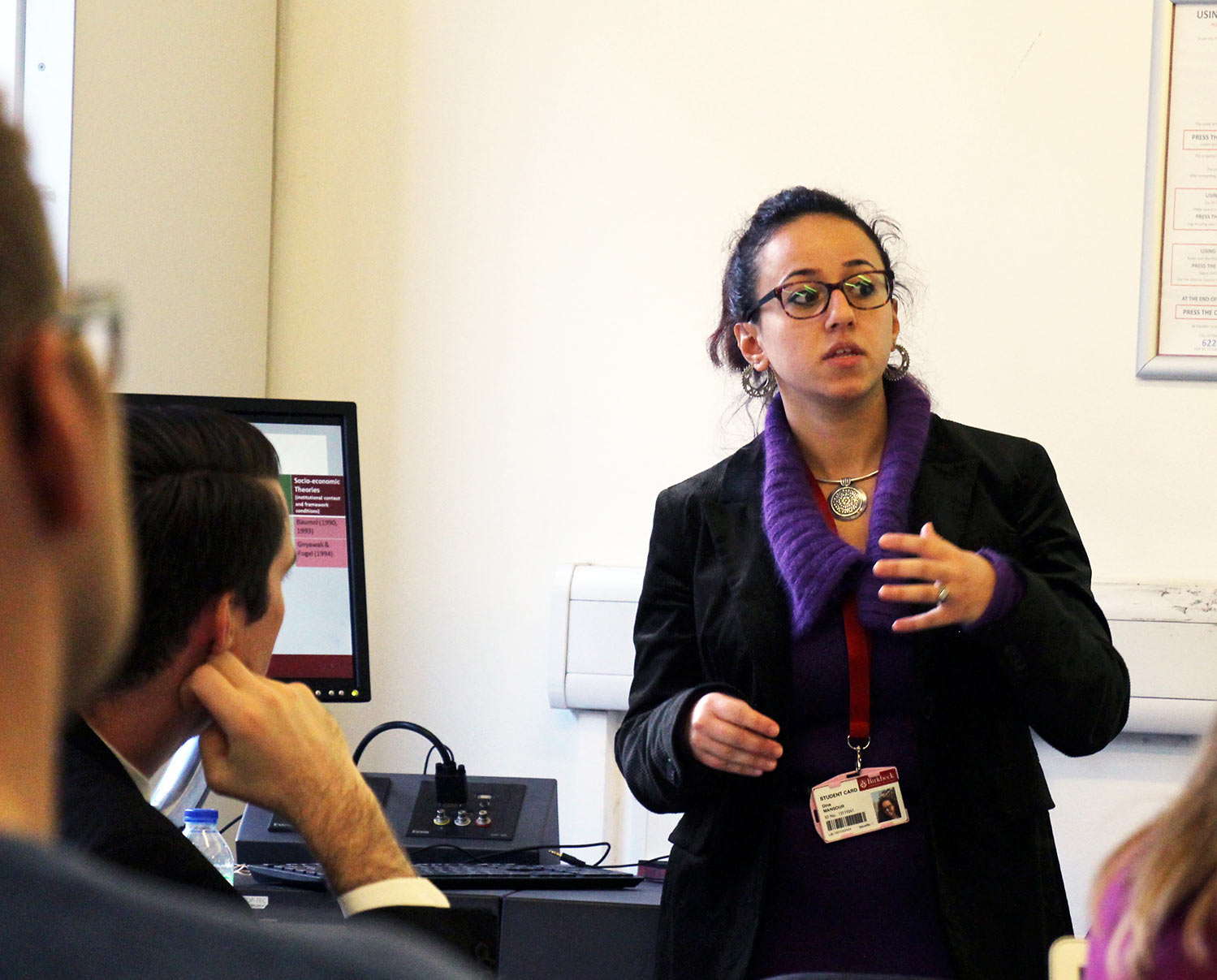
Birkbeck PhD candidate Dina Mansour

Open Research, Transparency and Relevance

When we talk about research in the current academic environment, the topic of impact inevitably comes up. In his presentation, Chris Graf, Director of Research Integrity at Wiley, asked what it means for research to be “open”, saying that open science/access is a way of doing research that brings about new opportunities for publishers by: (1) driving forward new models of publishing to emphasise relevance, (2) creating new services for researchers to support their requirements through innovation, and (3) taking a thought leadership position through community engagement. He also discussed issues of reproducibility in research and publication bias, whereby reviewers and editors may be more inclined to accept manuscripts based on the direction of findings, potentially neglecting lesser known research and making some studies seem more significant than they are. His recommendation was to increase the transparency of the research process and products to improve research reproducibility.

Research on Gender and Entrepreneurship

Professor Colette Henry (Dundalk Institute of Technology) provided greater insight into the nature of research on gender and entrepreneurship, noting that in the entrepreneurship literature, “gender typically means ‘women’s entrepreneurship’”, and there is urgent need for new perspectives on the topic, such as: (re-)conceptualising the gender perspective in entrepreneurship, the influence of gender on the entrepreneurial ecosystem, leadership styles, and business model innovation.

She also shared data on women’s participation in entrepreneurship, highlighting that more women are engaged in ‘necessity entrepreneurship’ than opportunity-based entrepreneurship. This means that women across the world are more likely to become entrepreneurs due to gender-specific issues, such as childcare challenges and restrictive workplace policies; and in some cases, some women simply become entrepreneurs to meet basic economic survival needs as they have no other options.

A Publisher’s Perspective: Maximising Research Impact

After a full day of discussing future areas of research in entrepreneurship and innovation, it was only appropriate to end with the publisher’s perspective on how to maximise the reach and impact of publications. Shannon Canney, Senior Editor at Wiley, began by asking the audience which metrics mattered to them. For most people, the answer was citations, which was consistent with Wiley’s research findings: most people think citations are highly important, whereas some think downloads come next, and a smaller percentage believe social media sharing matters.

Joshua Tufts, Editor at Wiley, said that all these metrics matter for research impact, as they contribute to a comprehensive view of a paper’s performance. It is important for researchers to use various channels to publicise their research because search engine optimisation (SEO) is vital in a digital age, and between June 2016 and July 2017, 54% of visits to Wiley Online Library came from search engines (26% had no referrers, 18% came from other websites, and 1% came from social media). Academics and researchers can maximise their impact through SEO in 4 easy steps, including: usage of relevant key words/phrases throughout the article, choosing a smart, descriptive title which incorporates key phrases, writing a good abstract by expressing key points from the article in simple terms, and creating a network of inbound links and citations to one’s article.

Wiley provides a useful self-promotional author toolkit that researchers can utilise to help ensure their work is seen, read, and cited.

It was a very insightful event for researchers in entrepreneurship and innovation, and the organisers would like to give particular thanks to the sponsors, Wiley, and all speakers:

  • Shannon Canney, Senior Editor, Wiley
  • Chris Graf, Director, Research Integrity & Publishing Ethics, Wiley
  • Colette Henry, Adjunct Professor of Entrepreneurship, Dundalk Institute of Technology
  • Carlo Milana, Editor in Chief, Strategic Change: Briefings in Entrepreneurial Finance
  • Damir Tokic, Professor of Finance, International University of Monaco
  • Joshua Tufts, Editor, Wiley

Birkbeck PhD Students

  • Maryam GhorbankhaniExploitation of Public Sector R&D
  • Maximillian Giehrl – Open Innovation Collaborations in German Manufacturing Firms
  • Dina MansourEntrepreneurship and Economic Development in Developing Countries: The Case of Egypt
  • Peter RossTheories of Diffusion of Innovation and Medical Engagement: Successful Adoption and Assimilation of Healthcare Reform

Presentations from the workshop can be downloaded from the CIMR website.

9 year old tells mum “You’re going to be amazing” as she graduates with a first class degree in Law from Birkbeck

Chloe Livingston, 29, took the meaning of multi-tasking to the extreme when she decided to enrol for a law degree whilst working full time and raising her son as a single parent. On 6 November 2018, she graduated with a first class honours in Law from Birkbeck.

Growing up, Chloe had always dreamed of being a lawyer or a doctor, but fell into a career in banking on leaving school. Although successful, she never lost the desire to return to study. “People always told me I was smart, but I had nothing to back it up,” she explains. “When I first began looking into university, it was really so I could tell people that I had a degree.”

Discussing returning to study with a friend, Chloe was reluctant to become a student again. “I didn’t want to go back to being a student with no money,” she says, “It wouldn’t have been fair to subject my son to that lifestyle.” That’s when Chloe’s friend suggested Birkbeck – the evening study model meant that she wouldn’t have to give up her job and could continue supporting her son while getting the education she’d always wanted.

Chloe knew that it wouldn’t be easy to give up so much time to study, but was lucky to have a support network of friends and family close by to help with childcare. Despite being only five years old when his mum started her course, Chloe’s son was really supportive. “Some days I would be locked in my room or glued to the dining room table working and he’d come in and say ‘are you ok mummy? Do you need anything?’” she remembers.

As well as her responsibilities as a parent, Chloe took on the additional challenge of full-time study while working. “I took part in a Birkbeck alumni mentoring scheme before starting my course, and my mentor asked if I was sure I could take on the workload,” she remembers. As a relationships manager for a bank, Chloe’s day job is no nine-to-five and she would frequently be required to stay late, even completing an additional banking course at one point during her studies. “I thought that because lots of Birkbeck students also work during the day, the lecturers might go easy on us, but that definitely wasn’t the case!” she laughs. Thankfully, Chloe’s employers were very supportive, especially as they could see the impact of her studies in the workplace, as she became a voice for key issues like diversity.

Just as she was hitting her stride though, a terrible accident almost changed everything. A near fatal head-on collision towards the end of second year threatened to stop Chloe’s progress in its tracks. “Thankfully I was okay,” she remembers, “Birkbeck were really supportive and gave me the adjustments I needed to complete my assignments. Second year nearly broke me, but I had too much to lose to not pull through. I couldn’t let the sacrifices my friends, family and most of all my son had made for me be for nothing.”

There’s no doubt that taking on further study alongside other commitments is tough. Chloe’s advice is to be realistic about what will be expected of you in terms of time and effort – “They’re not going to spoon feed you anything,” she warns. Having heard of the non-traditional routes that students take to Birkbeck, Chloe wasn’t expecting to make good friends on the course. She says, “People told me that I wouldn’t meet like-minded people at Birkbeck, but you get out what you put in and I’ve come away with some brilliant friends.”

Having begun her degree to prove herself, Chloe was surprised to find how much she enjoyed studying Law. On her course, she learned skills that she could put to use straight away – an in-depth knowledge of contract law proved particularly useful during a booking dispute for a family holiday!  Now, Chloe is looking to leverage her experience in finance with a career in corporate or commercial law and will be applying for a masters in Law next year.

Graduating with a first class University of London degree, Chloe is proud to be a role model for her son. “At first, I think he thought that university looked too much like hard work!” she remembers, “But when we were walking home from school the other day he turned to me and said ‘I’m so proud of you mum, you’re going to be amazing.’” Chloe, who has taken her son to both her siblings’ graduations, is looking forward to celebrating her own graduation with her family.

“The way I got my degree worked best for me,” she says. “If I’d gone to university at eighteen, I don’t know if I would have completed my course, or got a first. Now I’m wondering what to do with my evenings!”