Author Archives: R Bonaparte

Science Week 2019: The New Science of Astrobiology and the Search for Life in the Universe

Mauro Pirarba BSc, a first year Planetary Sciences Graduate Certificate student and Fellow of the Royal Astronomical Society discusses Professor Ian Crawford’s  talk, given during Science Week, on astrobiology and the search for life in the universe.

How common is life in the universe?

Sadly, we don’t have an answer to this basic question. All we can say is that life arose at least on one planet: the Earth. Fossils in very ancient rocks tell us that there were unicellular organisms around 3.5 – 3.8 billion years ago and it is probable that the first life forms were even older, i.e. life appeared on Earth “easily”, as soon as conditions were not too harsh.

If that is the case, we would expect microbial life to have arisen independently in other places in the solar system where conditions were similar to the early Earth a thick atmosphere that protected the surface from radiation, mitigated temperature variations and allowed the presence of liquid water on the surface.

Although water was once abundant on Mars, things changed dramatically billions of years ago, making the surface of the planet a very inhospitable place for life. Our only chance to find extant or past life on Mars is to look under the surface, something that the current NASA rovers cannot do. This will be within the grasp of ESA’s Rosalind Franklin rover, landing on Mars in 2021. Still, the search will only be skin-deep. Future robotic missions, the collection of samples to be returned to the Earth for sophisticated analyses and possibly the start of the human exploration of the red planet will one day give us a definite answer about the possibility that life arose on Mars.
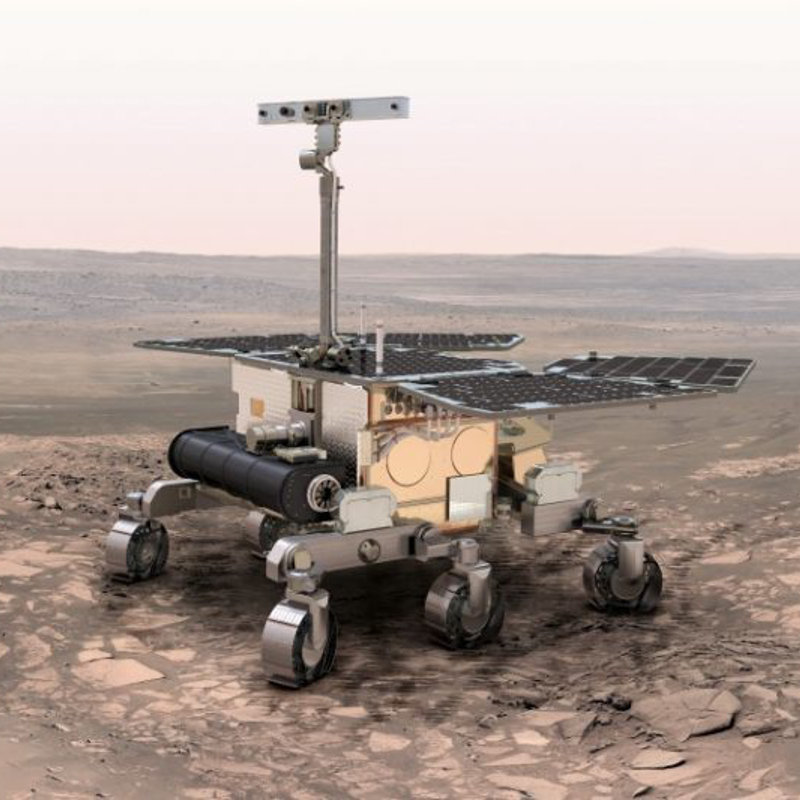
ESA’s Rosalind Franklin rover

However, the search for life in the solar system does not end at Mars and Professor Crawford’s audience got particularly excited about a moon, Europa. This is heated by tidal forces while orbiting Jupiter, resulting in the formation of an ocean under its thick icy crust. Water, energy and a rich chemistry could provide all the ingredients for life to have arisen on Europa, perhaps in a similar way to what may have happened along mid-ocean ridges on Earth.

We can also extend our search for habitable worlds beyond our solar system. Over the last 20 years thousands of planets orbiting other stars have been discovered. Trying to image these specks of light in the glare of their stars is still a formidable challenge, but large telescopes or sets of instruments flown into space will make it possible. Such instruments will be able to “analyse” the atmosphere of these worlds and look for hints about their potential habitability.

The Search for Extra Terrestrial Intelligence (SETI), offers a different and “targeted” approach to the search for life in the universe, in the sense that it is restricted to technological civilizations interested in communicating with other intelligent beings that have been able to build radio telescopes. The search was started by Frank Drake in the 1960s and has so far not found a single artificial radio signal.
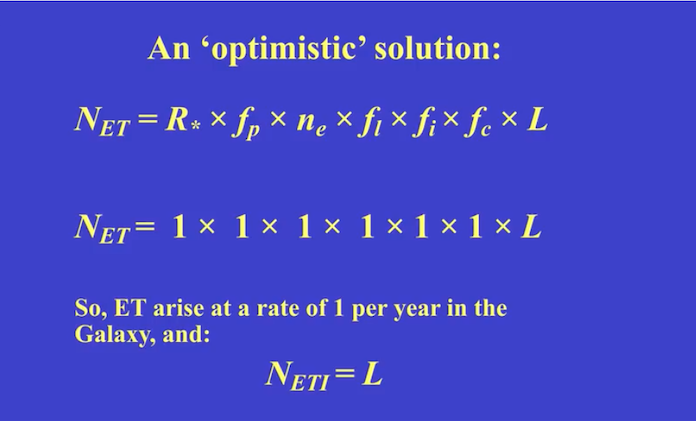
Drake equation, Optimistic Solution

Can we conclude that we are the only intelligent species who built radio telescopes in the galaxy?

No, we can’t, or at least not yet, according to Professor Crawford.

Drake came up with an equation to try and estimate the number of technological civilisations in our galaxy. Most of the terms in the equation were unknown in the 60s, but astronomers have since constrained a number of them. In the most optimistic scenario (giving the highest possible value to each term) and assuming that the average technological civilsiation lasts for 1000 years, at present there should be 1000 of them. The vastness of our galaxy justifies our failure in detecting them so far.

On the other hand, considering that it took over three billion years for life on Earth to “invent” multicellular organisms and out of the many millions of species that inhabited the planet only one has evolved to become a technological civilization, we could conclude that we may be alone in the (observable) present universe.

The reality, as Professor Crawford concluded, could be anywhere between those extremes and our inability to constrain them is a measure of our ignorance.

The closing slide of the presentation could have not been more appropriate:

“The discussions in which we are engaged belong to the very boundary regions of science, to the frontier where knowledge… ends and ignorance begins.” William Whewell (1853)

In spite of all the progress made by our species over the last century and a half, those words still hold true.

Does anyone want to join the search?
 

Eila Campbell Memorial Lecture 2019

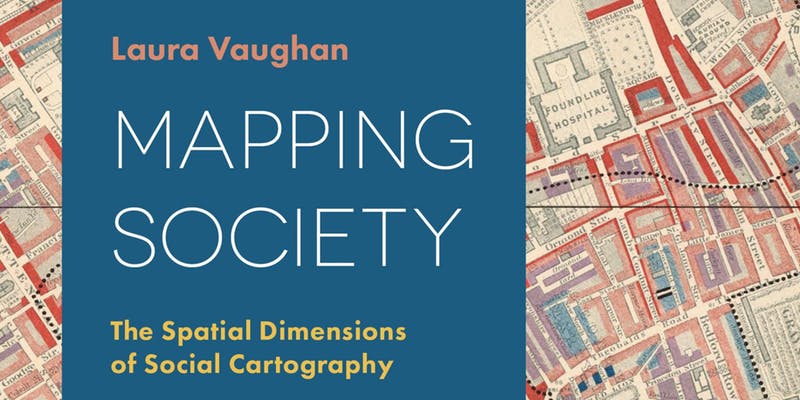
Ben Hughes, an MA Social and Cultural Geography student, shares insights from this year’s Eila Campbell Memorial Lecture given by Professor Laura Vaughan on her recently published book, ‘Mapping Society: The spatial dimensions of social cartography’.

Some people just love maps. Whether it be well thumbed road maps, atlases coloured by finger marks tracing mysterious routes, the rain-stained Ordinance Survey maps so beloved of ramblers, or big wall maps of the world – often with places of specific interest pinpointed, all maps tell a story. As fascinating and important as these physical maps are, they don’t capture – or reflect – the complexity of human existence. Addressing this is what lies behind social ‘cartography’, a technique first developed in eighteenth century to illuminate social issues. As a tool social mapping has grown in importance as a means of highlighting the spatial realities of a multitude of social and human features such as health, class, wealth, race and migration and the spatial distinctions they create.

Building on material from her recently published book, Mapping Society: The spatial dimensions of social cartography, the theme of Professor Laura Vaughan’s Eila Campbell Memorial Lecture spanned the most ‘recent’ 200 or so years of social mapping. She took us on a journey starting with a rare map of yellow fever in eighteenth-century New York to Charles Booth’s famous maps of poverty in nineteenth-century London; from an Italian racial zoning map of early twentieth-century Asmara, to a map of wealth disparities in the banlieues of twenty-first-century Paris.

Reflecting her background in architecture and her current role as professor at the Bartlett School of Architecture, Vaughan brought to life the spatial realities of social divides and inequalities that lie behind the concept of the divided city – a contemporary and timely area of study for human geographers. Drawing on current day human challenges such as climate change and (forced) migration, Vaughan identified the value of some of the emergent open source software packages such WorldMapper and GIS that are increasingly used in social media-led commentaries, around the social polarization of space.

The discussion highlighted many of the specific spatial issues that relate to social cartography. From the practical complexity of reflecting height vs breadth vs depth to ownership, and the inevitable power held by those controlling the production of maps, and so the stories that are portrayed, objectivity, recognizing that maps tend to be built on assumptions, perspectives or ideologies – e.g. is the UK really that big? Why are western nations often colored in calming pastels, when much of Africa and Asia is depicted as dangerous through use of stronger reds and oranges?

Also highlighted was the evolution of ‘non-literal’ maps, used to powerful effect by social geographer Danny Dorling and writer Rebecca Solnit, who sought to reflect human feelings and knowledge of place through maps that, in depicting social rather than physical actualities, result in distortions to the scale and shapes of physical places that we are all so used to.

It was telling that the discussion concluded with reflections on the increasing dominance of multi-national corporations such as Google, who through deployment of new satellite technologies are increasingly powerful in gathering data that is open to misuse and manipulation. With current algorithms able to instantly track and reflect your personal profile, Vaughan concluded with a note of both warning, that there is undoubtedly potential for an invidious market control, and hope, that these same technologies offer potential for counter-mapping to re-balance this.

Arts Week 2019: When a mathematician, a musician and a poet collaborate and converse about symmetry and asymmetry

Miranda Siow, a Birkbeck alumna, shares insights from the Arts Week event that explored symmetry and asymmetry in maths, music and poetry.

View of Dr William’s Library and Euston Church from the central gardens in Gordon Square

Birkbeck was like my first home in London. It began with a conversation on a beach in Melbourne. One of my best friends asked me what I would do if money was no object. After puzzling over her question for several minutes, I concluded that my dream was to travel. ‘What about travel writing?’ she said. The thought had never occurred to me. I returned to London, bought a guide to travel writing book and tried an evening class called Introduction to Creative Writing at Birkbeck. I loved the writing class and rediscovered my passion for stories. I never read the travel writing book.

For years, I studied literature and creative writing at Birkbeck. My studies took me to other institutions to explore the arts and creativity, including achieving my dream of a Masters in English Literature. Last month, I found my way back to Birkbeck through an event entitled ‘Symmetry and asymmetry: maths, music and poetry.’

2 Temple Gardens, a Victorian Building overlooking the Thames

The history of symmetry is even older than the library, church and central garden which also reside in Gordon Square, where we gathered that Friday. Symmetry is often attributed to the Italian renaissance. It celebrates beauty, art and proportion. Symmetry and asymmetry involve balance, harmony, or disrupting these. Sarah Hart was brimming with enthusiasm and knowledge about triangles, crystals and the laws of symmetry. Shapes were folded, sliced and converted. An array of slides showed us triangles, polygons, polyhedra and spheres. We discovered symmetry in sea creatures and in Escher’s Angels and Demons.

Did you know that our world is full of symmetry, not just in poetry, architecture, art and nature, but also in the answering phrases in Bach’s compositions? I didn’t appreciate scales when I practised them as a child. Iain Burnside played the keyboard in that small room that sunny evening. His music had a beautiful simplicity. We heard Dante’s sonata and Conlon Nancarrow’s study number 21. He discussed inversions, inevitability, perfect fifths to perfect fourths, major into minor, tritons, inversions and death how bitter thou art.

Poet, Fran Lock introduced us to gurlesque, rhymes, secret metaphors and metrical patterning in heartbeats. There’s symmetry in behaviour, families and crowds. We desire order in fashion, bus lines and voting. Symmetry can be a constraint. We may break the pattern and seek imperfection, which has its own beauty.

Spring flowers in bloom

After the event, I’ve become more conscious of symmetry and asymmetry in the buildings around London and the vibrant flowers in bloom. The way a path is designed or the branches of a tree stretching out like open arms previously did not warrant a second thought. I have a fascination with how we see the world, the idea of conspiracy theories and different perspectives. Like them, symmetry and asymmetry provide another way to look at things, with a new lens and dimension.

St Paul’s Cathedral dome

I hear songs on the radio and it’s a game of tones. Tunes have a character with progressions and echoes. Some refrains are more dominant and powerful. Patterns and motifs are pleasing to the ear. We need only look up into cathedral domes or even the clothes that we wear to see patterns and motifs. Maths, music and poems have propelled into my life on and off throughout my childhood, teens and adulthood. Now, I also see an abundance of symmetry and asymmetry around me.

Clothes from a catwalk show at London Fashion Week Festival September 2018

Birkbeck’s final day of Arts Week was a serendipitous homecoming. I’ve found symmetry in my life, from my first Birkbeck writing class to blogging about this Birkbeck event. After more than a decade, I’m even living again in the same building as when I first moved to London. I wonder what my life would have been without that conversation on the beach, Birkbeck or creative writing. If I hadn’t done them, I might not have had the pleasure of an evening with a mathematician, musician and poet.


Photos by Miranda Siow


Towards a Unified Theory of L1 and L2 Learning’: Professor Martha C. Pennington Lecture

Oscar MacMillan, a second year student on the BA Linguistics and Language shares insights from the lecture given by Martha C. Pennington on 6th June.

Professor Martha C. Pennington, PhD Linguistics, University of Pennsylvania, has written numerous books on various topics including Linguistics. On the 6th of June she gave a lecture at Birkbeck, where she shared her insights on the issues with current theories of L1 (first language) and L2 (second language) acquisition, and what the future for these theories may hold. She started by explaining the idea of a conceptual binarity, when something is perceived as falling into one of two extremes. She explained that L1 and L2  learning, implicit (learning while unaware) and explicit (learning while aware, intentionally), and language learning and language use serve as examples of conceptual binarities that have manifested within the field of Language Acquisition, implying that these ideas are false or overdrawn dichotomies.

Professor Pennington went on to explain her doubts of the critical period and related hypotheses. The idea of a critical period comes in many forms, but it fundamentally describes points after which the ability to learn language, or certain aspects of language, becomes limited. She pointed out problems with the evidence that has been presented, for example that the left-hemisphere lateralisation of language (the idea that language is local to the left-hemisphere) has been exaggerated and is not universal. Furthermore, she explained that some aspects of language seem to have earlier critical periods than puberty, for which there is a lack of a sufficient explanation of a biological mechanism or evolutionary benefit for those earlier critical (or so-called “sensitive”) periods, and discussions about this have been sparse.

This led to her next point, that some researchers see the evidence as indicating that there is no biological mechanism for critical periods, therefore, indicating there are no fundamental differences between L1 and L2 learning. Professor Pennington pointed out that the limitations of L2 performance can be explained by factors such as the L1 of an individual affecting their perception and attention, which could block future learning. She also pointed out that as children are exposed to writing and many begin to read fairly early literacy may be a factor, and that more research should be done to compare literate and non-literate individuals in terms of how they learn language. Also, while L1 is typically associated with implicit learning and L2 with explicit learning, she suggested that explicit learning still depends on implicit processes, which would further support the idea that L1 and L2 learning are more similar than people seem to think.

Finally, Professor Pennington discussed language use and language learning. She explained that even those who are fully proficient in a language continue to learn and change the way they use language. As even native-speakers are exposed to new vocabulary, they continue to adapt their language use, so language use influences language learning. They are not entirely independent from each other.

The talk was fascinating and raised many questions about the current consensus surrounding language acquisition. Professor Pennington argued that theories which may have originally been suitable are often adapted and expanded to remain compatible with new research and ideas, sometimes up to the point that they become overly complicated and arbitrary. It may be the case that some language acquisition theories have reached this point. While no one can know exactly what the future holds, it is clear that research will lead the way for new ideas, and that existing theories are bound to change.


Further information: