Author Archives: K Best

We’re not “made out of sugar”

A student from Brazil recently shared that in her country, people who are reluctant to go out in the rain are teased with the question, ‘Are you made out of sugar?’ Last week’s day-out to beautiful and historic Greenwich proved that while they are certainly sweet people, Birkbeck’s international students are not ‘made out of sugar’, willing to brave the pouring rain. Read this account of the day.

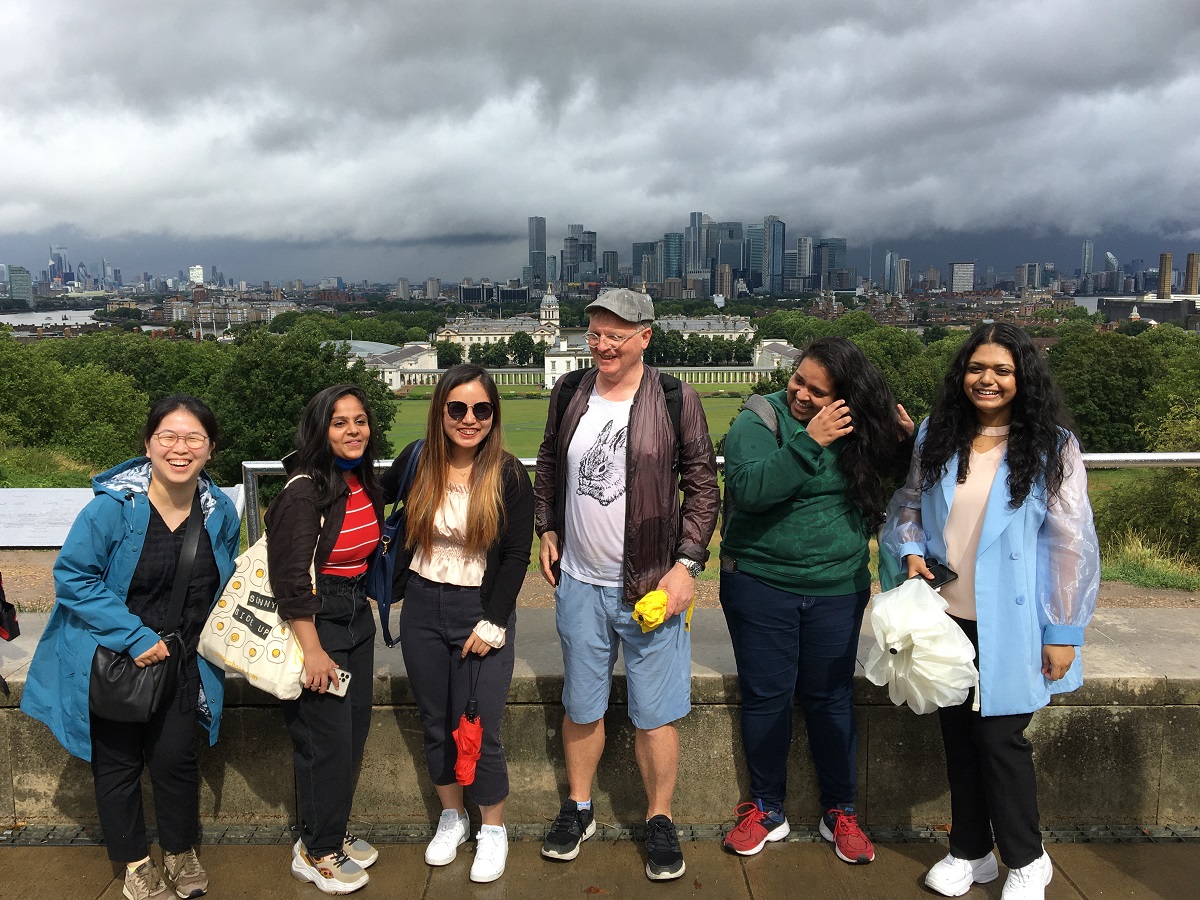
International students visiting Greenwich

Our day began early morning at Westminster Pier, to take the Thames Clipper boat service to Greenwich. On arrival, despite the weather, students were keen to put up their umbrellas and enjoy the sights with tour guide Andrew to discover the history and stories behind this fascinating part of London.

In Greenwich Park, Andrew led the group up the hill to see the famous Royal Observatory. Before ascending, commenting on the grey skies and rain, he joked, “Who knows?  Maybe there’s bright sunshine at the top!”

On arrival, a low grey mist obscured the usually impressive views. Even the tall buildings of the nearby Docklands were hidden. However, within a few minutes the mist cleared, the sun shone and students were folding up umbrellas and reaching for sunglasses. Everyone enjoyed the stunning views of London. “What I said earlier was a joke!” laughed Andrew.

International students standing by the Greenwich observatoyTo round off the tour, we visited the famous Goddard’s Pie & Mash shop, where students enjoyed this hearty and delicious traditional London food.

International students at a pie and mash shopAndrew explained that Pie & Mash predates Fish & Chips as a traditional British dish, and that Goddard’s has been a family-run Greenwich favourite for over 130 years.

International students on the tour of GreenwichStudents ended their day in Greenwich full-up, maybe a bit wet, but also happy and, we hope, with some new friends. Sweet!


Office housework collective writing: an Astrea collaboration

This article was written by Kayleigh Woods Harley, project support coordinator in Birkbeck’s Strategic Projects Directorate. She chairs Birkbeck Astrea, a staff network for women, transgender and nonbinary people in professional and support roles. Astrea hosted Uracha Chatrakul Na Ayudhya and Aylin Kunter for a talk on office housework in May 2021 and this will be followed by a series of collective writing workshops to allow members to process their thoughts and feelings about office housework. The goal is to publish the writing in an academic journal on gender and work. In this blog Kayleigh talks about her experience of the first collective writing session in July 2021.

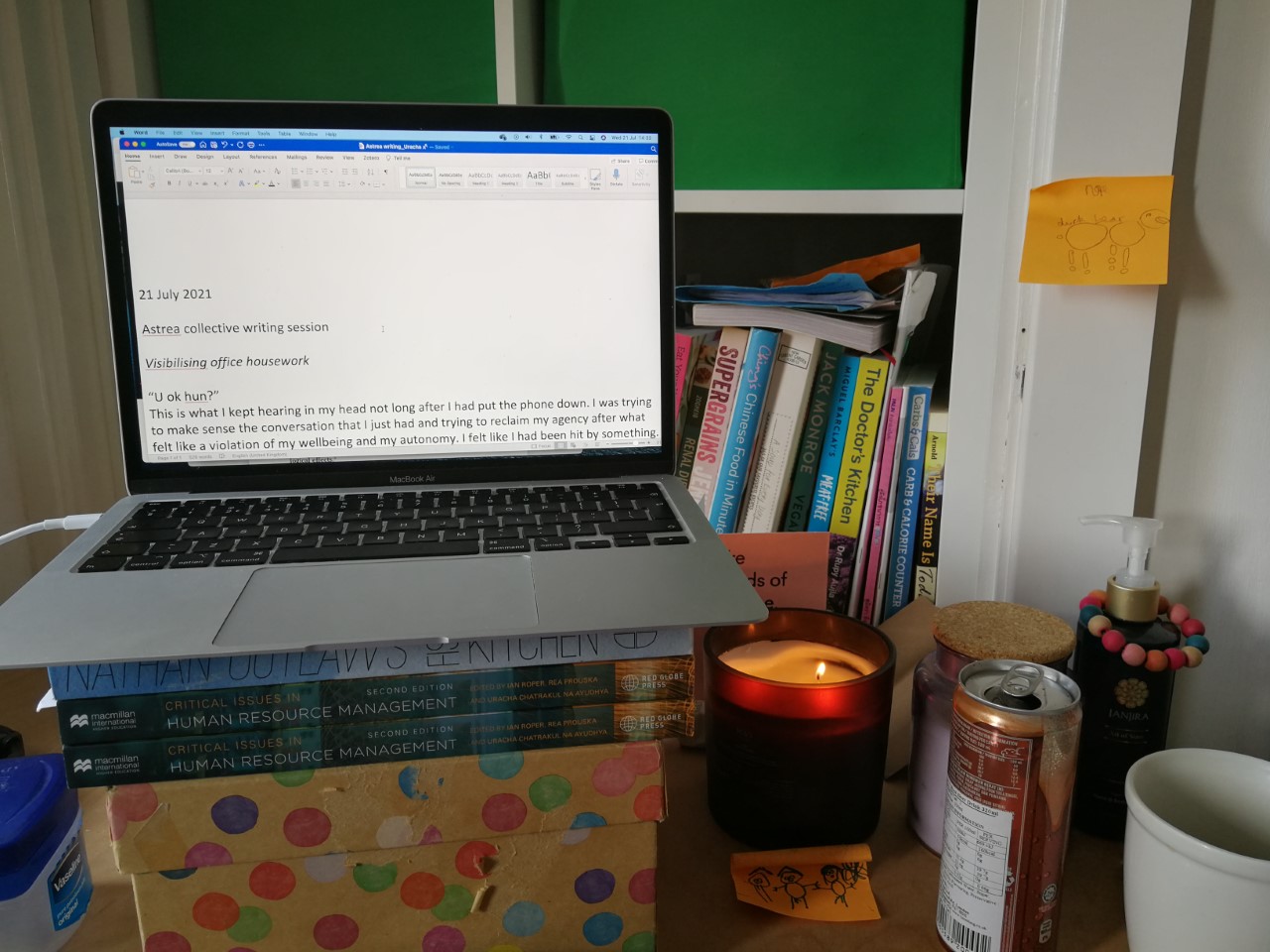
Photo of an academic's desk

I first came across the term ‘office housework’ during an Astrea event in May 2021, led by Aylin Kunter and Uracha Chatrakul Na Ayudhya, two academics who have collaborated in the past on the interactions between gender and work. Their talk was a natural extension of their previous research, but also a departure in that they were proposing to bring Astrea members along with them on a new strand exploring the particular experiences of professional services women, transgender and nonbinary people. I wasn’t familiar with the idea of office housework, nor aware that it tends to be undertaken by those with the least power in the workplace, making it an intersectional phenomenon. I now understand that office housework is all the tasks and responsibilities we carry out which are not part of our job description, nor are they rewarded or recognised as ‘work.’ And the more I thought about it, the more I realised I was doing it all the time.

So when Aylin and Uracha invited Astrea members to a collective writing session where we could think, through writing, about examples of office housework we had undertaken, I prepared a few notes ahead of time. Coming prepared to meetings is something I do often, as an extremely conscientious individual. You could argue that it’s a form of office housework, that feeling of always needing to go above and beyond to make sure you not only ‘turn up,’ but are ready to fully participate in a work-related meeting or interaction.

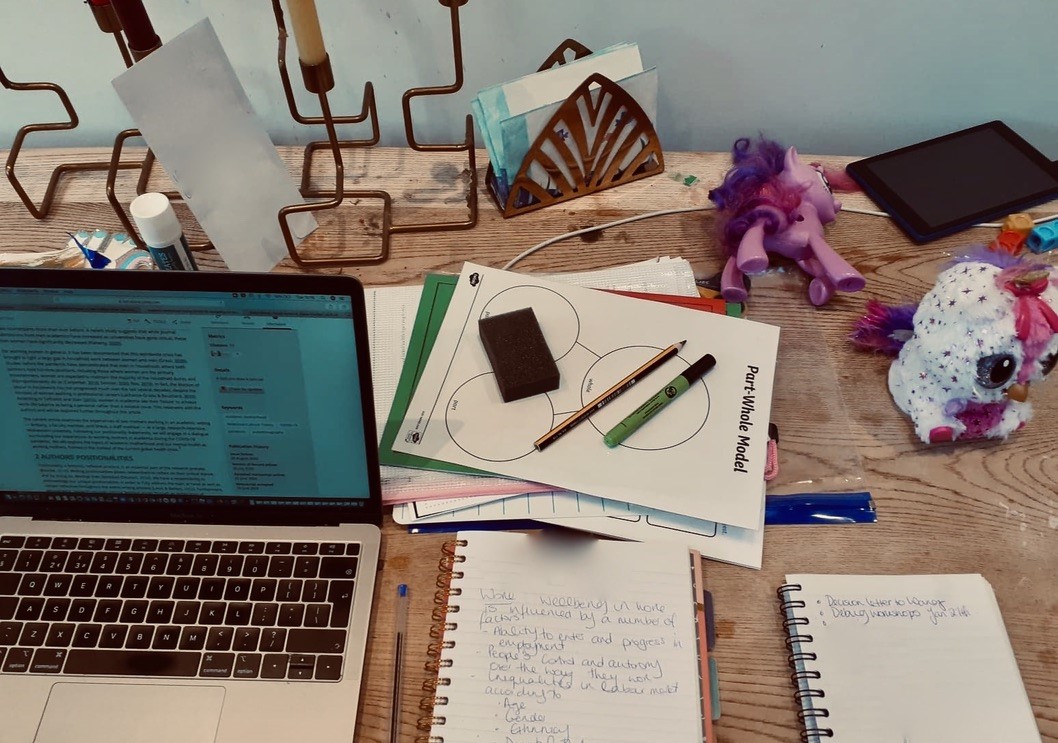
Photo of Aylin's desk

After some friendly deliberation over how to proceed and how long to give ourselves to write something, we muted our microphones and individually began to write. There was no script, no structure. Just write down what you feel, what you think. My mind turned from the stresses and worries of a normal workday and focused on one thing solidly for 30 minutes. It was possibly the fastest half hour of the day, and during that time I was engrossed, my mind completely engaged in the thinking-through of my subject. I was completely myself, by which I mean my authentic self, not my work self. This is a luxury I am rarely afforded.

The others had posted chat messages indicating they were ready to finish and even share their writing. Listening to them read their thoughts was a moment of pure connection. How brave they were for being able to write such honest things and to feel able to read them aloud! They could have chosen not to, and yet we each felt it was important to say what was on our minds, no matter how raw or emotional it might be. I read my piece, too, and felt immediately validated by their responses to it. How often do we take the time to say something uplifting or supportive to our colleagues? (Is doing so another form of office housework?) And yet I felt like the last hour or so had not felt difficult or straining, like a normal day spent at my living room table with my laptop open to my emails. It was a moment of true connection, of seeing and being seen for who I really am.

This feeling was not mine alone. Uracha affirmed, “For one hour today, I found myself being transported out of my daily chaotic work space into a safe and collective space through writing together and listening unreservedly to one another about office housework. It was truly freeing to be connected and to be heard, seen, and held.”

Astrea members can read more about the office housework project and find out when future collective workshops are scheduled on the Astrea SharePoint.

“Don’t call me El Chapo!”

Azucena Garcia Gutierrez has made it her mission to represent the very best of Mexican culture to the rest of the world. This is her #BBK Grad story.

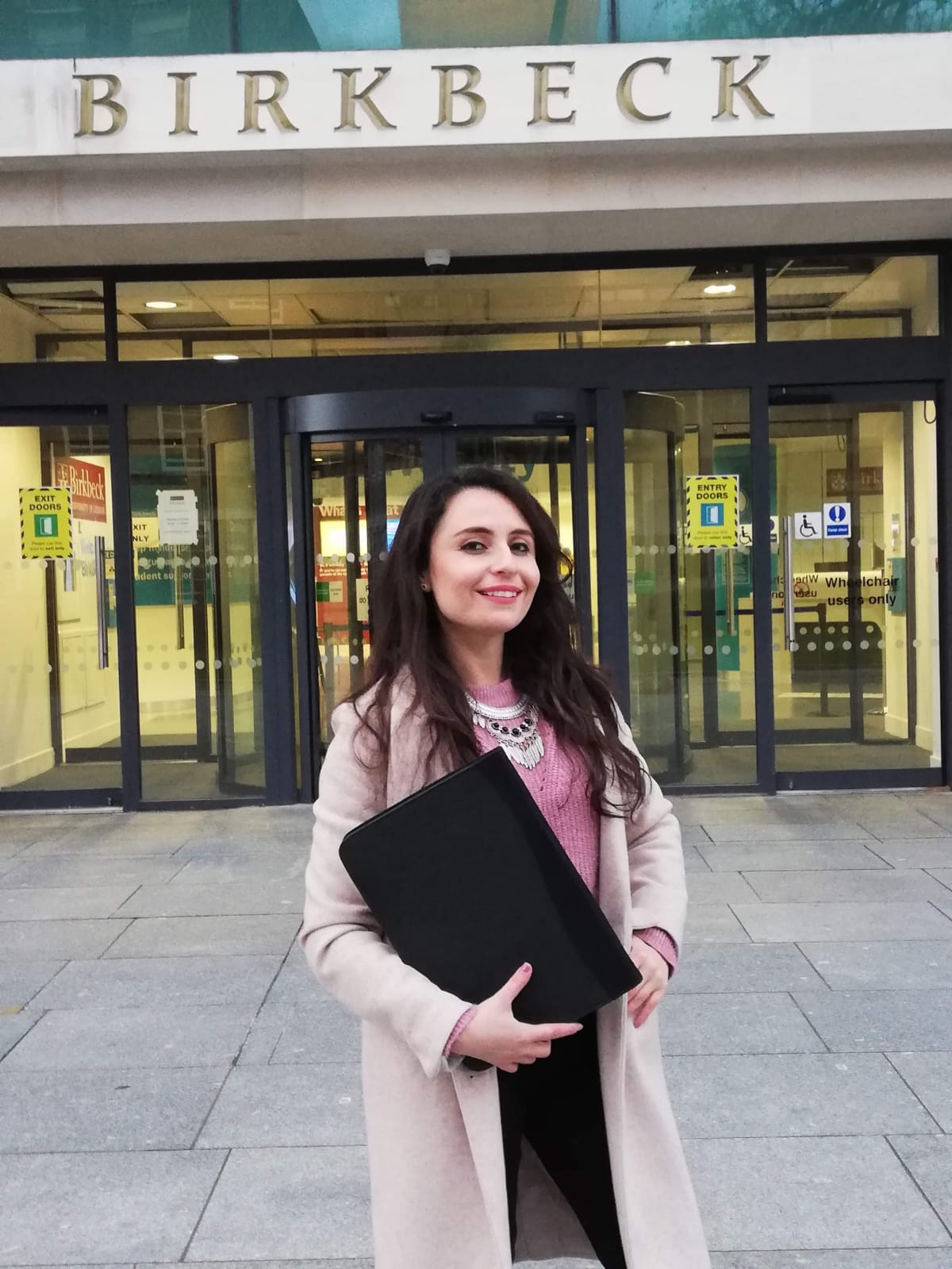
This is a photo of Azucena Garcia Gutierrez

Growing up in Toluca, a city close to Mexico City with parents who didn’t graduate but who still provided for their small family has given Azucena a perspective on life which has her always returning to her humble beginnings.

With just one sibling, the two had spent practically all their lives side by side so when Azucena decided to leave Mexico to study MA Applied Linguistics and Communication at Birkbeck, it left her stunned and a little lost. Not surprisingly, her sister would go on to also study languages.

Seeing first-hand the misconceptions that prevail about Mexico was part of Azucena’s culture shock throughout her international travel: “People would shout out ‘El Chapo!’ They had a view of Mexico which concerned me. When I was growing up as a teenager, it was very safe. But I realise the situation with crime is bad now; but that is not the only thing we have to share with the world.”

At Birkbeck, she would make every effort to explain the best parts about Mexico: the diversity and richness of the country, wanting to show others “what Mexicans are made of.” She applauds Birkbeck for its encouragement of international community and the support of students who comprise that. Azucena is both a Chevening scholar and the winner of the Michel Blanc prize for best MA dissertation and credits both with supporting students, like her, from around the globe.

Whilst lamenting the fact that indigenous languages are dying out in Mexico, Azucena also recognises the value in being able to speak English, seeing this “open doors for so many, including myself.” It was just fifteen years ago, at the age of 18 years, that she made the decision to be an English language teacher. She had previously learnt English at secondary school and found it hard at first, especially since her first teacher was American and spoke very fast.

It’s that experience and understanding which now crosses over into her own teaching of English. She witnesses students who are challenged with learning English as their second language but is fervent in her teaching and reinforces the message that the hurdles of learning another language, especially English, must be overcome in order to reach one’s aspirations.

For her beloved home country of Mexico, this is a matter which is even more paramount. With the Organisation for Economic Cooperation and Development (OECD) recently citing Mexico as the second most unequal country, education reform is a critical matter Azucena wishes to address. She says, “Education means hope for Mexico. When the people of a country are well educated, things will improve, it will shape better citizens and give them a thirst for knowledge which will contribute to a better country.”

Azucena returned to Mexico in February and is working on progressing her career in Education, using learnings from her time spent at Birkbeck and the contact with people of different mindsets to apply to her homeland in a meaningful way. She sees it as her duty to contribute to the education and social landscape in Mexico to improve the country’s academic and economic standing and in turn its international reputation.

Find out more about the Department of Applied Linguistics and Communication.

Struggle and Strife pave the way for Success

Demelza Honeyborne was born in Wales, taken to Liberia, West Africa aged 2 years old and survived a 10-year civil war, physical assault and years out of education to go on to recently graduate with a degree in Psychology. This is her #BBKgrad story.
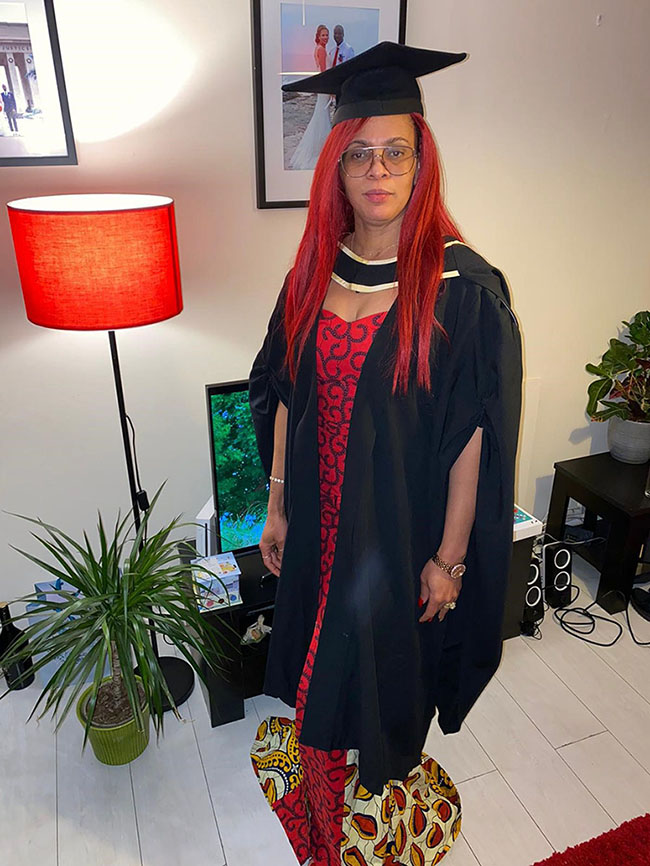
The early years in Liberia, ongoing conflict and the battle to stay in education:

My mother was from Liberia. She and my Dad had separated, so she took me to her home country when I was just two years old. Liberia’s 10-year civil war started in 1990 when I was 13 years old and my mother died that same year. My father had left when I was about four, and I had no contact with him so I effectively became like an orphan during the war. Schools were closed due to the war for a few years- I can’t remember the length of closure…probably till 1996, but they reopened at points where there were cease fires so I missed a massive portion of my junior and senior schooling.

At 18 years old, I got pregnant with my twins and attempted school again. I would study during the day and work at a nightclub from the evening until 4am and then start all over again with classes at 8am. I did this for a year or so. I later got a day job which meant I had to go to night classes. My children were taken away from me by their dad’s parents when they were one as they deemed me unqualified to be a mother due to my circumstances (having no parents, being unmarried). However, I got them back when they turned five.  This meant I could work, study and stay off the streets.

A chance reunion with her father and return to the UK:

I had sent a letter to my old neighbourhood in Wales (I could only remember the first line of the address) to see if anyone knew where my dad might be. I didn’t think I’d have any luck but in 1999, the British Red Cross found my father and reconnected us, which is a totally miraculous happening on its own, hence I returned to the UK in 2000.

I worked for a year upon arriving to the UK- two jobs, seven days a week- until I saved enough money to bring my children over. A friend of mine, Brenda, had encouraged me to get back to study but I still had the mentality that I couldn’t dream and achieve. But I had a strong faith…I always remember my Mum would drop me off at Church when she was alive then would come back and get me.

Study goals in sight and enrolment at Birkbeck:

Transport for London, which is my employer, offers free courses; and working full-time with kids meant it was difficult to study outside of work, so I enrolled onto one of the courses. I did my GCSE English and passed with a B grade. The following year I did my Math GCSE and passed with a C. That was around 2014 -2016. During this time, I became a Station Supervisor which meant a change to my shift pattern. I then enrolled at West Kensington and Chelsea college in 2016 and studied Access to Psychology while working at night.

This then led me to join Birkbeck where I studied BSc Psychology and achieved a 2:1 degree whilst still working full-time, including night shifts. My professors were all super-amazing especially Gillian Forester who is super-awesome. It was very difficult but rewarding to know that at my age (43 years old), I could still achieve my dreams. Birkbeck is amazing!

I am currently doing my master’s in Health and Clinical Psychology with Birkbeck. My aim is to go into counselling and volunteer in helping people who have experienced traumatic situations as myself. During the war I was subjected to the trauma of sexual assault which became a norm. There was a war and being alive was most important, with the belief that once I had another day it was okay. I was a survivor.

Counselling and a mission to help others:

I have had different forms of counselling and I have spoken at length to trusted friends and my pastors, so I believe I can better manage my trauma and live a productive life. However, not many of my friends or those who experience similar situations can. Additionally, before coming to the UK, counselling wouldn’t have been something I would use.  As most Liberians even today still believe, to admit any mental illness is a sign of weakness and you can’t tell the world you are hurting, or you will appear weak and a failure. Additionally, people in deprived counties like Liberia do not have access to counselling facilities, so once I qualify, I want to look into offering virtual counselling or volunteering overseas, perhaps attached to a charity.

FURTHER INFORMATION

Study Psychology at Birkbeck.
Learn more about the Health and Clinical Psychological Sciences Master’s degree.