Author Archives: B Merritt

East London in Flux

This post was contributed by Kevin Mullen, a student on Birkbeck’s BA History of Art.
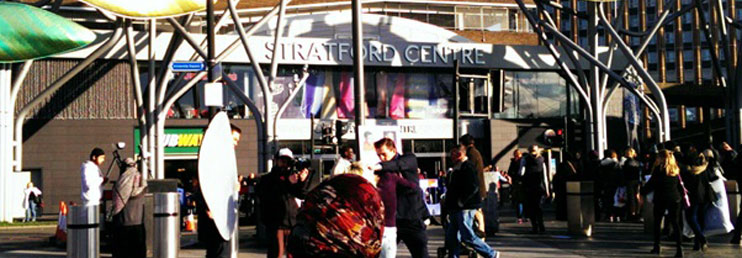
East London in Flux - Stratford CentreIn the four years of coming to Birkbeck for classes, I had never been back to Stratford, I only experienced it on screen. Despite my Olympic scepticism and opposition to the London games, I was hypocritically an avid viewer. Prompted and encouraged to put prejudice against the games aside I went along to East London in Flux on Saturday 16 November, an initiative of Birkbeck’s History of Art department along with Fundamental Architectural Inclusion, to bring interested individuals, mainly long term residents to get together and reflect on and interrogate further what the redevelopment and Olympic experience meant for Stratford, and East London more generally.

Birkbeck in the ‘community’

Bloomsbury can feel a little bit out of synch with the regular time and space of the city around it. Popping up from one of the surrounding underground stations and strolling into what feels very much like a university enclave, situated next to, but separate from the shopping, consumption and entertainment of Soho and the West End, and bounded to the North by a major thoroughfare and the terminal stations of North London, it does not seem the like site of community, or at least not much of a resident community.  This statement is far from being true, the institutional presence and the prestigious post code can sometimes mask what ‘community’ is here, but the construction of a new building and a tie up with UEL to give Birkbeck a greater presence in Stratford does make it seem like the university has now got a base that is in a real or ‘authentic’ community.

Perhaps that is a broad brush statement, a look and feel assessment of two different urban environments that some of my lecturers may frown upon, demand more clarity and perhaps a little evidence along the way, but I think we carry these impressions and ideas with us, they shape the way we think about and experience the city, and we may not ever really take the time to interrogate them. They are reinforced as shared and socially understood divisions of space. The name Bloomsbury carries a great deal of meaning, and for most, travels further, picking up yet more associations in space and time than somewhere like Stratford. Well that may have been true, until Stratford had to get ready to host the Olympics, becoming the home of spectacle, on display around the world.

Boots-on-the-ground-3Boots on the ground

The event itself, led by Leslie Topp from Birkbeck and Nick Edwards from Fundamental Architectural Inclusion, was lightly styled as a focus group, and marketing speech aside it genuinely felt like a way of using the bricks and mortar investment to reach out to a group of people who may not otherwise enter the university, and find out what sort of future events they would want to attend. Providing a forum to speak about and share experience, learn more about what is happening in/to the area, and gather information to construct an ongoing adult education programme.

The day was a positive break with regular classroom experience, but seemed to fit well with the Birkbeck model of adult education, in many ways it was opening up a new strand of dialogue for Fundamental Architectural Inclusion who had in the run up to the games mostly engaged young people from the area in discussion about the changes happening around them. Being able to get to grips with the issues on the ground, and listen to experiences both positive and negative from the people living in the area was a refreshing change to more orthodox learning, mediated by the printed word or screen images.

The second part of the day was a walking tour of Stratford led by Nick from Fundamental, setting out from University Square through the 1970s Stratford Centre into what could now be described as the old town centre, then looping back around, through residential development old and new, to Westfield and the gateway to the Olympic park. This provided another opportunity to share recollections of the building phase, the arrival of the games and of what was there before. Also to witness up close the dramatic changes in architecture, although noting along the way that high rise dwellings of a previous era, seemed oddly forgotten as the new developments seem to multiply.

Transit

Stratford is now an East London transport hub, apparently with up to 200 trains an hour on the various lines that run through it. Getting the transport right was a key concern in the run up to the games and obviously now facilitates access to the shopping destination that is Westfield. It is also sold as the engine to drive future developments and to make the area attractive to investment. In some way though the transport that has put Stratford firmly on the map for more and more Londoners, was also seen by a number of participants as the same force that could destabilise the local community. You may well ask what I, and indeed they, mean by the use of the term community, and it is fair to say that I don’t exactly know, hopefully future events will also lead to some fruitful discussion of that idea. But there was a repeated concern that a “transitory” population was not conducive to their perceived sense of community. The area will no doubt continue to change, I think for the worse, I am unable to celebrate a Westfield-led vision of community, but it does seem like there can and should be more dialogue on how a shop or office worker commuting into Stratford is not just seen a body in transit, they are also part of the human makeup of the area.

LegacyLegacy

I retain my scepticism of course, regeneration in London is only likely to benefit the majority of people accidentally if at all, and will mostly see profits for developers with little thought given to addressing income inequality. The Olympic park itself, clearly holds great potential for everyone in the area, although it currently seems largely unused. It has something of the character of a dreary suburban industrial estate but without the concomitant industry. Whatever vitality the empty Olympic venues possessed is dormant, and the main stadium is imprisoned behind a chain-link fence.

Having left our party in the shadow of the velodrome, that is sealed off to the young people on BMXs in the park, who were left to extract enjoyment and challenge from performing balancing tricks on the bicycle stands, I trudged back through what is still ostensibly an empty space. When the housing fills up and the planned office developments arrive it will morph into a new environment yet again, how that relates to what was there before, and what holds together the various communities of interest, both transitory and rooted in the area, seems bound to provide an ongoing appeal for future events in this timely series.

Kevin Mullen completed a Certificate of Higher Education in History of Art at Birkbeck and has subsequently moved on to the BA programme in the same department. He co-curates an informal screen studies group, The Screen Network, and is an editor with Minor Literature[s]. He tweets too frequently as @kevheadbone

Man Booker at Birkbeck 2013: Alan Hollinghurst

This post was contributed by Birkbeck alumnus Dr Ben Winyard.

On 27 November, in a wide-ranging, vibrant and thought-provoking exchange, novelist Alan Hollinghurst and Birkbeck’s professor of Creative Writing Russell Celyn Jones considered the crafting, reception and afterlives of Hollinghurst’s Booker Prize-winning novel, The Line of Beauty, alongside Hollinghurst’s biography, literary influences and writing practices. With many Birkbeck creative writing and English literature students in the audience, the conversation naturally turned to the craft and discipline of writing, the origins and development of plot, narrative and character, and the overlaps and dissonances between autobiography and fiction. As the purveyor of what the Guardian termed – in a tone falling short of complimentary – ‘high literary style and low-rent sex’, Hollinghurst was unruffled by searching queries about gay male life, sex between men, drugs, the AIDS crisis and Thatcherite politics.

The Line of Beauty opens in the summer of 1983. That summer, in which AIDS began to impact forcefully on British life, appears, in retrospect, a fulcrum on which subsequent gay history turned. Indeed the novel is ostensibly a historical one – albeit history within living memory for many – and it taps into a gay tradition of using history fictionally to frame and explore the sexual self. Hollinghurst spoke openly about the problem of AIDS for male gay writers; the author felt pressure throughout the early, frightening and politically-charged years of the pandemic to represent the suffering and loss of gay men, particularly in the face of official intransigence and popular homophobia. Hollinghurst himself lost friends to the disease, but it was only with The Line of Beauty that he felt finally able to satisfactorily represent the ‘queasy situation’ of AIDS impinging on new-found gay freedoms. AIDS is, like many communicable diseases, literary in its metaphoric permutations and its usefulness as an authorial tool for imposing moral meaning and order, but the roster of infected, dying and dead at the close of the novel suggests less a moral structure than the virus’s banal randomness.

The novel’s protagonist is Nick Guest, a gay Oxford graduate newly arrived in London, and events are mediated through him alone. Hollinghurst spoke of his wish to emulate Henry James in presenting experience with the intensity of one protagonist’s solitary viewpoint, and he sought to apply James’s fastidious powers of social analysis to the situations he was depicting, exposing a ‘seedy and corrupt world’. Hollinghurst confessed to taking a Jamesian delight in ruthlessly dissecting social intercourse, exposing what lies beneath social niceties – ‘all the things not said or that can’t be said’. For Hollinghurst, there were clear parallels between the callous dog-eat-dog culture of the 1980s and the fin de siècle era of the 1890s so adroitly analysed by James. Hollinghurst spoke amusingly of his concerted efforts to overcome his ‘terror’ of James’s notoriously dense novels, joining a reading group dedicated to just such a task. Celyn Jones observed the parallels between James’s and Hollinghurst’s precise use of ornate language that captures and holds a moment.

Applied to Nick, ‘hero’ is perhaps too grandiose a term for a character drawn with such studied ambivalence and so divisive in his reception by readers. Nick is, as his surname suggests, a visitor, lodging indefinitely and with little settled purpose in the home of Toby Fedden, his straight undergraduate friend. In the exquisitely appointed, aesthetically captivating environs of the Feddens’ Notting Hill mansion, Nick is beguiled by the wealth, manners and exalted social status of the family, becoming the de facto carer-companion of their psychologically troubled daughter, Catherine, while providing general support to Gerald Fedden, a boorish, newly elected Tory MP, and his captivating and refined society wife, Rachel.

Hollinghurst spoke at length about Nick’s uncertain status as both insider and outsider: he is highly educated (‘stuffed with knowledge’ in his creator’s words), self-confident and socially outgoing, eliciting trust from the highest ranking members of the ruling classes. Indeed, in one of the novel’s most brilliantly cheeky and admired vignettes, Nick, high on coke and just returned from a threesome, asks Margaret Thatcher to dance with him at the Feddens’ grimly self-aggrandising silver anniversary party. However, Nick is also secretly gay, sexually and socially inexperienced (initially), anxious about his background, and he exists in an ambivalent space between classes, lacking upper-class breeding and nous but possessing an education, aesthetic sense and sexual orientation that distinguish him from his tediously respectable bourgeois parents. Hollinghurst confessed that the amusing but painful scene in which Nick returns home and is embarrassed by, and condescending towards, his parents was ‘a rather personal experience’. Nick is though, Hollinghurst insisted, ‘a distinct fictional character’ and he expressed wonderment at the ‘fascinating, unknowable variables’ that arise when new readers ‘create [the novel] afresh’. One questioner asked if Hollinghurst imaginatively carried his protagonists with him; Hollinghurst confessed that he is usually ‘pleased to see the back of them’ – ‘I don’t terribly like [them]’.

Hollinghurst referred to Nick as ‘a political blank’ who allows his thirst for the aesthetic to mould his behaviour and shape his experience. Nick thus follows the line of beauty – the ogee – a double ‘s’ curve identified by William Hogarth as an underlying aesthetic principle in his derided 1753 Analysis of Beauty. Hogarth, rather like Nick – and perhaps a little like Hollinghurst – was the son of a middling family who used his artistic prowess to leverage his way into the upper echelons. For Hogarth, The Analysis of Beauty offered a means of bringing aesthetic knowledge and pleasure to ordinary people, while Hogarth’s art, rather like Hollinghurst’s, uses an outsider’s eye to dissect upper-class mores, foibles and hypocrisies. Hollinghurst considered how his focus on the upper-classes allowed him to tap into a rich literary heritage and admitted that upper-class ‘people are tremendously fun to write about because they’re rich enough to behave so badly’.

Like the ogee, Nick’s life follows two parallel but separate paths: one his ‘official’ life of wealth, comfort and politely received doctoral research into the novels of Henry James (a wry reference to Hollinghurst’s own Jamesian preoccupations); the other is his hidden life of initially tentative and then increasingly compulsive and brutish sex and drug-taking. Nick exhibits less desire for its own sake than a calculated Wildean eagerness to prioritise beauty and experience over morality; what Hollinghurst sought to explore through Nick is ‘the limitation of being led through life by your sense of beauty’.

The novel seethes with barely concealed secrets, as Nick first embarks upon a tentative, romantic affair with the closeted Leo and then a destructive, loveless affair with the cold, jaded and self-loathing Wani. Increasingly, Nick becomes enamoured with secrecy itself, revelling in his risky sauntering between the two worlds he keeps separate. Nick’s increasingly outré adventures are later served as a tabloid side-dish to Gerald’s adultery, eliciting his stinging eviction from the cosseted world of the Feddens. It is Catherine Fedden, with her manic depression (which her father maintains a wilful stupidity about), unsuitable lower-class boyfriends and visceral distaste for the smothering hypocrisy of her own class, who, Cassandra-like, speaks the truth of the outsider and brings down the artifice of her parents’ – and Nick’s – lives. The double helix of the ogee also suggested, to one questioner, a tension in the novel between the public and the private, between privacy and surveillance, which Hollinghurst admiringly admitted he hadn’t considered before.

In the decade in which Wham! famously encouraged ‘young guns’ to ‘go for it’, Nick’s descent into hard-heartedness and unthinking, repetitious excess suggests one destination for those following the line of beauty. From the range of reactions expressed by readers at the event – from sympathy, identification and admiration, to irritation, dislike and even hatred – it is clear that the mutable character of Nick continues to abundantly evoke the ‘fascinating, unknowable’ responses that Hollinghurst so enjoys.

The Shock of the Flash: Prof. Flint on the History of Documentary Flash Photography

This post was contributed by Oyedepo Olukotun, an MA History Of Art with Photography student in Birkbeck’s Department of History of Art.

“Flash photography startles (and) gives significance to that which might otherwise go completely unseen”, so began Prof. Kate Flint in her potted history of documentary flash photography.  Prof. Flint, Provost Professor of English and Art History at the University of Southern California, gave her talk, Intrusive Light: Flash Photography and Documentary work, at the Friday 15 November 2013 installment of the “Birkbeck forum for 19th-century studies and Birkbeck History and Theory of Photography Research Centre” series, chaired by Prof. Lynda Nead.

Riis versus Beals: The Man Ray and Lee Miller of Documentary Flash Photography?

To start our foray through history, Prof. Flint introduced us to the photographs of Jessie Tarbox Beals, a contemporary of Jacob Riis at the advent of the 20th century. In spite of being, what Prof. Flint describes as a “huge self-promoter” and “daredevil”, Beals is overshadowed by Riis in the history of photography, even though the two worked together as part of the “early American documentary movement”. We were told how Beals, a pioneering woman photographer, often had her work confused with Riis’s or even wrongly attributed to him.  The image that occurred to me while listening to Prof. Flint was a parallel between the story of Riis/Beals and Man Ray/Lee Miller.

Lange versus White: The Shock of the Flash

To draw parallels between the uses of flash and natural light, Prof. Flint presented a sympathetic and ethical Dorothea Lange, of 1930s Farm Security Administration fame, compared with an impetuous Margaret Bourke-White. Lange made a point of shooting her subjects outside so she did not have to use flash, not just for aesthetic reasons, but for ethical reasons also, as using flash to shoot indoors meant intruding on her subjects’ private spaces. In complete contrast to Lange, Bourke-White, further to using flash indiscriminately and without reverence, went on to mock her subjects in the captions she put on her photographs. The reaction to the use of flash by some of Bourke-White’s subjects, a band of Christian worshippers, was seen as akin to the shock of being visited by avenging angels!

Parks versus DeCarava: Black or light

As examples of African American documentary photographers, Prof. Flint contrasted the documentary flash photography of Gordon Parks with the anti-flash rhetoric of Roy DeCarava’s photographs. Juxtaposing Parks’ output with the profile of the short-lived 1930s “negro” news and picture magazine, Flash Prof. Flint showed us how flash photography played its part in the African American associated subject matters of being on the periphery, violent race relations and skin tone, or more appropriately, skin lightness.

Parks’ zeal for flash was contrasted, by Prof. Flint, with DeCarava’s “love” for natural light and its “near transcendental significance”. Claiming he “hates it (flash) with a passion”, DeCarava’s principle was to let black be black and dark be dark. On this expressive note Prof. Flint ended, appropriately concluding “the vocabulary of flash photography has been an emotionally loaded one throughout its history”.

The contents of Prof. Flint’s talk forms a part of her forthcoming book Flash! Photography, Writing, and Surprising Illumination.

The Weird: Fugitive Fictions/Hybrid Genres

This post was contributed by James Machin, a PhD candidate in Birkbeck’s Department of English and Humanities.

The 7 and 8 November saw a strange and unsettling confluence of scholars and enthusiasts of weird fiction in Bloomsbury. Is the weird a mode? A genre? Is it horror? Science fiction? The fantastic? The uncanny? A hybrid of all of these things? Everything was up for discussion. M. John Harrison — who has been described as ‘a writer of faultless fluency’ by Robert Macfarlane, ‘a Zen master of prose’ by Neil Gaiman, ‘a blazing original’ by Clive Barker, and, memorably, ‘an existential anarchist,’ by Michael Moorcock — headlined an exciting line up of contemporary writers reading their own work at the Horse Hospital on the Thursday evening. The night also saw the weird psychogeography of the local area ably investigated by Robert Kingham of minimumlabyrinth.org and a fascinating Q&A session expertly chaired by renowned genre critic John Clute, during which the weird was interrogated from the creative viewpoint.

After reconvening the next morning at Senate House, it was the turn of the scholars to continue the discussion of all things weird through the medium of three keynotes and twenty seven papers across nine panels. American editor and critic S. T. Joshi, who has perhaps forgotten more about H. P. Lovecraft than most of us will ever know, discussed the evolution of the weird tale through the work of Lovecraft and another ‘revolutionary’ of the form, Edgar Allan Poe. Mark Pilkington of Strange Attractor Press then led us into the rabbit hole of the imagination of fin-de-siècle weird artist Sydney Sime, giving every indication that Mark’s forthcoming book on Sime will be a fascinating read.

The first panels of the day saw discussions on weird occultations, genre weirding, and also the birth of a new literary adjective — ‘Harrisonian’ — which considering Harrison’s increasing reputation as the UK’s premier exponent of the form, we hope will stick. You heard it here first! After lunch, there were panels on the pre-modernist weird, weird landscapes and other weird media: topics included the monstrous and the human in William Hope Hodgson, the imaginative space provided by the Antarctic in weird fiction, and weird manifestations in online roleplaying games.

Dark-corridorBirkbeck’s own Professor Roger Luckhurst began his keynote by informing the audience that, in contrast to his wide-ranging presentation at last year’s China Miéville conference, his paper for the Weird Conference would explore a single aspect of the weird suggested to him by a close reading of Rudyard Kipling’s 1890 story ‘At the End of the Passage’. Thus, we were treated to a fascinating, haunting and unsettling disquisition on the place of the corridor in the cinema and literature of fear, which made debouching into the warren-like maze of Senate House for afternoon coffee a little disquieting. The final panels of the afternoon saw discussions of the weird crossover with musical subgenres in heavy metal culture, the posthuman weird, and also a bold and perhaps mischievous attempt to reposition Arthur Machen as a Modernist before Modernism. In the final keynote of the day, U.S. scholar and author Victoria Nelson shifted focus away from the Anglophone world to guide us through the weird Russia of Vladimir Sorokin’s Ice trilogy.

The task of unravelling (or indeed ravelling) the disparate and tangled weird threads of the day fell to the plenary panel of John Clute, S. T. Joshi, and Victorian Nelson, deftly and insightfully chaired by Guardian columnist, critic, and author Damien Walter. Although the numerous devils in the details were amiably disputed, a consensus seemed to be reached that the Weird represented something, and that that something was gathering speed and demanded ongoing interrogation.

Special thanks to: Jon Millington and the Institute of English Studies at Senate House, Roger Luckhurst, the Modern Humanities Research Association, Birkbeck School of Arts, and Birkbeck Centre for Contemporary Literature.

‘The conference has re-enthused my interest in academia and research.’ Dr Justin Woodman, Goldsmiths, University of London

‘One of the best readings I’ve ever attended, either as a performer or an audience member. Full of energy.’ M. John Harrison

‘A superb achievement! This was, hands down, the most riveting and intellectually exciting night of readings that I’ve had the pleasure to attend!’ Helen Marshall (British Fantasy Award winner 2013, ‘Best Newcomer’)